
RRBO vs Virgin Base Oil: Cost, Performance & Sustainability Compared
Introduction
Choosing the right base oil is no longer just a technical decision, it’s a cost, performance, and sustainability challenge. In today’s lubricant industry, the debate around RRBO vs Virgin Base Oil gaining momentum as companies look to reduce costs without compromising quality. Globally, base oil contributes to over 50% of a lubricant’s carbon footprint, making material choice critical for sustainability goals . At the same time, re-refining used oil can consume up to 66% less energy and reduce carbon emissions by 81% compared to conventional refining .
Yet, many businesses still struggle to decide: should they stick with traditional virgin oils or switch to re-refined alternatives? This guide breaks down RRBO vs Virgin Base Oil across cost, performance, and environmental impact helping you make a smarter, data-driven choice.
What is RRBO (Re-Refined Base Oil)?
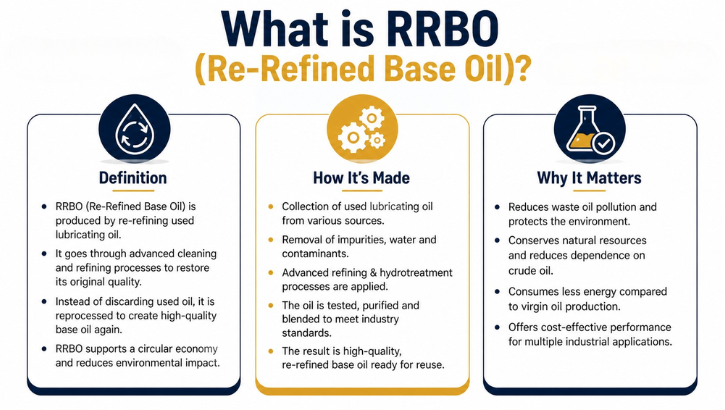
Re-refined base oil (RRBO) comes from used lubricating oils that go through advanced cleaning and refining processes to restore their original quality. Instead of discarding used oil, industries collect and process it to produce high-quality base oil again. This approach reduces waste and supports a circular economy.
In the RRBO vs Virgin Base Oil debate, RRBO stands out for its sustainability and cost-efficiency. Studies show that re-refining used oil saves up to 85% of the original oil resource and significantly cuts environmental impact. For example, a manufacturing plant can reuse RRBO in hydraulic systems instead of purchasing fresh oil, reducing both cost and carbon footprint.
Think of RRBO like recycling metal or plastic but with higher value recovery. Modern re-refining technologies remove impurities, heavy metals, and degraded additives, producing oil that often meets industry standards.
Definition & Process
RRBO refers to base oil produced by reprocessing used lubricating oil through advanced refining techniques. Instead of burning or dumping used oil, companies clean and convert it into reusable base oil.
How the Process Works
- Collection of used oil from vehicles and industries
- Removal of water and light fuels (dehydration)
- Vacuum distillation to separate oil fractions
- Hydrotreatment to remove sulfur, nitrogen, and contaminants
- Final polishing for clarity and stability
Example:
A transport company collects used engine oil from its fleet. A re-refining plant processes it and supplies fresh base oil back to lubricant manufacturers.
Key Process Stages
| Stage | Purpose | Outcome |
| Collection | Gather used oil | Raw material ready |
| Dehydration | Remove water & light fuels | Cleaner input oil |
| Distillation | Separate oil components | Base oil fractions |
| Hydrotreatment | Remove impurities & toxins | High-quality refined oil |
| Finishing | Improve color & stability | Market-ready RRBO |
Key Characteristics
RRBO offers several strong characteristics that make it competitive with virgin base oil. Modern refining technologies ensure consistent quality and performance.
Main Characteristics
- High Purity: Advanced hydrotreatment removes contaminants effectively
- Stable Viscosity: Maintains performance across temperature ranges
- Cost-Effective: Typically 20 – 40% cheaper than virgin base oil
- Eco-Friendly: Reduces waste oil pollution and carbon emissions
- Comparable Performance: Meets many API and industry standards
Example:
A lubricant manufacturer can blend RRBO with additives to produce engine oil that performs similarly to products made from virgin base oil.
Performance Insight
Modern RRBO can match Group II base oil quality in many applications. This makes it suitable for both automotive and industrial use.
Sustainability Edge
- Reduces landfill waste
- Conserves crude oil resources
- Supports circular economy practices
Simple analogy:
RRBO works like refurbished electronics tested, restored, and ready to perform again at a lower cost.
Because of these characteristics, RRBO continues to gain acceptance across industries that prioritize both performance and sustainability.
Common Applications
RRBO fits into a wide range of industrial and automotive applications. Companies choose it to reduce costs while maintaining performance standards.
1. Automotive Lubricants
RRBO is widely used in:
- Engine oils
- Gear oils
- Transmission fluids
Example:
Fleet operators use RRBO-based engine oil to cut maintenance costs without affecting engine life.
2. Industrial Machinery
Industries use RRBO in:
- Hydraulic systems
- Compressors
- Turbines
Example:
A factory running hydraulic presses can switch to RRBO-based oil and reduce operating expenses significantly.
3. Manufacturing Sector
RRBO supports:
- Metalworking fluids
- Process oils
- General lubrication
Example:
Steel plants use RRBO in rolling operations where large volumes of oil are required.
4. Marine & Heavy Equipment
- Marine engines
- Construction machinery
- Mining equipment
Example:
Construction companies use RRBO in excavators and loaders to lower fuel and maintenance costs.
What is Virgin Base Oil?
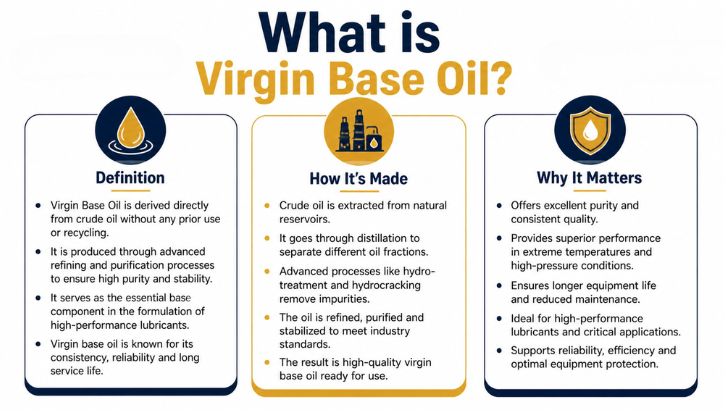
Virgin base oil comes directly from crude oil through refining processes, without any prior use or recycling. Refineries extract it from crude using distillation and advanced treatments to produce clean, stable base stocks for lubricants. In the RRBO vs Virgin Base Oil comparison, virgin oil represents the traditional choice known for consistency and purity.
Globally, virgin base oil accounts for the majority of lubricant production, with base oils forming nearly 70–90% of finished lubricants. Industries rely on it for predictable performance, especially in high-stress environments.
Definition & Production
Virgin base oil refers to lubricant base stock produced directly from crude oil through refining and chemical processing. Refineries design this process to remove unwanted components and enhance oil performance.
How Production Works
- Crude oil enters the refinery
- Atmospheric distillation separates lighter fuels
- Vacuum distillation isolates heavier base oil fractions
- Hydrotreatment removes sulfur, nitrogen, and impurities
- Optional hydrocracking improves quality further
| Stage | Purpose | Outcome |
| Distillation | Separate crude into fractions | Base oil feedstock |
| Vacuum Distillation | Isolate heavy oils | Lubricant-grade fractions |
| Hydrotreatment | Remove impurities | Cleaner, stable oil |
| Hydrocracking | Improve molecular structure | Higher-quality base oil |
| Finishing | Enhance color & stability | Market-ready virgin base oil |
Key Characteristics
Virgin base oil offers several defining characteristics that make it the preferred choice for high-performance applications.
Core Characteristics
- High Purity: Derived directly from crude, with controlled refining
- Consistent Quality: Uniform molecular structure ensures reliability
- Strong Oxidation Stability: Performs well under heat and pressure
- Wide Performance Range: Suitable for extreme conditions
- Long Shelf Life: Maintains properties over time
Performance Strength
Virgin base oil performs better in:
- Extreme temperatures
- High-load machinery
- Long drain intervals
Common Applications
Virgin base oil supports a wide range of industries that demand high reliability and performance.
1. Automotive Industry
Used in:
- Engine oils
- Transmission fluids
- Gear oils
Example:
Car manufacturers recommend virgin base oil-based lubricants for new engines to ensure durability and warranty compliance.
2. Industrial Machinery
Used in:
- Turbines
- Compressors
- Hydraulic systems
Example:
Power plants rely on virgin base oil in turbines to maintain efficiency and reduce breakdown risks.
3. High-Performance Lubricants
Used in:
- Synthetic and semi-synthetic oils
- Aviation lubricants
- Racing engines
Example:
Aircraft engines use high-grade base oils to handle extreme pressure and temperature variations.
4. Marine & Heavy Equipment
Used in:
- Ship engines
- Mining equipment
- Construction machinery
Example:
Marine engines use virgin base oil to ensure long operating cycles in harsh environments.
RRBO vs Virgin Base Oil – Key Differences
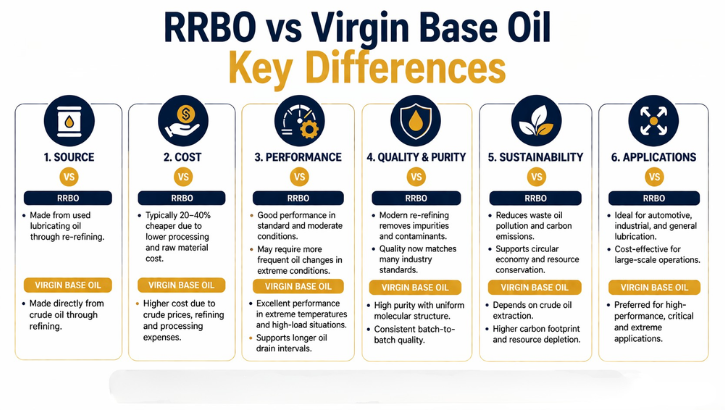
When you compare RRBO vs Virgin Base Oil, three factors drive most decisions: cost, performance, and environmental impact. RRBO focuses on sustainability and savings, while virgin base oil delivers consistent, high-end performance.
Here’s a quick breakdown:
- Source: RRBO comes from recycled used oil; virgin base oil comes from crude oil
- Cost: RRBO usually costs 20–40% less
- Performance: Both perform well, but virgin oil leads in extreme conditions
- Sustainability: RRBO reduces waste and emissions significantly
- Consistency: Virgin oil offers more uniform quality
Cost Comparison
Cost plays a major role in the RRBO vs Virgin Base Oil decision. RRBO offers clear savings because it reuses existing resources instead of relying on crude oil extraction.
Why RRBO Costs Less
- Re-refining uses less energy than crude oil processing
- Raw material (used oil) costs less than crude oil
- Lower dependency on global oil price fluctuations
Virgin Base Oil Cost Factors
- Crude oil price volatility
- High refining and processing costs
- Transportation and global supply chain impact
Real-World Example
A logistics company operating 200 trucks switched to RRBO-based engine oil:
- Reduced lubricant costs by nearly 25% annually
- Maintained acceptable engine performance
Performance Comparison
Performance remains a key concern in the RRBO vs Virgin Base Oil debate. Many people assume RRBO performs poorly, but modern refining technology has changed that perception.
RRBO Performance
- Matches industry standards in many applications
- Offers stable viscosity and lubrication
- Works well in standard operating conditions
Virgin Base Oil Performance
- Handles extreme temperatures and pressure better
- Delivers consistent molecular structure
- Supports longer oil drain intervals
Key Differences
- RRBO performs well in normal to moderate conditions
- Virgin oil excels in extreme and high-load environments
Quality & Purity
Quality and purity directly impact oil performance and equipment life. In the RRBO vs Virgin Base Oil comparison, both options offer strong quality but through different approaches.
RRBO Quality
Modern re-refining removes:
- Heavy metals
- Carbon residues
- Degraded additives
This process produces clean base oil that often matches Group II standards.
Example:
A lubricant manufacturer uses RRBO to produce industrial oil that meets performance specifications without quality compromise.
Virgin Base Oil Quality
- Starts from crude oil with controlled refining
- Offers uniform molecular structure
- Ensures consistent batch-to-batch quality
Example:
OEM-approved engine oils often use virgin base oil for guaranteed consistency.
Sustainability Comparison
Sustainability now drives major decisions in the RRBO vs Virgin Base Oil debate. Companies don’t just look at performance they also measure environmental impact, waste reduction, and long-term resource use. RRBO clearly leads in this area because it reuses existing oil instead of extracting new crude.
Quick Comparison
- RRBO: Recycles used oil, reduces waste, lowers emissions
- Virgin Base Oil: Requires crude extraction, energy-intensive refining
Example:
A manufacturing plant that switches to RRBO for hydraulic systems can significantly cut its carbon footprint while maintaining operational efficiency.
Why It Matter
- Governments push for greener industrial practices
- Companies aim to meet ESG (Environmental, Social, Governance) goals
- Customers prefer sustainable brands
Simple takeaway:
RRBO supports sustainability goals directly, while virgin base oil increases environmental pressure due to resource extraction and emissions.
Environmental Impact
Environmental impact forms the biggest difference in the RRBO vs Virgin Base Oil comparison. RRBO reduces pollution, while virgin base oil production adds to environmental stress.
RRBO Environmental Benefits
Prevents improper disposal of used oil
Reduces soil and water contamination
Lowers greenhouse gas emissions
Example:
When automotive workshops send used oil for re-refining instead of dumping it, they prevent large-scale environmental damage.
Virgin Base Oil Impact
- Requires crude oil extraction (drilling, transportation)
- Produces higher carbon emissions during refining
- Contributes to resource depletion
Example:
Oil refineries consume large amounts of energy and release emissions during crude processing, increasing environmental impact.
Real-World Scenario
A fleet management company shifted 50% of its lubricant usage to RRBO:
- Reduced waste oil disposal issues
- Lowered environmental compliance risks
Simple takeaway:
RRBO actively reduces environmental damage, while virgin base oil increases ecological burden.
Resource Conservation
Resource conservation plays a crucial role in sustainable industrial practices. In the RRBO vs Virgin Base Oil comparison, RRBO offers a clear advantage by reusing existing materials.
How RRBO Conserves Resources
- Reuses used lubricating oil
- Reduces dependence on crude oil
- Supports circular economy
Virgin Base Oil Resource Use
- Depends entirely on non-renewable crude oil
- Consumes more energy during production
- Depletes natural reserves over time
Circular Economy Advantage
RRBO keeps materials in use for longer:
- Less waste generation
- Lower raw material demand
- Improved sustainability metrics
Regulatory & Compliance Trends
Regulations increasingly influence the shift in the RRBO vs Virgin Base Oil market. Governments and environmental bodies encourage sustainable practices, pushing industries toward re-refined oils.
Growing Regulatory Pressure
- Stricter waste oil disposal laws
- Emission reduction targets
- Sustainability reporting requirements
Example:
Industries must follow proper waste oil disposal regulations or face penalties. RRBO provides a compliant solution.
- Incentives for recycling and re-refining
- Policies promoting circular economy
- Government-backed sustainability initiatives
Support for RRBO
Example:
Some countries offer tax benefits or subsidies to companies using recycled oil products.
Compliance Benefits of RRBO
- Easier environmental compliance
- Reduced legal risks
- Improved ESG reporting
Virgin Base Oil Challenges
- Higher carbon footprint scrutiny
- Increasing environmental regulations
- Pressure to reduce reliance on fossil fuels
Industry Trend
More companies now include sustainability metrics in procurement decisions, favoring RRBO over traditional options.
Example:
A large manufacturing firm switched to RRBO to meet its annual sustainability targets and reduce compliance costs.
Conclusion
The choice between RRBO vs Virgin Base Oil ultimately comes down to priorities cost, performance, and sustainability. RRBO offers a clear advantage in reducing expenses, minimizing environmental impact, and supporting circular economy goals. At the same time, virgin base oil continues to deliver unmatched consistency and reliability in high-performance and extreme operating conditions.
For many businesses, the smartest approach isn’t choosing one over the other it’s using both strategically. Apply RRBO where cost efficiency and sustainability matter most, and rely on virgin base oil for critical, high-stress applications. This balanced strategy helps you optimize performance without overspending or compromising environmental responsibility.
As industries move toward greener and more efficient operations, RRBO is no longer just an alternative it’s becoming a necessity.
FAQs
1. What is the main difference between RRBO vs Virgin Base Oil?
RRBO comes from recycled used oil that undergoes re-refining, while virgin base oil is produced directly from crude oil. RRBO focuses on sustainability and cost savings, whereas virgin oil offers consistent performance.
2. Is RRBO as good as virgin base oil?
Modern RRBO can match the quality of Group I and Group II base oils in many applications. However, virgin base oil performs better in extreme conditions like high temperature and pressure.
3. Why is RRBO cheaper than virgin base oil?
RRBO costs less because it uses recycled oil and requires less energy compared to crude oil refining. This reduces production and raw material costs.
4. Is RRBO safe for engines and machinery?
Yes, high-quality RRBO that meets industry standards is safe for engines and industrial equipment. Proper refining ensures removal of contaminants.
5. Which is more eco-friendly: RRBO or virgin base oil?
RRBO is more eco-friendly because it reduces waste, lowers carbon emissions, and supports recycling, while virgin base oil depends on crude oil extraction.
6. Can RRBO be used in high-performance engines?
RRBO works well in standard and moderate conditions. For high-performance or extreme applications, virgin base oil is usually preferred.
7. What industries commonly use RRBO?
RRBO is widely used in automotive lubricants, industrial machinery, manufacturing processes, and heavy equipment operations.
8. Does RRBO meet industry standards?
Yes, advanced re-refining processes allow RRBO to meet API and other industry standards, making it suitable for many applications.
9. How does RRBO support sustainability goals?
RRBO reduces oil waste, conserves natural resources, and lowers emissions, helping companies meet ESG and environmental compliance targets.
10. Should businesses switch completely to RRBO?
Not always. Many businesses use a hybrid approach RRBO for cost-effective applications and virgin base oil for critical, high-performance needs.