
Furnace Oil (FO) vs Diesel Oil (LDO) vs Base Oil (RRBO) vs Used Oil Collection: Complete Industrial Guide
Introduction
Selecting the right industrial fuel or oil management solution can significantly impact operating costs, equipment performance, and environmental compliance. Industries often compare Furnace Oil (FO), Light Diesel Oil (LDO), Re-Refined Base Oil (RRBO), and Used Oil Collection programs to identify the most efficient and cost-effective option for their operations. The decision goes beyond fuel prices alone. Factors such as calorific value, combustion efficiency, maintenance requirements, emissions, storage conditions, and equipment compatibility directly influence long-term operational success. At the same time, growing environmental concerns are pushing industries toward more sustainable fuel and recycling practices. Global energy-related CO₂ emissions reached a record 37.4 billion tonnes in 2023, highlighting the increasing importance of efficient fuel selection and responsible oil management.
Understanding Industrial Fuels and Oil Management
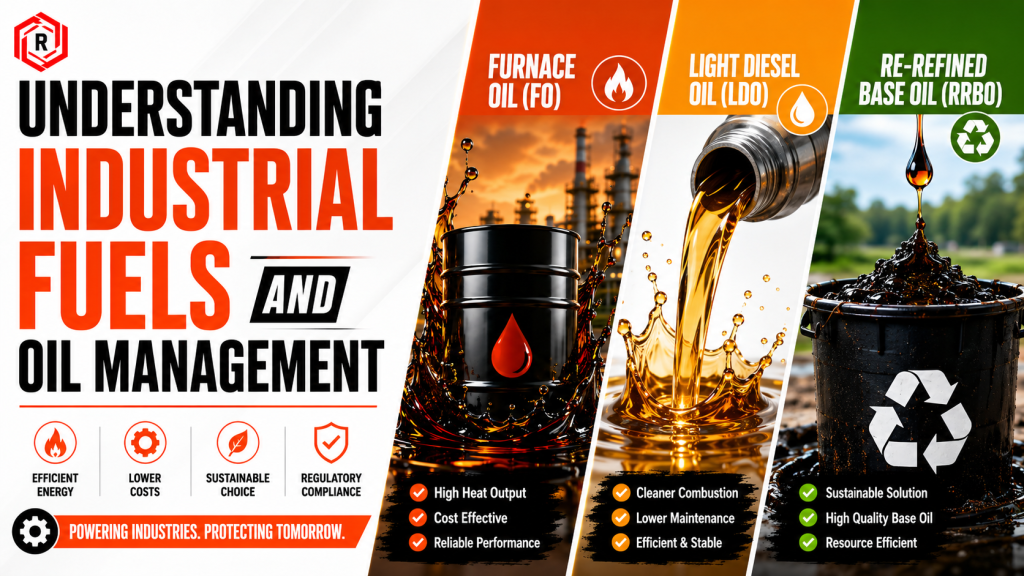
Industrial fuels and oil management play a critical role in maintaining efficient, cost-effective, and environmentally responsible operations. Manufacturing plants, power generation facilities, textile mills, chemical industries, and engineering companies rely on different fuels and lubricants to run equipment, generate heat, and support production processes.
Key factors that influence fuel selection include:
- Fuel efficiency and calorific value
- Equipment compatibility and burner performance
- Fuel procurement and maintenance costs
- Emission levels and regulatory compliance
For example, a textile factory may choose Furnace Oil for high-temperature heating applications, while a pharmaceutical manufacturer may prefer LDO because it burns cleaner and requires less maintenance. Similarly, lubricant manufacturers often use RRBO as a sustainable alternative to virgin base oil.
What Is Furnace Oil (FO)?
Furnace Oil (FO) is a heavy industrial fuel derived from the residual fractions of crude oil refining. Industries primarily use it in boilers, furnaces, thermic fluid heaters, and other high-temperature heating systems where large amounts of thermal energy are required.
Common industrial applications include:
- Textile processing units
- Chemical manufacturing plants
- Cement industries
- Paper and pulp mills
Key characteristics of Furnace Oil:
- High calorific value for strong heat generation
- Relatively low fuel cost compared to diesel-based fuels
- Higher viscosity requiring preheating before combustion
Advantages of Furnace Oil:
- Reduces fuel expenses for high-volume users
- Provides consistent thermal energy
- Supports continuous industrial operations
What Is Light Diesel Oil (LDO)?
Light Diesel Oil (LDO) is a medium-viscosity petroleum fuel designed for industrial heating and combustion applications. It offers cleaner combustion than heavier fuels such as Furnace Oil, making it a popular choice for industries that prioritize operational efficiency and lower maintenance requirements.
| Property | Light Diesel Oil (LDO) |
| Fuel Type | Distillate petroleum fuel |
| Calorific Value | Approximately 10,200–10,800 kcal/kg |
| Viscosity | Low to medium |
| Combustion Quality | Clean and efficient |
| Preheating Requirement | Usually not required |
| Maintenance Requirement | Lower than Furnace Oil |
Benefits of Using LDO:
- Provides stable and efficient combustion
- Reduces carbon deposits in burners
- Minimizes maintenance downtime
- Requires simpler fuel handling systems
Limitations Industries Should Consider:
- Costs more than Furnace Oil in most markets
- Fuel price fluctuations can increase operating expenses
- May become less economical for large-scale heating applications
For example, pharmaceutical manufacturers often use LDO because cleaner combustion helps maintain product quality and reduces contamination risks within production environments.
What Is Re-Refined Base Oil (RRBO)?
Re-Refined Base Oil (RRBO) is a high-quality lubricant base stock produced by processing and purifying used lubricating oils. Advanced re-refining technologies remove contaminants, oxidation products, water, metals, and degraded additives, allowing the oil to regain properties similar to virgin base oil.
The RRBO manufacturing process typically includes:
- Collection of used lubricating oil
- Dehydration and contaminant removal
- Vacuum distillation
- Hydro-treatment or advanced refining
Unlike virgin base oil, which comes directly from crude oil refining, RRBO originates from recovered used oil. This process conserves natural resources while reducing dependence on crude oil extraction.
Common industrial applications include:
- Automotive lubricants
- Industrial lubricants
- Hydraulic oils
- Gear oils
For example, lubricant manufacturers can use RRBO to produce engine oils and industrial lubricants while maintaining performance standards and reducing environmental impact. As industries increasingly focus on sustainability and resource efficiency, RRBO continues to gain importance as an environmentally responsible alternative to conventional base oils.
Key Properties Comparison of FO, LDO, RRBO, and Used Oil
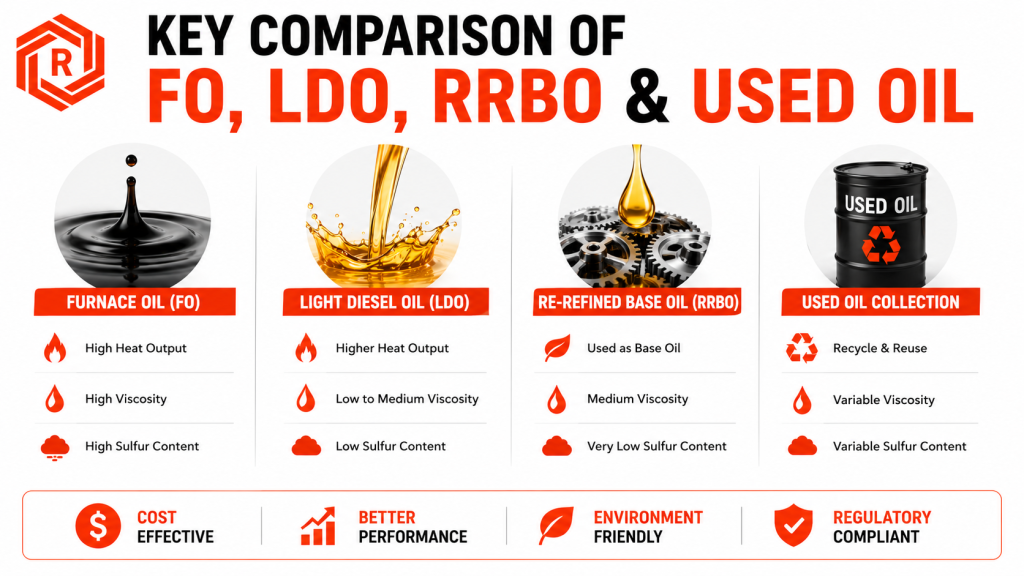
Understanding the key properties of Furnace Oil (FO), Light Diesel Oil (LDO), Re-Refined Base Oil (RRBO), and Used Oil helps industries make informed decisions about fuel selection, equipment performance, operating costs, and environmental compliance.
When comparing these options, industries typically evaluate:
- Calorific value and heat output
- Viscosity and flow behavior
- Sulfur content and emissions
- Storage and handling requirements
- Equipment compatibility
For example, a textile plant may prioritize Furnace Oil because of its lower fuel cost and high heat output. In contrast, a pharmaceutical manufacturer may prefer LDO for its cleaner combustion and lower maintenance requirements. Lubricant manufacturers often select RRBO because it reduces raw material costs while supporting sustainability goals.
Calorific Value Comparison
Calorific value measures the amount of heat energy a fuel produces during combustion. Industries use this property to evaluate fuel efficiency because higher heat output often translates into lower fuel consumption and better thermal performance.
Approximate calorific values of common industrial oils include:
- Light Diesel Oil (LDO): 10,200-10,800 kcal/kg
- Furnace Oil (FO): 10,000-10,500 kcal/kg
- Used Oil (depending on quality): 9,000-10,500 kcal/kg
- RRBO: Primarily designed as a lubricant base stock rather than a fuel
Higher calorific values help industries generate more heat from the same quantity of fuel. This advantage becomes especially important in energy-intensive sectors such as textiles, chemicals, cement manufacturing, and food processing.
Impact on industrial energy generation:
- Higher heat output improves boiler efficiency.
- Lower fuel consumption reduces operating costs.
- Consistent combustion improves production reliability.
- Better thermal performance supports continuous operations.
For example, a chemical manufacturing plant operating 24 hours a day may consume several tons of fuel daily. Even a small improvement in calorific value can produce substantial annual fuel savings.
Fuel efficiency considerations:
- Combustion efficiency matters as much as calorific value.
- Poor burner settings can waste energy despite high fuel quality.
- Fuel viscosity and sulfur content also influence overall performance.
- Regular maintenance helps maximize energy conversion efficiency.
Industries should evaluate calorific value alongside combustion quality, maintenance costs, and environmental impact rather than relying solely on heat output figures.
Viscosity and Flow Characteristics
Viscosity describes a fuel’s resistance to flow. It directly affects fuel handling, pumping efficiency, storage requirements, atomization quality, and combustion performance. Industries must carefully consider viscosity when selecting fuels for boilers, furnaces, and heating systems.
Different industrial oils exhibit different flow characteristics:
| Oil Type | Relative Viscosity | Flow Characteristics | Preheating Requirement |
| Furnace Oil (FO) | High | Thick and heavy | Usually required |
| Light Diesel Oil (LDO) | Low to Medium | Flows easily | Generally not required |
| RRBO | Medium | Depends on refining grade | Application-specific |
| Used Oil | Variable | Inconsistent flow behavior | Often required |
Fuel handling requirements:
- High-viscosity fuels require stronger pumping systems.
- Low-viscosity fuels move easily through pipelines.
- Proper filtration prevents clogging and equipment damage.
Pumping and storage considerations:
- Furnace Oil often requires heated storage tanks.
- LDO remains pumpable under normal operating conditions.
- Used Oil may contain contaminants that affect flow performance.
- RRBO generally offers stable handling characteristics after proper refining.
Sulfur Content and Emissions
Sulfur content plays a major role in determining the environmental impact of industrial fuels. During combustion, sulfur converts into sulfur dioxide (SO₂) and other pollutants that contribute to acid rain, poor air quality, equipment corrosion, and regulatory compliance challenges.
Environmental impact comparison:
- Furnace Oil can generate higher SO₂ emissions.
- LDO typically produces cleaner exhaust gases.
- RRBO reduces the demand for crude oil extraction through recycling.
- Proper Used Oil collection prevents soil and water contamination.
Air pollution concerns include:
- Sulfur dioxide emissions
- Particulate matter formation
- Increased carbon deposits
- Reduced air quality around industrial facilities
For example, a food processing plant operating in an environmentally regulated zone may choose LDO instead of Furnace Oil to reduce sulfur emissions and simplify compliance with local air-quality standards.
Furnace Oil (FO): Advantages and Challenges
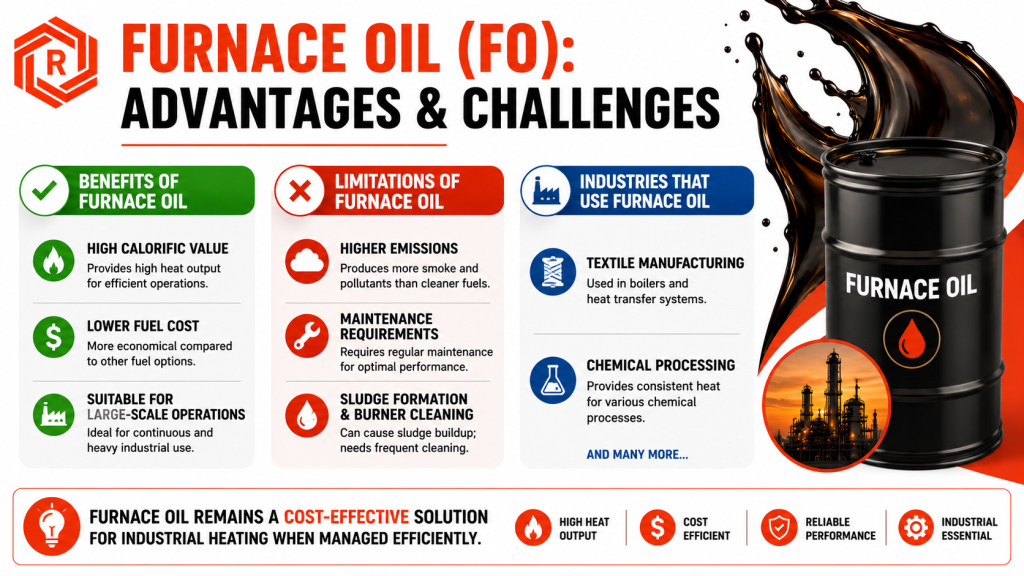
Furnace Oil (FO) remains one of the most widely used industrial fuels because it delivers high heat output at a relatively low cost. Industries that require continuous heating often choose Furnace Oil to reduce fuel expenses and maintain production efficiency.
Key advantages include:
- High heat generation capacity
- Lower cost compared to diesel-based fuels
- Reliable performance for large-scale operations
- Easy availability in industrial markets
However, Furnace Oil also presents several challenges:
- Higher sulfur emissions than cleaner fuels
- Regular burner and boiler maintenance requirements
- Preheating needs due to high viscosity
- Sludge and carbon deposit formation
Benefits of Furnace Oil for Industrial Heating
Furnace Oil offers several advantages for industries that require large volumes of thermal energy. Its combination of high calorific value and lower procurement cost makes it a preferred fuel for many manufacturing operations.
Key benefits of Furnace Oil include:
- High calorific value for efficient heat generation
- Lower fuel costs compared to Light Diesel Oil (LDO)
- Suitable for continuous industrial operations
- Widely available across industrial markets
Industries that consume large fuel volumes often achieve significant cost savings by switching from diesel-based fuels to Furnace Oil. Even small reductions in fuel costs can generate substantial annual savings for facilities operating around the clock.
For example:
- Textile dyeing units use Furnace Oil for steam generation.
- Chemical plants depend on it for process heating.
- Paper mills utilize it for drying and manufacturing operations.
Because Furnace Oil delivers reliable thermal energy at a competitive price, it remains an economical solution for industries focused on maximizing production efficiency while controlling operating expenses.
Limitations of Furnace Oil
Despite its cost advantages, Furnace Oil presents several operational and environmental challenges that industries must manage carefully. Its heavier composition can affect combustion efficiency, maintenance schedules, and regulatory compliance.
The most common limitations include:
| Challenge | Impact on Operations |
| Higher Sulfur Content | Increased SO₂ emissions and environmental concerns |
| High Viscosity | Requires fuel preheating before combustion |
| Sludge Formation | Can clog pipelines and fuel systems |
| Carbon Deposits | Reduces burner efficiency over time |
| Frequent Maintenance | Increases operational downtime and servicing costs |
Higher sulfur levels often result in greater emissions compared to cleaner fuels such as LDO. Industries operating in environmentally regulated zones may need additional emission-control equipment to meet compliance requirements.
Maintenance also becomes an important consideration. Poor combustion can create:
- Carbon deposits on burner nozzles
- Sludge accumulation in storage tanks
- Blocked fuel filters and pipelines
- Reduced heat transfer efficiency
Industries That Commonly Use Furnace Oil
Many energy-intensive industries rely on Furnace Oil because it provides high thermal output at a relatively low operating cost. Its ability to support continuous heating applications makes it especially valuable in large-scale manufacturing environments.
Industries that commonly use Furnace Oil include:
- Textile Manufacturing: Used for steam generation, dyeing, drying, and fabric processing.
- Chemical Processing: Supports reactors, boilers, and process-heating systems that operate continuously.
- Cement Plants: Provides thermal energy for kilns and material processing operations.
For example, a textile mill may operate multiple boilers throughout the day to produce steam for dyeing and finishing processes. Using Furnace Oil helps reduce fuel expenses compared to diesel-based alternatives. Similarly, chemical manufacturing facilities often choose Furnace Oil because it delivers the large amounts of heat required for production while keeping energy costs under control.
Light Diesel Oil (LDO): Advantages and Challenges
Light Diesel Oil (LDO) serves as a popular industrial fuel for businesses that prioritize cleaner combustion, operational reliability, and easier fuel handling. Compared to heavier fuels such as Furnace Oil, LDO flows more easily and burns more efficiently, making it suitable for a wide range of industrial heating applications.
Many industries choose LDO because it offers:
- Cleaner combustion with fewer carbon deposits
- Lower maintenance requirements
- Easy storage and handling
- Consistent burner performance
However, LDO also presents certain challenges:
- Higher fuel costs than Furnace Oil
- Exposure to market-driven price fluctuations
- Reduced cost-efficiency in large-scale heating operations
As a result, industries must balance fuel quality, operational requirements, and long-term costs when deciding whether LDO is the most suitable fuel for their facilities.
Benefits of LDO in Industrial Operations
Light Diesel Oil (LDO) offers several operational advantages that make it a preferred fuel for industries requiring reliable and efficient heating systems. Its cleaner-burning characteristics help improve equipment performance while reducing maintenance requirements.
Major benefits of LDO include:
- Cleaner combustion with reduced smoke and soot formation
- Lower carbon buildup inside boilers and burners
- Easy pumping, storage, and handling
- No significant preheating requirements
LDO also provides operational flexibility. Industries can store and transport it more easily because of its lower viscosity. This characteristic simplifies fuel management and improves system reliability.
For example:
- Food processing plants use LDO to maintain clean heating systems.
- Pharmaceutical manufacturers rely on it for controlled production environments.
- Small industrial units benefit from its low maintenance requirements.
Reliable burner performance further enhances fuel efficiency. Better atomization allows more complete combustion, which helps industries maximize energy output while minimizing fuel waste. These advantages make LDO a practical solution for facilities seeking cleaner operations and dependable heating performance.
Limitations of LDO
Although Light Diesel Oil offers cleaner combustion and operational convenience, it also presents several economic challenges that industries should evaluate before selecting it as their primary fuel source.
| Limitation | Impact on Industrial Operations |
| Higher Fuel Cost | Increases overall energy expenses |
| Price Volatility | Creates budgeting uncertainty |
| Lower Cost-Efficiency for Bulk Heating | Raises operating costs in large facilities |
| Market Dependency | Exposes industries to global fuel price changes |
| Long-Term Operating Expense | Can exceed alternative fuel options |
For example, a large textile mill operating multiple boilers around the clock may find Furnace Oil more economical because its lower cost offsets the additional maintenance requirements.
Industries That Prefer LDO
Several industries prefer Light Diesel Oil because it combines cleaner combustion, reliable performance, and easier fuel handling. Organizations that operate in regulated environments or require consistent production quality often choose LDO over heavier fuels.
Industries that commonly use LDO include:
- Food Processing: Supports clean steam generation and heating applications while minimizing contamination risks.
- Pharmaceutical Manufacturing: Helps maintain hygienic production environments and consistent process control.
- Small and Medium-Scale Industries: Offers simple storage, handling, and burner operation without extensive fuel-heating systems.
For example, a pharmaceutical company may use LDO in boilers because cleaner combustion reduces soot formation and helps maintain strict quality standards. Similarly, food processing plants often rely on LDO to generate steam used in cooking, sterilization, and packaging operations.
Conclusion
Choosing between Furnace Oil (FO), Light Diesel Oil (LDO), Re-Refined Base Oil (RRBO), and Used Oil Collection solutions requires a careful evaluation of cost, efficiency, environmental impact, and operational requirements. Each option serves a different purpose, and the best choice depends on your industry’s fuel consumption patterns, equipment specifications, compliance obligations, and sustainability goals. Furnace Oil remains a cost-effective solution for high-volume industrial heating, while LDO offers cleaner combustion and easier maintenance. RRBO provides a sustainable alternative for lubricant manufacturing and industrial applications, helping businesses reduce dependence on virgin petroleum products. At the same time, effective Used Oil Collection and recycling programs support resource recovery, minimize environmental risks, and contribute to circular economy initiatives.
Frequently Asked Questions (FAQs)
1.What is the main difference between Furnace Oil, LDO, RRBO, and Used Oil Collection?
FO and LDO are industrial fuels, RRBO is a re-refined lubricant base oil, and Used Oil Collection focuses on recovering and recycling waste oil.
2.Which fuel offers the highest calorific value for industrial heating?
LDO generally offers a slightly higher calorific value than Furnace Oil, providing efficient heat generation.
3.Is Furnace Oil cheaper than LDO for industrial operations?
Yes, Furnace Oil is typically more cost-effective than LDO for large-scale industrial heating applications.
4.Why do industries use RRBO instead of virgin base oil?
Industries use RRBO because it reduces costs, conserves resources, and supports sustainability initiatives.
5.Can RRBO be used as an industrial fuel?
RRBO primarily serves as a lubricant base stock, although some industries may use certain grades in specialized applications.
6.What industries commonly use Furnace Oil?
Textile mills, chemical plants, cement factories, and paper mills commonly use Furnace Oil for process heating.
7.Which fuel produces fewer emissions, FO or LDO?
LDO generally produces fewer sulfur emissions and cleaner combustion than Furnace Oil.
8.What are the environmental benefits of used oil collection?
Used oil collection prevents pollution, supports recycling, and reduces waste disposal risks.
9.How does used oil recycling support sustainability goals?
Used oil recycling conserves natural resources and promotes a circular economy by recovering valuable oil products.
10.Is used oil considered hazardous waste?
Yes, used oil can become hazardous if it contains contaminants or is improperly handled and disposed of.