

Diesel Oil (LDO) vs Base Oil (RRBO): Which Oil Is Better for Industrial Needs?
Introduction
Industrial operations depend heavily on choosing the right oil for fuel efficiency, equipment reliability, and long-term cost control. A poor oil selection can increase fuel consumption, cause unplanned downtime, and shorten machinery lifespan. According to the International Energy Agency (IEA), industrial energy consumption and related emissions continue to rise globally, making fuel efficiency and sustainable oil usage a major priority for manufacturers.
This is why industries frequently compare Light Diesel Oil (LDO) and Re-Refined Base Oil (RRBO). While LDO is widely used as an industrial fuel for boilers, furnaces, and generators, RRBO is primarily used in lubricant manufacturing and machinery lubrication applications. Understanding the difference between these oils is critical because the right choice directly affects operational productivity, maintenance costs, equipment protection, and environmental compliance. Selecting the appropriate industrial oil helps businesses improve efficiency while reducing emissions and overall operating expenses.
What Is Diesel Oil (LDO)?
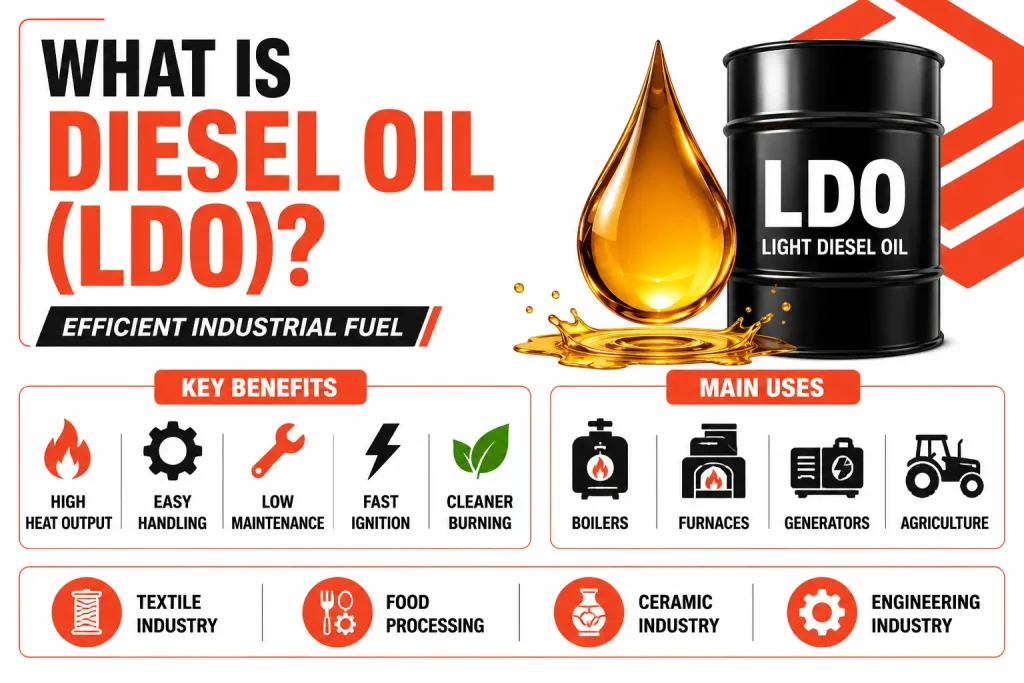
Light Diesel Oil (LDO) is a low-viscosity industrial fuel widely used in medium-scale heating and power generation applications. Industries prefer LDO because it delivers stable combustion, cleaner burning performance, and better operational efficiency than heavier furnace oils. Refineries produce LDO during the fractional distillation of crude oil, placing it between kerosene and heavy diesel fractions in terms of density and composition.
Many industries rely on LDO to run essential equipment such as boilers, furnaces, generators, and heating systems. Its smooth ignition and lower sulfur content help reduce carbon deposits and maintenance frequency. According to industrial fuel studies, cleaner-burning fuels can improve combustion efficiency and lower equipment wear over time.
Key reasons industries use LDO include:
- High heat generation capability
- Easy fuel handling and storage
- Lower maintenance requirements
- Faster burner ignition
For example, textile factories often use LDO in boilers to maintain consistent steam production, while small manufacturing units depend on LDO-powered generators during power outages. Because of its balance between performance and operational cost, LDO remains one of the most commonly used industrial fuels across multiple sectors.
Definition of Light Diesel Oil
Light Diesel Oil (LDO) is a low-viscosity liquid fuel designed mainly for industrial heating and power applications. Petroleum refineries produce LDO during the crude oil refining process through fractional distillation. This process separates crude oil into different fuel grades based on boiling points and density levels.
LDO contains a blend of hydrocarbons with moderate volatility and controlled sulfur levels. Its lighter composition allows smoother fuel flow, better atomization, and cleaner combustion than heavier industrial fuels like furnace oil. Industries often choose LDO because it burns efficiently without creating excessive sludge or carbon buildup.
Key characteristics of LDO include:
- Low to medium viscosity for easy pumping
- High calorific value for strong heat output
- Controlled sulfur content for cleaner combustion
- Stable ignition properties
Industries commonly use LDO in:
- Steam boilers
- Industrial furnaces
- Diesel generators
- Agricultural pumps
For example, food processing plants use LDO-fired boilers to generate steam for cooking and sterilization processes. Similarly, ceramic industries use LDO in heating chambers where consistent temperature control plays a critical role.
Key Properties of LDO
The performance of Light Diesel Oil depends heavily on its physical and chemical properties. These characteristics directly affect combustion quality, fuel efficiency, maintenance frequency, and equipment lifespan. Industries prefer LDO because it provides reliable heating performance while maintaining smoother burner operation.
| Property | Typical Range | Industrial Importance |
| Calorific Value | 10,200 -10,800 kcal/kg | Generates high heat energy |
| Sulfur Content | Low to moderate | Reduces smoke and emissions |
| Viscosity | Low to medium | Improves fuel flow and atomization |
| Combustion Efficiency | High | Supports cleaner and stable burning |
| Flash Point | Around 66°C or higher | Enhances storage and handling safety |
Calorific Value
LDO offers a high calorific value, usually between 10,200 and 10,800 kcal/kg. This strong energy output helps industries generate consistent heat for boilers, furnaces, and thermal systems.
Low Sulfur Content
Compared to heavier industrial oils, LDO contains lower sulfur levels. Reduced sulfur lowers smoke formation, minimizes corrosion, and supports cleaner industrial emissions.
Viscosity Range
LDO maintains low to medium viscosity, which improves pumping efficiency and fuel atomization. Better atomization allows burners to mix fuel and air more effectively, leading to smoother combustion.
Combustion Efficiency
Industries value LDO for its stable and efficient combustion. Cleaner burning reduces carbon deposits inside burners and heat exchangers, lowering maintenance costs.
Common Industrial Uses of LDO
Industries use Light Diesel Oil across multiple sectors because it delivers reliable combustion, efficient heat generation, and smooth operational performance. Its low viscosity and stable ignition make it suitable for both heating and power applications.
Industrial Boilers
Many factories use LDO in boilers to produce steam for manufacturing operations. Textile plants, food processing units, and chemical industries rely on LDO-fired boilers for continuous steam generation.
Furnaces
Industrial furnaces use LDO to maintain high temperatures during metal treatment, ceramic production, and glass manufacturing. The fuel burns consistently and helps achieve controlled heating conditions.
Generators
Several businesses use LDO-powered generators as backup power sources during electricity interruptions. Small manufacturing units and commercial facilities prefer LDO because it starts quickly and performs reliably.
Agricultural Equipment
Farmers and agro-processing industries use LDO in irrigation pumps, tractors, and agricultural machinery. Its efficient combustion supports long operating hours in rural environments.
Small Industrial Heating Systems
Small-scale industries often choose LDO for thermal heating systems because it requires less complex fuel handling infrastructure than heavier oils.
Common sectors using LDO include:
- Textile manufacturing
- Food processing plants
- Ceramic industries
- Engineering workshops
For example, rice mills frequently use LDO-fired heating systems to support drying and processing operations efficiently.
What Is Base Oil (RRBO)?
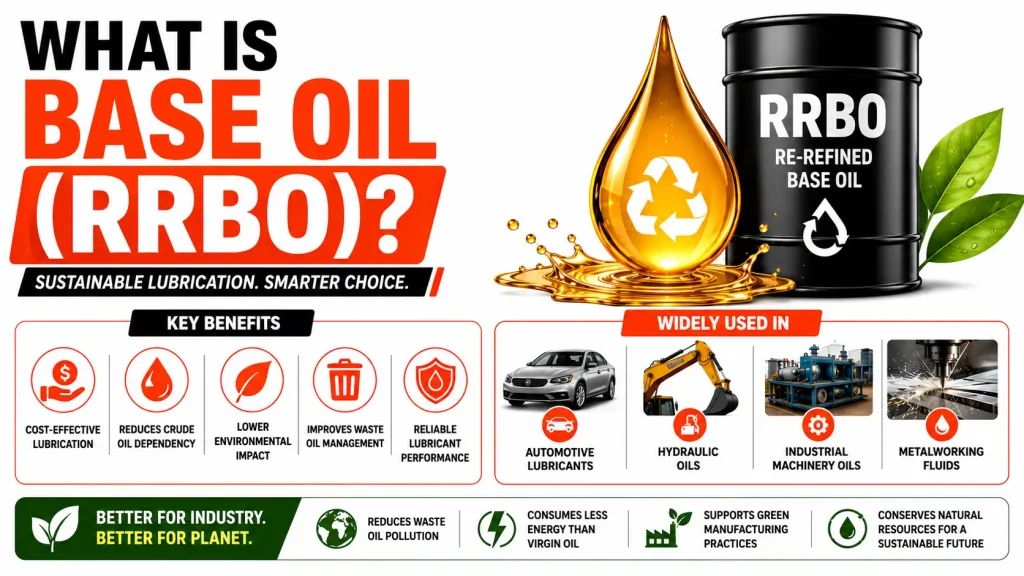
Re-Refined Base Oil (RRBO) is a recycled lubricant oil produced by processing used industrial and automotive oils through advanced refining methods. Industries use RRBO as a sustainable alternative to virgin base oil because it delivers reliable lubrication performance while reducing environmental waste. Instead of disposing used lubricants, re-refining plants clean and restore the oil for reuse in industrial applications.
Industries prefer RRBO because it offers:
- Cost-effective lubrication solutions
- Reduced dependency on crude oil
- Lower environmental impact
- Improved waste oil management
- Reusable industrial lubricant properties
For example, automotive lubricant manufacturers often blend RRBO into engine oils and hydraulic fluids after quality testing. Heavy machinery operators also use RRBO-based lubricants to reduce operating costs without compromising lubrication efficiency.
As industries move toward greener manufacturing practices, RRBO continues to gain popularity due to its balance of performance, affordability, and environmental sustainability.
Definition of Re-Refined Base Oil
Re-Refined Base Oil (RRBO) is a processed lubricant oil created by recycling and purifying used engine oils, hydraulic oils, and industrial lubricants. Instead of treating waste oil as disposal material, re-refining facilities remove contaminants, sludge, water, heavy metals, and degraded additives to restore the oil into reusable base oil.
Industries widely use RRBO in:
- Automotive lubricants
- Hydraulic oils
- Industrial machinery oils
- Metalworking fluids
RRBO supports sustainable industrial operations because it reduces waste oil pollution and conserves natural petroleum resources. Industry reports suggest that re-refining used oil consumes significantly less energy than producing virgin base oil from crude petroleum.
Key advantages of RRBO include:
- Lower lubricant production costs
- Reduced environmental waste
- Conservation of crude oil resources
- Reliable lubrication performance
For example, manufacturing plants often use RRBO-based hydraulic oils in heavy equipment where consistent lubrication remains critical. Similarly, transport companies use lubricants containing re-refined oil to reduce maintenance expenses and improve sustainability targets.
How RRBO Is Manufactured
RRBO manufacturing involves multiple refining stages that transform contaminated waste oil into high-quality reusable base oil. Modern re-refining plants use advanced technologies to remove impurities and restore lubricant performance characteristics.
| Process Stage | Purpose | Example |
| Used Oil Collection | Gather waste lubricants from industries and workshops | Automotive service stations |
| Filtration & Dehydration | Remove water, sludge, and solid particles | Hydraulic waste oil cleaning |
| Vacuum Distillation | Separate usable oil fractions | Recovery of base oil components |
| Re-Refining Process | Eliminate contaminants and degraded compounds | Hydro-treatment purification |
| Additive Treatment | Improve lubricant performance | Anti-wear additive blending |
Used Oil Collection
Manufacturers collect waste lubricating oil from factories, vehicle workshops, power plants, and industrial machinery operations. Proper collection prevents environmental contamination.
Filtration and Dehydration
The collected oil passes through filtration systems that remove dirt, carbon particles, and metal residues. Dehydration units eliminate water contamination that can damage lubricant quality.
Vacuum Distillation
Refining plants heat the oil under vacuum pressure to separate usable lubricant fractions from unwanted materials. This process improves purity without damaging the oil structure.
Re-Refining Process
Advanced purification technologies remove sulfur compounds, oxidation residues, and degraded additives. Many plants use hydro-treatment systems to improve oil stability and clarity.
Key Properties of RRBO
Re-Refined Base Oil offers several performance characteristics that make it suitable for industrial lubrication applications. Modern re-refining technology allows RRBO to achieve lubrication quality close to virgin base oils while supporting sustainability goals.
Lubrication Performance
RRBO provides effective lubrication that reduces friction between moving machine components. Proper lubrication minimizes equipment wear and helps industries improve machinery lifespan.
For example, factories often use RRBO-based hydraulic oils in compressors, pumps, and heavy industrial systems where continuous lubrication remains essential.
Viscosity Stability
High-quality RRBO maintains stable viscosity across varying operating temperatures. Stable viscosity helps lubricants flow smoothly and maintain protective oil films under pressure.
Industries benefit from:
- Better machinery efficiency
- Reduced mechanical wear
- Lower energy losses
- Improved operational reliability
Reusability
One of RRBO’s biggest advantages lies in its recyclability. Re-refining allows industries to reuse waste lubricants instead of depending entirely on virgin petroleum oils.
This supports:
- Waste reduction initiatives
- Lower lubricant procurement costs
- Sustainable manufacturing practices
Reduced Contaminants After Refining
Modern refining processes remove harmful contaminants such as:
- Water
- Heavy metals
- Carbon residues
- Oxidation compounds
As a result, properly refined RRBO delivers cleaner lubrication performance and safer industrial operation.
LDO vs RRBO: Detailed Industrial Comparison
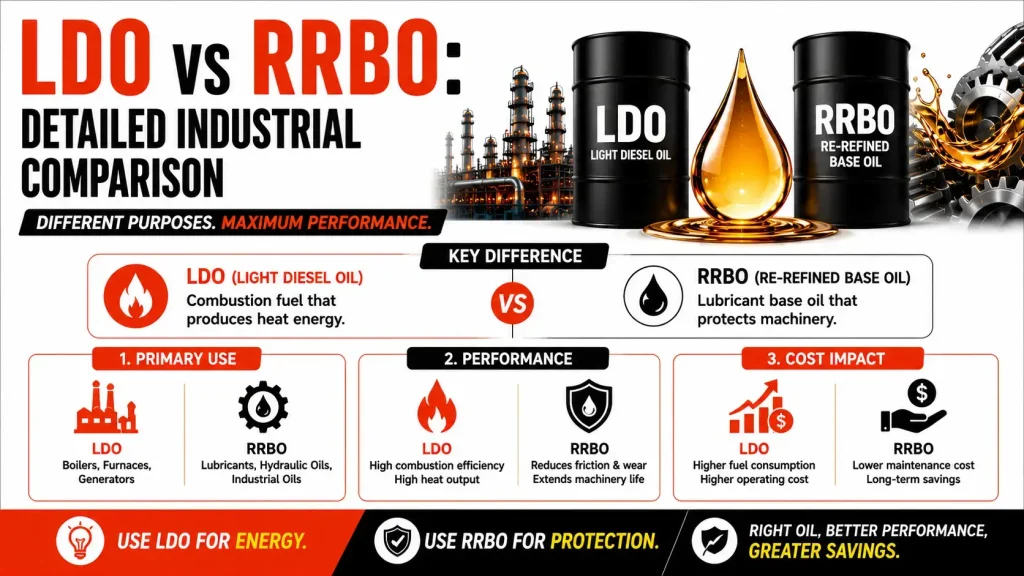
Industries often compare Light Diesel Oil (LDO) and Re-Refined Base Oil (RRBO) because both play important roles in industrial operations. However, these oils serve completely different purposes. LDO works as a combustion fuel for heat generation, while RRBO functions as a lubricant base oil for machinery protection and maintenance.
The right selection directly affects:
- Fuel efficiency
- Equipment lifespan
- Maintenance costs
- Operational productivity
- Environmental performance
LDO performs better in boilers, furnaces, and generators because it burns efficiently and produces high thermal energy. In contrast, RRBO supports machinery lubrication by reducing friction, heat buildup, and mechanical wear.
For example, textile industries use LDO in steam boilers for continuous heat production, while engineering plants use RRBO-based lubricants in hydraulic systems and industrial machines. Studies show that proper lubrication can reduce machinery wear by up to 30-40%, improving long-term equipment reliability.
Understanding these differences helps industries avoid operational problems, reduce downtime, and improve overall cost efficiency.
Combustion Efficiency
Light Diesel Oil delivers superior combustion efficiency because refineries specifically design it for heat generation and fuel-burning applications. Its low viscosity and balanced hydrocarbon composition allow smoother atomization inside burners, helping fuel mix efficiently with air during combustion.
Key reasons why LDO performs better for combustion include:
- Faster ignition capability
- Stable flame generation
- High heat output
- Cleaner fuel burning
For example, food processing plants use LDO-fired boilers because they require steady steam production for sterilization and cooking operations.
RRBO, however, does not perform well as a direct combustion fuel. Manufacturers design RRBO primarily for lubrication rather than heat generation. Its composition focuses on viscosity stability and machinery protection instead of combustion quality.
Using RRBO as fuel can create several problems:
- Incomplete combustion
- Excessive smoke formation
- Higher carbon residue buildup
- Burner clogging issues
Industrial systems designed for combustion require fuels with controlled ignition and burning properties. RRBO lacks those optimized fuel characteristics, making it unsuitable for direct industrial firing applications.
Lubrication Performance
Re-Refined Base Oil delivers strong lubrication performance because manufacturers specifically process it to reduce friction and protect machinery components. Unlike LDO, RRBO functions as a lubricant base oil rather than a combustion fuel. Industries use RRBO in hydraulic oils, industrial lubricants, greases, and machinery oils where smooth mechanical operation remains critical.
RRBO creates a protective oil film between moving machine parts. This film minimizes direct metal-to-metal contact and reduces mechanical wear during continuous operation. Studies in industrial maintenance show that proper lubrication can improve machinery efficiency and significantly lower equipment failure rates.
Key lubrication benefits of RRBO include:
- Reduced friction between components
- Better wear protection
- Improved machinery lifespan
- Lower operating temperatures
For example, manufacturing plants often use RRBO-based hydraulic oils in heavy presses, compressors, and industrial pumps. These lubricants help machines operate continuously under high pressure without excessive overheating.
Industries benefit from reduced maintenance expenses because effective lubrication lowers:
- Bearing damage
- Gear wear
- Heat buildup
- Energy losses
As re-refining technology improves, high-quality RRBO now delivers lubrication performance close to many virgin base oils while supporting sustainable industrial operations.
Cost Comparison
Cost plays a major role when industries compare LDO and RRBO. However, businesses must evaluate these oils based on their specific industrial functions rather than direct price alone. LDO mainly affects fuel consumption expenses, while RRBO influences lubrication and maintenance costs.
LDO usually carries higher operational fuel expenses because industries consume it continuously for heat generation and power production. Boilers, furnaces, and generators often require large fuel volumes during daily operations.
Major LDO-related costs include:
- Fuel procurement expenses
- Burner maintenance
- Storage and transportation
- Combustion-related servicing
For example, textile factories using LDO-fired boilers may experience rising operational costs during periods of fluctuating petroleum prices.
RRBO, on the other hand, helps industries reduce long-term lubrication costs. Re-refined oils generally cost less than virgin base oils while still providing effective machinery protection.
RRBO helps industries save money through:
- Lower lubricant replacement costs
- Reduced machinery wear
- Longer equipment lifespan
- Lower maintenance downtime
For instance, engineering plants using RRBO-based hydraulic lubricants often reduce maintenance frequency and spare-part replacement expenses.
From a long-term operational perspective:
- LDO supports energy production efficiency
- RRBO supports machinery protection and maintenance savings
Industries achieve better overall economics when they use each oil for its intended application rather than treating them as interchangeable industrial products.
Conclusion
Light Diesel Oil (LDO) and Re-Refined Base Oil (RRBO) serve completely different industrial purposes, even though industries often compare them during operational planning. LDO works primarily as a combustion fuel that supports boilers, furnaces, generators, and industrial heating systems with high thermal efficiency and reliable energy output. RRBO, on the other hand, functions as a sustainable lubricant base oil that protects machinery, reduces friction, and supports long-term equipment performance. Both oils offer unique advantages depending on industrial requirements. LDO helps industries achieve stable heat generation and smoother combustion, while RRBO helps reduce maintenance costs, improve machinery lifespan, and support environmentally responsible operations through oil recycling and reuse.
FAQ
1.What is the main difference between LDO and RRBO?
LDO is an industrial fuel, while RRBO is a re-refined lubricant base oil used for machinery lubrication.
2. Can RRBO be used as industrial fuel?
RRBO is primarily designed for lubrication and is not commonly used as an industrial fuel.
3.Is LDO better for boilers and furnaces?
Yes, LDO is well-suited for boilers and furnaces due to its efficient combustion and heat output.
4.Why is RRBO considered environmentally friendly?
RRBO reduces waste and conserves resources by recycling used lubricating oil.
5.Which oil is more cost-effective for industrial operations?
LDO is cost-effective for fuel applications, while RRBO helps reduce lubrication and maintenance costs.
6.Can RRBO replace fresh base oil?
Yes, high-quality RRBO can replace virgin base oil in many industrial lubricant applications.
7.Does LDO produce more emissions than RRBO?
Yes, LDO produces combustion emissions, whereas RRBO is mainly used as a lubricant.
8.Which industries commonly use RRBO?
Automotive, manufacturing, engineering, and heavy machinery industries commonly use RRBO.
9.How does oil quality affect industrial equipment lifespan?
High-quality oil reduces wear and improves equipment reliability and lifespan.
10.What factors should industries consider before choosing industrial oil?
Industries should evaluate performance needs, cost, equipment compatibility, maintenance requirements, and environmental regulations.