
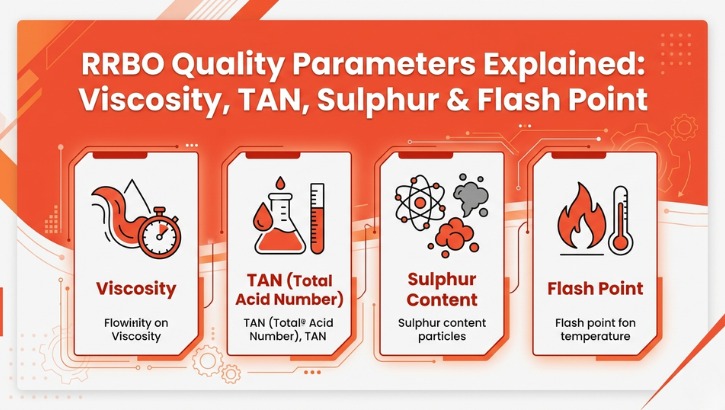
RRBO Quality Parameters Explained: Viscosity, TAN, Sulphur & Flash Point
Introduction
Managing waste lubricating oil is a growing global challenge, with over 24 million tons of used oil generated annually, much of which risks improper disposal and environmental harm (International Energy Agency). At the same time, industries remain heavily dependent on crude-derived base oils, increasing both costs and carbon emissions. This is where Re-Refined Base Oil(RRBO) offers a powerful, sustainable solution. By reprocessing used oil through advanced refining technologies, RRBO delivers performance comparable to virgin base oils while significantly reducing environmental impact. According to the U.S. Environmental Protection Agency, re-refining used oil consumes up to 85% less energy than producing base oil from crude. As industries shift toward circular economy practices, RRBO stands out as a cost-effective, eco-friendly alternative that addresses both operational efficiency and sustainability goals.
What is Re-Refined Base Oil?
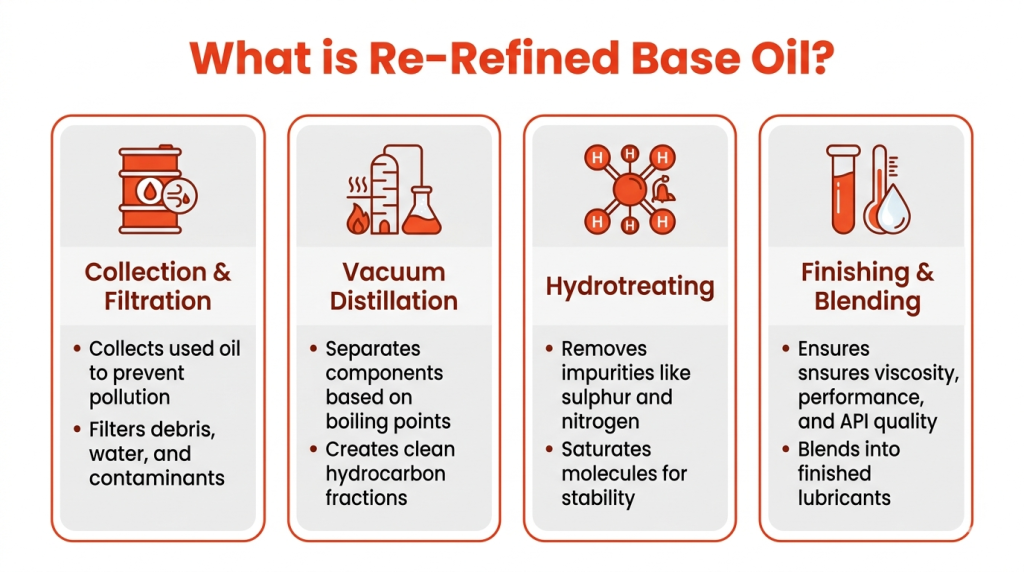
Re-Refined Base Oil(RRBO) is a refined lubricant base oil made from used or waste engine oils that industries collect after use. Instead of disposing of this oil, companies recycle it through advanced refining technologies to restore its original quality. This process helps reduce environmental pollution and saves valuable crude oil resources.
Every year, the world generates around 24-30 million tons of used lubricating oil, but only a portion gets properly recycled. RRBO transforms this waste into a usable product that performs almost like virgin base oil.
For example, an automotive service center collects used engine oil after oil changes. Instead of sending it to waste disposal, the oil goes to a re-refining plant where technicians remove impurities like dirt, metal particles, and water. The final product becomes clean base oil suitable for new lubricants.
Definition and Meaning
Re-Refined Base Oil(RRBO) means a high-quality base oil produced by processing used lubricating oil through purification and refining techniques. It removes contaminants such as carbon deposits, oxidation products, sludge, and heavy metals to restore the oil’s performance.
You can think of RRBO as “recycled oil that gets a second life.” Instead of discarding used oil after engine use, industries clean and upgrade it to meet industrial lubricant standards.
Key points:
- RRBO comes from used lubricating oil
- It undergoes deep purification and refining
- It meets industrial-grade base oil standards
- It supports sustainable oil management
For example, a truck fleet operator who regularly changes engine oil produces large quantities of waste oil. That oil, instead of being wasted, becomes RRBO after re-refining and can be reused in industrial lubricants.
How RRBO is Produced
Re-Refinery Base Oil(RRBO) production follows a structured recycling process that ensures high-quality output.
Step-by-step process:
- Collection: Used oil is gathered from industries, vehicles, and machinery
- Pre-treatment: Water and large impurities get removed
- Vacuum Distillation: Separates oil from light fuels and contaminants
- Hydrotreating: Improves color, stability, and performance
- Finishing: Final filtration ensures purity and quality
Example:
A recycling plant processes 1,000 liters of used oil and converts nearly 700–800 liters into reusable base oil, depending on contamination levels.
Importance of RRBO in Modern Industries
RRBO plays a critical role in today’s industrial and environmental landscape. It reduces dependency on crude oil, lowers costs, and supports sustainability goals.
Key benefits of RRBO:
- Cuts crude oil usage by up to 60–70%
- Reduces energy consumption by nearly 80% compared to virgin base oil production
- Minimizes environmental pollution from waste oil disposal
- Supports circular economy practices
- Helps industries meet ESG and sustainability targets
Industry usage comparison:
| Industry Sector | Use of RRBO | Benefit |
| Automotive | Engine & gear oils | Cost savings |
| Manufacturing | Hydraulic oils | High efficiency |
| Marine | Engine lubrication | Stable performance |
| Construction | Heavy machinery oils | Durability |
Key Benefits of Re-Refined Base Oil(RRBO)
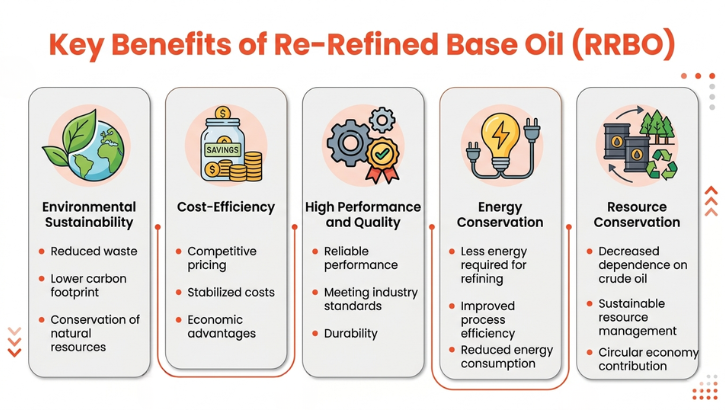
Re-Refined Base Oil(RRBO) gives industries a practical way to cut costs while supporting sustainable operations. Instead of relying only on crude oil extraction, companies recover used lubricants and transform them into high-quality base oil through advanced refining methods.
Independent environmental studies show that re-refining used oil consumes significantly less energy than producing base oil from crude sources, helping industries reduce both operational expenses and carbon emissions.
Key benefits include:
- Reduces dependence on crude oil imports
- Lowers production and procurement costs
- Minimizes hazardous waste generation
- Supports circular economy practices
- Maintains performance standards comparable to virgin oils
RRBO now supports multiple industries such as automotive servicing, heavy machinery operations, and manufacturing plants where lubrication demand remains continuous and high.
Environmental Benefits
Re-Refined Base Oil(RRBO) plays a strong role in reducing industrial pollution and protecting natural resources. Improper disposal of used lubricants can severely damage ecosystems, especially when oil enters soil or water systems.
How RRBO supports the environment:
- Prevents contamination of soil and groundwater
- Reduces industrial hazardous waste output
- Lowers carbon emissions from oil production processes
- Extends the lifecycle of petroleum-based resources
Environmental impact overview:
| Factor | RRBO | Virgin Base Oil |
| Waste Generation | Low | High |
| Energy Requirement | Reduced | High |
| Emissions | Lower | Higher |
| Resource Consumption | Recycled input | Crude extraction |
RRBO directly supports cleaner production systems and helps industries move toward greener operations.
Economic Advantages
RRBO offers strong financial benefits for industries that rely heavily on lubricants. It helps reduce procurement costs while maintaining consistent supply availability.
Key economic advantages:
- Reduces base oil procurement costs significantly
- Lowers dependency on fluctuating crude oil prices
- Minimizes waste handling and disposal expenses
- Improves long-term operational savings
Cost comparison:
| Cost Factor | RRBO | Virgin Base Oil |
| Raw Material Expense | Lower | Higher |
| Production Cost | Efficient | High |
| Waste Management Cost | Minimal | Higher |
| Total Operating Cost | Optimized | Expensive |
RRBO helps businesses balance performance needs with budget control.
Performance Efficiency
Re-Refinery Base Oil(RRBO) delivers strong performance when processed with modern refining technologies. It maintains essential lubrication properties required for industrial and automotive applications.
Performance strengths:
- Stable viscosity under varying temperatures
- Reliable wear protection for machinery
- Good oxidation resistance
- Suitable for hydraulic, engine, and gear systems
Example:
Construction machinery operating under heavy loads uses RRBO-based lubricants to maintain smooth hydraulic performance without frequent oil replacement issues.
Applications of RRBO in Industries
Re-Refined Base Oil(RRBO) supports a wide range of industries that depend on reliable and cost-efficient lubrication. Companies no longer treat it as a secondary option; they actively use it to meet performance needs while reducing environmental impact. Industry data shows that lubricants account for a significant share of maintenance costs, which pushes businesses to adopt alternatives like RRBO.
RRBO fits easily into existing lubricant formulations, which makes adoption simple across sectors.
Automotive Lubricants
The automotive sector uses RRBO extensively in engine oils, gear oils, and transmission fluids. Vehicle owners and fleet operators look for lubricants that reduce wear, improve engine life, and control costs and RRBO delivers on all three.
Key automotive applications:
- Passenger car engine oils
- Commercial vehicle lubricants
- Gear and transmission oils
- Fleet maintenance programs
Why automotive sector prefers RRBO:
- Maintains stable viscosity under engine heat
- Reduces friction and engine wear
- Supports longer oil drain intervals
- Lowers overall maintenance costs
Performance snapshot:
| Feature | RRBO-Based Oil | Conventional Oil |
| Engine Protection | Strong | Strong |
| Cost Efficiency | High | Moderate |
| Thermal Stability | Good | Good |
| Usage in Fleets | Widely adopted | Standard |
RRBO helps automotive businesses balance performance and cost without sacrificing reliability.
Industrial Lubricants
Industrial operations rely heavily on lubrication to keep machines running smoothly. RRBO plays a key role in hydraulic systems, compressors, turbines, and heavy equipment.
Common industrial uses:
- Hydraulic oils for machinery
- Compressor oils in factories
- Turbine lubrication systems
- Gear oils in heavy equipment
Benefits in industrial use:
- Improves equipment efficiency
- Reduces wear and tear on components
- Maintains viscosity under high pressure
- Cuts lubricant procurement costs
Manufacturing Sector
Manufacturing units depend on continuous machine operation, and RRBO helps maintain smooth production flow. It supports various processes where lubrication directly impacts productivity and product quality.
Key applications in manufacturing:
- Machine tool lubrication
- Metal cutting and forming fluids
- Conveyor and gear systems
- Injection molding machinery
Why manufacturers choose RRBO:
- Ensures consistent machine performance
- Reduces downtime caused by lubrication failure
- Lowers operational and maintenance costs
- Supports sustainable production practices
How to Choose High-Quality RRBO
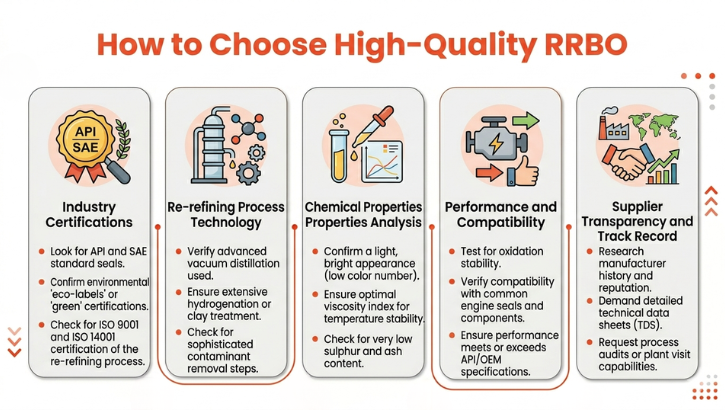
Choosing high-quality Re-Refined Base Oil(RRBO) requires more than comparing prices. You need to evaluate performance, purity, and supplier reliability to ensure consistent results. Poor-quality base oil can increase equipment wear, raise maintenance costs, and reduce operational efficiency.
Industry insights show that lubrication-related issues account for nearly 30-40% of mechanical failures in industrial equipment. That makes quality selection critical.
Start by reviewing technical specifications such as viscosity index, sulfur content, and oxidation stability. Reliable RRBO should match or closely align with virgin base oil standards. Always request product data sheets and lab test reports before making a decision.
Supplier credibility also plays a major role. Established suppliers follow strict refining processes and quality control measures, which ensures consistency in every batch.
In short, focus on performance, certification, and supplier transparency rather than just cost. A well-informed choice helps you improve machine life, reduce downtime, and achieve long-term savings.
Key Factors to Consider
When selecting RRBO, you need to focus on multiple factors that directly affect performance and reliability.
Key factors include:
- Purity Level: Check for low contaminants such as water, metals, and sludge
- Viscosity Index: Higher values indicate better temperature stability
- Sulfur Content: Lower sulfur improves environmental performance
- Consistency: Uniform quality across batches ensures stable operation
- Supplier Reputation: Trusted suppliers maintain strict quality standards
Why these factors matter:
- Improve equipment lifespan
- Reduce maintenance frequency
- Ensure smooth system operation
- Maintain production efficiency
Ignoring these factors can lead to increased wear, unexpected breakdowns, and higher operating costs.
Tips for Buyers
Buying RRBO becomes easier when you follow a structured approach. Instead of choosing the lowest price option, focus on long-term value.
Practical tips for buyers:
- Request lab test reports for every batch
- Verify industry certifications and compliance
- Compare technical specifications, not just pricing
- Ask for sample testing before bulk purchase
- Evaluate supplier track record and customer feedback
Key Quality Parameters to Check
To ensure you choose the right RRBO, you must evaluate specific technical parameters that define oil quality and performance.
Critical parameters to check:
- Viscosity Index (VI): Indicates stability across temperatures
- Flash Point: Higher values improve safety and performance
- Pour Point: Determines performance in low temperatures
- Sulfur Content: Lower levels ensure cleaner operation
- Total Acid Number (TAN): Lower values indicate better oil condition
Quality comparison table:
| Parameter | High-Quality RRBO | Low-Quality RRBO |
| Viscosity Index | High | Low |
| Flash Point | High | Lower |
| Sulfur Content | Low | Higher |
| Contaminants | Minimal | Higher |
| Stability | Consistent | Variable |
Conclusion
Re-Refined Base Oil(RRBO) has moved beyond being just an alternative; it now stands as a practical, high-performance solution for industries that want to reduce costs and operate sustainably. It transforms used oil into a valuable resource, cuts energy consumption, lowers environmental impact, and delivers performance comparable to virgin base oils. From automotive applications to heavy industrial use, RRBO proves its reliability across demanding environments.
Industries that adopt RRBO don’t just save money they strengthen operational efficiency and align with global sustainability goals. As environmental regulations tighten and resource costs rise, RRBO offers a smart way forward.
If you’re looking to optimize your lubrication strategy while reducing your environmental footprint, now is the time to make the shift. Explore high-quality RRBO solutions from trusted suppliers and take the next step toward efficient, sustainable operations.
FAQ
1. What is Re-Refined Base Oil(RRBO)?
Re-Refined Base Oil(RRBO) is a high-quality base oil produced by refining used lubricating oil through advanced processes to restore its original properties.
2. Is RRBO as good as virgin base oil?
Yes, high-quality RRBO meets industry standards and delivers performance comparable to virgin base oil when properly refined.
3. What industries use RRBO?
Industries such as automotive, manufacturing, construction, marine, and power generation widely use RRBO for lubrication purposes.
4. How is RRBO produced?
Re-Refined Base Oil(RRBO) is produced through processes like dehydration, vacuum distillation, hydrotreating, and filtration to remove impurities and restore oil quality.
5. Is RRBO environmentally friendly?
Yes, RRBO reduces waste oil pollution, lowers carbon emissions, and conserves natural crude oil resources.
6. Can RRBO be used in engines?
Yes, RRBO can be used in engines if it meets required specifications and quality standards.
7. Is RRBO cost-effective?
Yes, RRBO typically costs less than virgin base oil and helps reduce overall operational expenses.
8. What are the main benefits of RRBO?
Re-Refined Base Oil(RRBO) offers cost savings, environmental protection, reduced energy use, and reliable performance.
9. What certifications should RRBO have?
RRBO should meet industry standards such as API and ISO certifications to ensure quality and safety.
10. What is the future of RRBO?
RRBO has strong growth potential due to increasing demand for sustainable and cost-efficient industrial solutions.