

Base Oil (RRBO) vs Diesel Oil (LDO) vs Furnace Oil (FO): Complete Industrial Fuel Comparison
Introduction
Industrial fuel selection directly affects operating costs, energy efficiency, equipment performance, and environmental compliance. Industries often compare Re-Refined Base Oil (RRBO) vs Diesel Oil (LDO) vs Furnace Oil (FO) because each fuel offers distinct advantages in terms of heat output, combustion quality, maintenance requirements, and sustainability. With global energy-related CO₂ emissions reaching a record 37.8 billion tonnes in 2024, businesses face increasing pressure to optimize fuel usage while reducing environmental impact. At the same time, the demand for sustainable alternatives is growing. According to the U.S. EPA, an estimated 380 million gallons of used oil are recycled annually, highlighting the expanding role of re-refined products such as RRBO in industrial operations. annually, highlighting the expanding role of re-refined products such as Rerol Refinery in industrial operations.
Understanding RRBO, LDO, and Furnace Oil
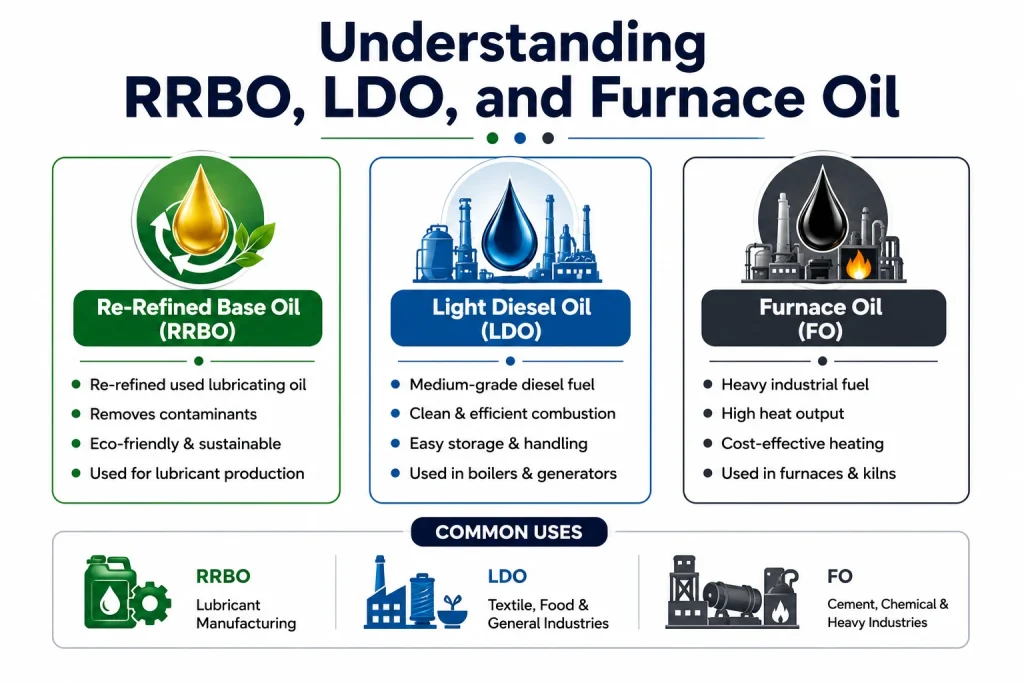
Industries rely on different fuels and oil products to power equipment, generate heat, and maintain efficient operations. Among the most commonly used options are Re-RefinedBase Oil (RRBO) vs Diesel Oil (LDO) vs Furnace Oil (FO) . Although all three originate from petroleum sources, they serve different industrial purposes and offer distinct performance characteristics.
Businesses compare these products because fuel selection directly affects:
- Operating costs
- Energy efficiency
- Equipment maintenance
- Emission levels
For example, a textile factory may choose LDO for cleaner combustion and easier handling, while a cement plant often prefers Furnace Oil for high-temperature heating applications.
What Is Re-Refined Base Oil (RRBO)?
Re-Refined Base Oil (RRBO) is a high-quality base oil produced by processing and refining used lubricating oil. Instead of disposing of waste oil, re-refining removes contaminants, water, oxidation products, and metal particles, allowing the oil to return to a usable condition.
The RRBO manufacturing process typically involves:
- Used oil collection from industries, workshops, and automotive service centers
- Dehydration to remove water content
- Filtration to eliminate sludge and solid impurities
- Vacuum distillation to separate valuable oil fractions
For example, used engine oil collected from transportation fleets can undergo re-refining and later serve as raw material for manufacturing industrial lubricants.
What Is Light Diesel Oil (LDO)?
Light Diesel Oil (LDO) is a medium-grade petroleum fuel widely used in industrial heating and power-generation applications. Refineries produce LDO during the fractional distillation of crude oil. It contains a balanced mix of hydrocarbons that provides stable combustion, reliable heat output, and easier handling compared to heavier fuels.
Industries prefer LDO because it offers:
- Good combustion efficiency
- Lower viscosity than Furnace Oil
- Easier storage and transportation
For example, textile processing plants often use LDO in boilers to generate steam for dyeing and finishing operations.
Key Characteristics of LDO
| Property | Typical Characteristic | Industrial Benefit |
| Calorific Value | High | Generates efficient heat output |
| Viscosity | Low to medium | Improves fuel flow and atomization |
| Sulfur Content | Lower than many heavy fuels | Reduces emissions |
| Combustion Quality | Clean and stable | Minimizes maintenance issues |
| Storage Requirement | Moderate | Simplifies fuel management |
What Is Furnace Oil (FO)?
Furnace Oil (FO) is a heavy petroleum fuel used primarily for industrial heating applications that require large amounts of thermal energy. Refineries produce furnace oil from the heavier residual fractions that remain after extracting lighter fuels such as petrol, diesel, and kerosene during crude oil refining.
Because of its dense composition, Furnace Oil contains:
- Higher viscosity
- Higher density
- Strong heat-generating capability
- Greater energy concentration
Furnace Oil plays a major role in high-temperature industrial operations, including:
- Boiler heating systems
- Rotary kilns
- Industrial furnaces
For example, cement manufacturers use furnace oil to generate the intense heat required inside kilns, while chemical plants use it for continuous process heating.
Quick Comparison of RRBO vs LDO vs Furnace Oil
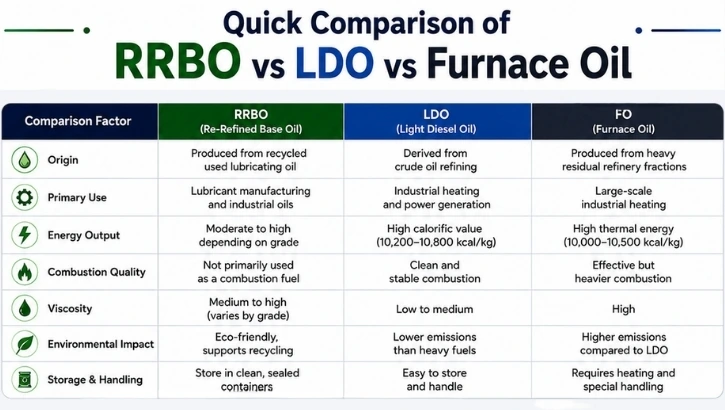
When comparing RRBO, LDO, and FO, industries typically evaluate:
- Fuel source and production method
- Energy output and heating efficiency
- Storage and handling requirements
Each option offers unique advantages:
- RRBO supports waste oil recycling and lubricant production.
- LDO provides stable combustion and operational flexibility.
- FO delivers high thermal energy for large-scale industrial heating.
Understanding these differences helps businesses select the most suitable product based on operational needs, environmental goals, and budget considerations.
Key Differences at a Glance
Although RRBO, LDO, and Furnace Oil originate from petroleum-based resources, they differ significantly in composition, performance, and industrial applications.
Fuel Source
- RRBO comes from recycled and re-refined used lubricating oil.
- LDO comes directly from crude oil refining.
- FO comes from heavy residual fractions left after refining lighter fuels.
Calorific Value
- LDO generally offers a calorific value of around 10,200-10,800 kcal/kg.
- FO typically provides 10,000-10,500 kcal/kg.
- RRBO varies depending on refining quality and intended application.
Comparison Table: RRBO vs LDO vs FO
Selecting the right industrial fuel or oil requires evaluating several performance factors. The table below highlights the major differences between RRBO, LDO, and Furnace Oil.
| Comparison Factor | RRBO (Re-Refined Base Oil) | LDO (Light Diesel Oil) | FO (Furnace Oil) |
| Origin | Produced from recycled used lubricating oil | Derived from crude oil refining | Produced from heavy residual refinery fractions |
| Primary Use | Lubricant manufacturing and industrial oils | Industrial heating and power generation | Large-scale industrial heating |
| Energy Output | Moderate to high depending on grade | High calorific value | High thermal energy output |
| Combustion Quality | Not primarily used as a combustion fuel | Clean and stable combustion | Effective but heavier combustio |
Common Sources of RRBO vs LDO vs Furnace Oil
Understanding where RRBO, LDO, and Furnace Oil originate helps industries evaluate their availability, sustainability, and long-term supply reliability.
Common Sources of RRBO
RRBO originates from used lubricating oils collected from:
- Automotive service centers
- Industrial manufacturing plants
- Transportation fleets
For example, used engine oil from commercial trucks can undergo re-refining and return as high-quality base oil for lubricant production.
Common Sources of LDO
Refineries produce LDO during crude oil processing. Industrial users typically purchase LDO from:
- Petroleum refineries
- Authorized fuel distributors
- Industrial fuel suppliers
Industries such as textiles, food processing, and pharmaceuticals often maintain regular LDO supply contracts to ensure uninterrupted operations.
Common Sources of Furnace Oil
Furnace Oil comes from the heavier residual fractions left after refining lighter petroleum products. Major sources include:
- Oil refineries
- Bulk industrial fuel suppliers
- Petroleum storage depots
Large industrial consumers such as cement plants, steel mills, and chemical manufacturers usually purchase furnace oil in bulk quantities.
Fuel Properties Comparison
Fuel properties play a major role in determining industrial performance, operating costs, equipment efficiency, and maintenance requirements. When comparingBase Oil (RRBO) vs Diesel Oil (LDO) vs Furnace Oil (FO), industries focus on characteristics that directly influence combustion quality and fuel handling.
Some of the most important fuel properties include:
- Calorific value
- Viscosity
- Flash point
- Sulfur content
For example, a textile factory operating multiple boilers may prioritize LDO because of its lower viscosity and cleaner combustion. In contrast, a cement plant often chooses Furnace Oil because it delivers high thermal energy for continuous high-temperature operations.
Calorific Value Comparison
Calorific value measures the amount of heat energy a fuel produces during combustion. Industries use this parameter to evaluate fuel efficiency because higher heat output often translates into lower fuel consumption and improved operational performance.
Typical calorific values include:
- LDO: Approximately 10,200-10,800 kcal/kg
- Furnace Oil: Approximately 10,000-
- 10,500 kcal/kg
- RRBO: Varies depending on refining quality and intended use
LDO generally provides slightly higher energy output than Furnace Oil, making it a popular choice for industries that require stable and efficient combustion. However, Furnace Oil remains highly effective for large-scale heating operations because of its ability to generate substantial thermal energy at lower fuel costs.
Which Fuel Delivers Better Energy Efficiency?
The answer depends on the application:
- LDO offers excellent combustion efficiency and energy utilization.
- FO provides strong thermal performance for heavy industrial heating.
- RRBO serves primarily as a lubricant base stock rather than a dedicated heating fuel.
Viscosity and Flow Characteristics
Viscosity determines how easily a fuel flows through pipelines, pumps, storage systems, and burner nozzles. It directly affects fuel handling efficiency, atomization quality, and combustion performance.
Viscosity Comparison
| Fuel Type | Typical Viscosity | Flow Characteristics | Operational Impact |
| RRBO | Medium | Depends on refining grade | Suitable for lubricant blending and industrial applications |
| LDO | Low | Flows easily at normal temperatures | Simplifies pumping and burner operation |
| Furnace Oil | High | Thick and dense | Often requires preheating before use |
Fuel Handling Requirements
LDO offers the simplest handling process because it flows efficiently through pipelines and burner systems without additional heating.
Burner Compatibility
Different fuels require different burner configurations:
- LDO works well with standard industrial burners.
- Furnace Oil requires burners designed for heavy fuels.
- RRBO generally serves lubrication applications rather than direct combustion.
Pumping and Storage Considerations
Industries should consider infrastructure requirements before selecting a fuel.
LDO Advantages
- Easy pumping
- Lower maintenance
For example, a textile manufacturer may prefer LDO because it reduces fuel-handling complexity, while a steel plant may accept Furnace Oil’s handling requirements in exchange for economical high-temperature heating performance.
Flash Point and Safety Features
Flash point refers to the lowest temperature at which a fuel releases enough vapor to ignite when exposed to an external ignition source. Industries use flash point as a key safety indicator when storing, transporting, and handling fuels.
Safe fuel management practices include:
- Storing fuel in approved containers and tanks
- Maintaining adequate ventilation
- Monitoring storage temperatures
- Conducting regular safety inspections
For example, industrial facilities storing Furnace Oil often use dedicated heated tanks equipped with temperature controls and emergency shutdown systems.
Transportation Considerations
During transportation, industries should:
- Follow hazardous material regulations
- Use certified fuel transport vehicles
- Prevent contamination and leakage
LDO typically offers easier transportation because of its lower viscosity, while Furnace Oil often requires additional handling precautions.
Workplace Safety Implications
Proper fuel management helps reduce:
- Fire hazards
- Equipment failures
- Environmental incidents
Industrial facilities often train employees on fuel handling procedures, spill response protocols, and emergency preparedness measures. Whether using RRBO, LDO, or Furnace Oil, businesses that prioritize safe storage and handling practices can improve workplace safety, maintain regulatory compliance, and protect valuable equipment assets.
Industrial Applications of RRBO, LDO, and FO

Base Oil (RRBO) vs Diesel Oil (LDO) vs Furnace Oil (FO)support a wide range of industrial operations, but each serves different purposes based on its properties and performance characteristics. Industries select these products according to their heating requirements, production processes, maintenance goals, and operating budgets.
Some of the most common industrial applications include:
- Lubricant manufacturing
- Boiler and furnace operations
- Power generation
- Hydraulic oil production
For example, lubricant manufacturers use RRBO as a cost-effective alternative to virgin base oil. Textile mills often rely on LDO to generate steam through boilers because it offers cleaner combustion and easier handling. In contrast, cement and steel plants frequently choose Furnace Oil because it delivers high thermal energy for continuous high-temperature operations.
The choice between RRBO, LDO, and FO depends on factors such as:
- Energy requirements
- Equipment compatibility
- Environmental regulations
- Maintenance considerations
Understanding where and how industries use these products helps businesses identify the most suitable solution for maximizing efficiency, productivity, and sustainability.
Industries Using RRBO
Re-Refined Base Oil (RRBO) plays a critical role in lubricant manufacturing and industrial lubrication applications. By converting used oil into reusable base oil, industries reduce raw material costs while supporting sustainability initiatives.
Common industries using RRBO include:
Lubricant Manufacturing
Lubricant producers use RRBO as a base stock for manufacturing:
- Engine oils
- Hydraulic oils
- Gear oils
- Industrial lubricants
For example, many lubricant blending plants incorporate RRBO into finished lubricant formulations to reduce dependence on virgin base oils.
Automotive Sector
The automotive industry uses products derived from RRBO in:
- Commercial vehicle maintenance
- Fleet lubrication programs
- Automotive service centers
- Workshop operations
These applications help reduce lubricant production costs while maintaining performance standards.
Hydraulic Oil Production
Manufacturers often use RRBO to produce:
- Hydraulic fluids
- Industrial hydraulic oils
- Construction equipment lubricants
- Agricultural machinery fluids
Hydraulic systems require reliable lubrication to reduce wear and improve equipment life.
As industries increasingly focus on environmental responsibility, RRBO continues to grow as a practical and cost-effective solution for lubricant production and machinery maintenance.
Industries Using LDO
Light Diesel Oil (LDO) remains one of the most widely used industrial fuels because it offers reliable combustion, operational flexibility, and efficient heat generation. Industries often choose LDO when they need consistent thermal energy without the handling challenges associated with heavier fuels.
Common Applications of LDO
LDO commonly fuels:
- Industrial boilers
- Furnaces
- Thermic fluid heaters
- Diesel generator systems
For example, textile factories frequently use LDO-fired boilers to generate steam for dyeing, washing, and finishing operations.
Industries That Commonly Use LDO
| Industry | Typical Application | Benefit of Using LDO |
| Textile Industry | Steam generation and process heating | Clean combustion and reliable performance |
| Food Processing | Boiler operations | Consistent heat supply |
| Pharmaceutical Manufacturing | Controlled heating processes | Improved operational efficiency |
| Chemical Industry | Process heating systems | Stable combustion characteristics |
| Engineering Units | Furnaces and generators | Easy fuel handling |
For instance, a packaging manufacturer may use LDO to power boilers and heating systems without investing in specialized fuel-heating infrastructure. This flexibility makes LDO an attractive choice for industries seeking dependable energy performance and simplified fuel management.
Industries Using Furnace Oil
Furnace Oil (FO) serves industries that require large amounts of thermal energy for continuous operations. Its high heat output and relatively economical cost make it a preferred fuel for energy-intensive manufacturing processes.
Cement Plants
Cement manufacturers use Furnace Oil in rotary kilns and process-heating systems. These operations require extremely high temperatures to produce clinker and other cement products efficiently.
Chemical Industries
Chemical plants depend on Furnace Oil for:
- Process heating
- Reactor temperature control
- Steam generation
- Industrial heating systems
For example, ceramic and paper manufacturing plants often use Furnace Oil because it provides substantial thermal energy at competitive fuel costs.
Conclusion
Choosing between Re-RefinedBase Oil (RRBO) vs Diesel Oil (LDO) vs Furnace Oil (FO) depends on your industry’s operational goals, equipment requirements, budget, and environmental priorities. While Rerol supports sustainable manufacturing and lubricant production through waste oil recycling, LDO offers cleaner combustion, easier handling, and reliable performance for boilers and industrial heating systems. Furnace Oil remains a cost-effective solution for energy-intensive industries that require high thermal output for continuous operations.
FAQs
What is the main difference between RRBO, LDO, and Furnace Oil?
RRBO is a re-refined base oil used mainly in lubricant production, while LDO and Furnace Oil serve as industrial fuels.
Which fuel offers the highest calorific value for industrial heating?
LDO generally provides the highest calorific value, delivering efficient and stable heat output.
Is RRBO environmentally friendly compared to LDO and FO?
Yes. RRBO supports waste oil recycling and reduces dependence on virgin petroleum resources.
Why is Furnace Oil widely used in heavy industries?
Its high thermal energy and cost-effectiveness make it suitable for large-scale heating operations.
Which fuel is more cost-effective for boilers and furnaces?
Furnace Oil often costs less for high-volume heating, while LDO may lower maintenance expenses.
Does LDO produce fewer emissions than Furnace Oil?
Yes. LDO usually contains lower sulfur levels and burns cleaner than Furnace Oil.
Can RRBO be used as an industrial fuel?
RRBO mainly serves lubricant manufacturing, although some processed variants may support industrial heating applications.
Which fuel requires the least maintenance?
LDO generally requires less maintenance due to cleaner combustion and lower residue formation.
How do emission regulations affect fuel selection?
Industries often select cleaner fuels to meet environmental standards and avoid compliance issues.
What factors should industries consider before choosing between RRBO, LDO, and FO?
Consider energy requirements, fuel costs, emissions, equipment compatibility, storage needs, and sustainability goals.