
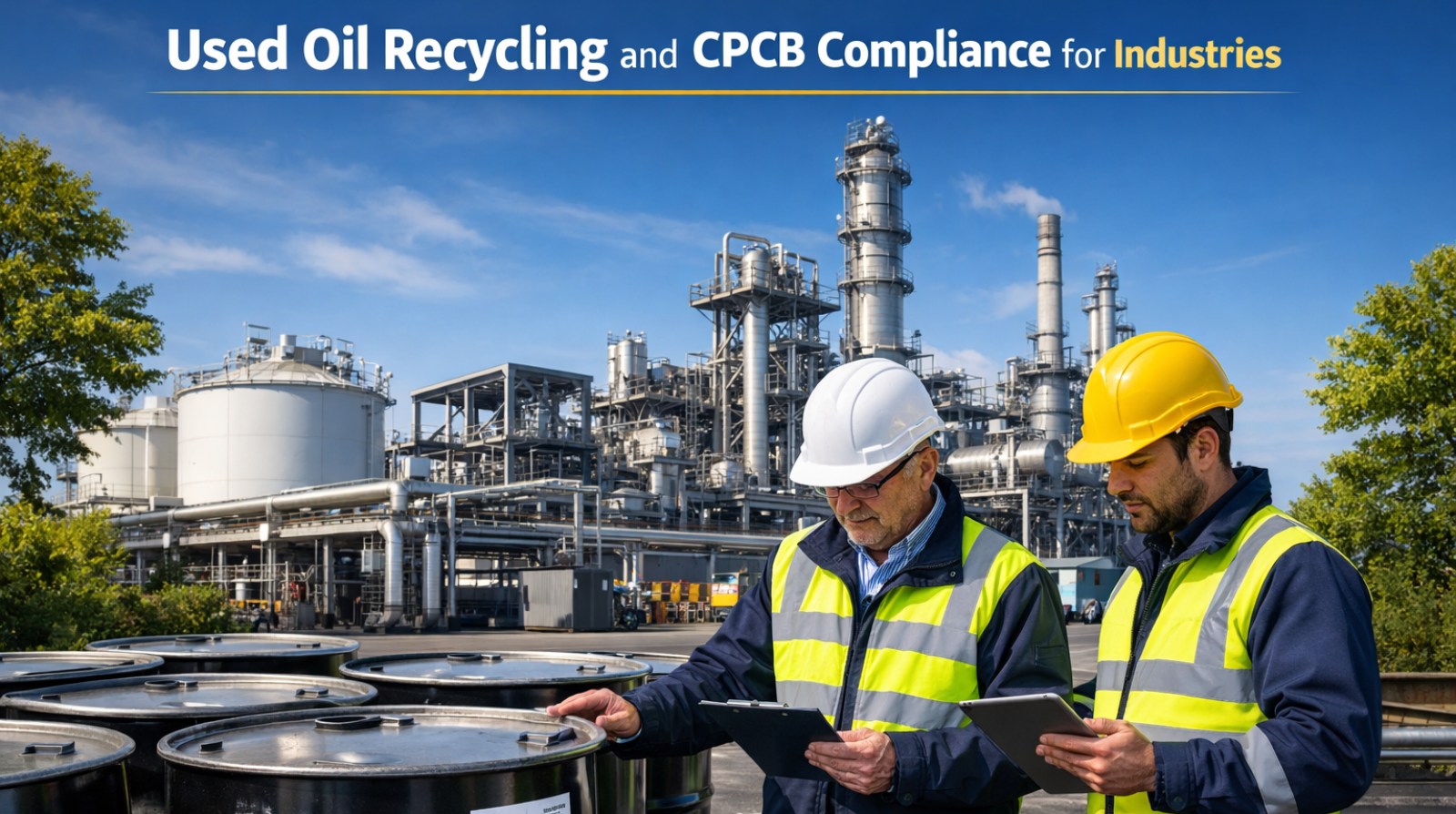
Used Oil Recycling and CPCB Compliance for Industries
Authorized used oil recycling services for industries are no longer optional, they are a regulatory and operational necessity. Industries such as manufacturing, power generation, automotive workshops, and heavy engineering units generate significant quantities of used oil every year. According to the Central Pollution Control Board (CPCB), used oil is classified as hazardous waste under India’s Hazardous and Other Wastes Management Rules, requiring strict authorization, documentation, and traceability.
Improper disposal can contaminate soil and groundwater, and regulatory violations may lead to penalties, production disruptions, and reputational risk. Many industrial units still face challenges in compliant collection, transport, and record maintenance.
This is where structured, CPCB-compliant recycling processes become critical ,ensuring safe handling, scientific testing, lawful re-refining, and complete regulatory transparency. You can see the detailed information below.
What Is Used Oil and Why It Is Classified as Hazardous Waste
Used oil is any petroleum-based or synthetic oil that has been contaminated through industrial use. During operation in engines, turbines, hydraulic systems, compressors, and generators, oil accumulates heavy metals, carbon residues, sludge, water, and chemical impurities. Over time, it loses lubricating efficiency and becomes unsafe for continued use.
Under India’s Hazardous and Other Wastes (Management and Transboundary Movement) Rules, notified by the Central Pollution Control Board (CPCB), used oil is officially classified as hazardous waste. This means it cannot be discarded like normal industrial waste.
Industrial Sources of Used Oil
Common generators include:
- Manufacturing plants and processing units
- Automotive workshops and fleet operators
- Power plants and diesel generator facilities
- Heavy equipment and construction sites
Environmental Impact of Improper Disposal
Improper handling can lead to:
- Soil contamination
- Groundwater pollution
- Toxic emissions during uncontrolled burning
Even a small quantity can severely damage ecosystems.
Legal Consequences Under Indian Law
Non-compliance may result in:
- Monetary penalties
- Cancellation of operating licenses
- Legal prosecution
- Environmental liability during inspections
This is why structured, authorized recycling and documentation are mandatory,not optional for industrial operations.
Overview of CPCB and SPCB Regulations for Used Oil
Used oil management in India is governed under the Hazardous and Other Wastes (Management and Transboundary Movement) Rules, enforced by the Central Pollution Control Board (CPCB) and respective State Pollution Control Boards (SPCBs). These regulations ensure that hazardous waste like used oil is collected, transported, stored, recycled, or disposed of in a scientifically controlled manner.
CPCB Authorization Requirements
Industries and recyclers must:
- Obtain valid authorization for handling hazardous waste
- Maintain proper storage infrastructure
- Submit periodic returns and compliance reports
- Ensure recycling only through approved facilities
Operating without authorization can lead to penalties and operational shutdowns.
SPCB Monitoring and Reporting
SPCBs conduct inspections and require:
- Annual waste generation disclosures
- Proof of disposal through authorized recyclers
- On-site verification of storage practices
Manifest System and Tracking
A formal manifest system tracks:
- Quantity of used oil
- Source and destination
- Transporter details
- Acknowledgment of receipt
This documentation ensures traceability and prevents illegal dumping, protecting both the environment and the industry from regulatory risk.
Why Industries Need Authorized Used Oil Recycling Services
Industries generating hazardous waste cannot afford regulatory mistakes. Authorized used oil recycling services for industries provide structured collection, compliant processing, and documented traceability, protecting operations from legal, environmental, and financial risks. When waste oil is handled by unauthorized parties, companies expose themselves to penalties, audit failures, and environmental liability.
Regulatory Protection
Partnering with authorized recyclers ensures:
- Valid CPCB/SPCB authorization
- Manifest-based tracking of every batch
- Proper storage and transport compliance
- Submission of required regulatory returns
This significantly reduces the risk of fines, license suspension, or shutdown notices during inspections.
Environmental Responsibility
Improper disposal can contaminate soil and groundwater. Authorized recyclers:
- Use approved containment systems
- Prevent illegal dumping or uncontrolled burning
- Recover valuable base oil through scientific re-refining
- Reduce dependence on virgin crude resources
This strengthens ESG reporting and corporate sustainability commitments.
Audit and Compliance Readiness
During internal or regulatory audits, industries must show:
- Waste generation records
- Transport manifests
- Recycler authorization proof
- Batch-wise testing reports
Working with certified recyclers ensures documentation is always inspection- ready minimizing operational disruption and reputational risk.
Used Oil Collection and Logistics Process
Efficient used oil management starts long before recycling, it begins at the source. A structured collection and logistics process ensures safety, regulatory compliance, and traceability from pickup to processing facility.
Safe Storage at Industrial Sites
Industries must store used oil in:
- Leak-proof, labeled containers
- Covered areas with spill-control measures
- Designated hazardous waste zones
Improper storage increases contamination risks and can lead to regulatory action during inspections. Secondary containment systems and periodic inspection logs are strongly recommended to prevent accidental leaks.
Sealed Container Transport
Authorized recyclers use:
- Sealed and approved transport containers
- GPS-enabled vehicles for route tracking
- Trained personnel handling hazardous material
This prevents pilferage, illegal dumping, and environmental exposure during transit. Secure transport also ensures that the waste reaches only authorized processing units.
Documentation During Pickup
Every collection should include:
- Quantity measurement and batch details
- Manifest documentation
- Transporter authorization proof
- Acknowledgment of receipt
This documentation creates a transparent compliance trail.
Used Oil Testing and Quality Assessment
Before re-refining or industrial reuse, every batch of used oil must undergo systematic quality testing. This step determines whether the oil is suitable for recovery, fuel blending, or requires specialized treatment. Testing is conducted as per recognized IS and ASTM test methods, ensuring technical reliability and regulatory acceptance.
Density and Viscosity Testing
These parameters determine the oil’s physical behavior:
- Density indicates contamination levels and composition changes.
- Viscosity measures flow characteristics and lubricant performance.
For example, abnormal viscosity can signal oxidation or mixing with foreign substances, affecting re-refining efficiency.
Flash Point and Pour Point
- Flash point measures ignition temperature and indicates fire safety risk.
- Pour point determines low-temperature flow properties.
Low flash points may suggest fuel contamination, making the oil unsafe for transport without corrective processing.
Water, Sediment, Ash and Sulphur Analysis
Laboratory evaluation checks for:
- Water content (affects combustion efficiency)
- Sediment and sludge
- Ash content
- Sulphur levels impacting emissions
Batch-wise test reports improve traceability, ensure compliance, and support transparent industrial reuse decisions.
Re-Refining Process of Used Oil
Re-refining transforms contaminated used oil into valuable base oil through controlled industrial processes. Instead of burning or disposing of waste oil, modern re-refining recovers usable hydrocarbons while reducing environmental impact. According to the International Energy Agency (IEA), recycling lubricating oil saves significantly more energy compared to producing base oil from crude petroleum, making it both environmentally and economically efficient.
Pre-Treatment and Dehydration
The process begins with:
- Removal of water through heating and settling
- Filtration of solid particles and sludge
- Separation of light fuel fractions
This step stabilizes the feedstock and prevents processing damage.
Vacuum Distillation
Under controlled vacuum conditions:
- Oil is heated at reduced pressure
- Contaminants and light fractions are separated
- Thermal degradation is minimized
Vacuum systems ensure efficient separation without excessive cracking of hydrocarbons.
Base Oil Recovery
Final treatment includes:
- Refining and purification
- Removal of sulphur and residual impurities
- Production of re-refined base oil meeting industrial standards
The result is a high-quality output suitable for approved industrial applications.
Industrial Applications of Re-Refined Oil
Re-refined oil is not waste , it is a recovered industrial resource. When processed under controlled conditions and tested as per applicable IS/ASTM standards, it can be safely reused in approved industrial applications. However, all usage must remain subject to regulatory permissions and compliance with CPCB/SPCB guidelines.
Furnace Fuel Usage
Re-refined or processed oil meeting specified parameters can be used in:
- Industrial furnaces
- Foundries
- Metal processing units
These systems are designed to handle heavier fuel grades. Proper flash point and sulphur limits must be verified before use to ensure safe combustion and emission compliance.
Boiler Applications
Certain grades may be utilized in:
- Industrial steam boilers
- Thermal heating systems
- Process heating equipment
Low water content and controlled viscosity are critical to prevent efficiency loss or equipment damage.
Approved Blending Uses
Processed oil may also be:
- Blended with other industrial fuels
- Used in controlled energy recovery systems
- Applied in permitted secondary industrial operations
Every application must follow emission norms, fuel quality standards, and regulatory authorization. Proper testing and documentation ensure safe, compliant, and economically viable industrial reuse.
Environmental and Sustainability Benefits
Used oil re-refining is not just a compliance activity,it is a measurable sustainability strategy. Recycling waste lubricants significantly reduces dependence on virgin crude and lowers environmental impact across the industrial value chain.

Conservation of Crude Oil
According to the United States Environmental Protection Agency (EPA), re-refining used oil requires substantially less energy than refining crude oil into base stock. Every tonne of used oil recycled reduces the need for fresh petroleum extraction, conserving natural resources and supporting circular economy goals.
Reduction in Carbon Footprint
Re-refining:
- Cuts greenhouse gas emissions compared to crude refining
- Reduces energy-intensive upstream extraction processes
- Minimizes transportation emissions linked to imported base oil
Lower energy input directly translates into lower carbon output, improving ESG performance metrics.
Hazardous Waste Minimization
Improper disposal of used oil contaminates soil and groundwater. Recycling ensures:
- Controlled processing of hazardous material
- Prevention of illegal dumping
- Reduction of toxic environmental exposure
For industries aiming to meet sustainability benchmarks, authorized recycling delivers both environmental protection and regulatory compliance, while converting waste into recoverable value.
Documentation and Regulatory Compliance Support
In hazardous waste management, documentation is not paperwork-it is legal protection. Industries handling used oil must maintain transparent records to demonstrate compliance with CPCB and SPCB regulations. Proper documentation reduces regulatory risk and ensures traceability from generation to final processing.
Batch-wise Test Reports
Every consignment should include:
- Laboratory test results (density, viscosity, flash point, water content)
- IS/ASTM method references
- Quality suitability remarks
These reports validate that the oil has been scientifically assessed before reuse or re-refining.
Transport Manifests
A compliant manifest system records:
- Quantity collected
- Generator details
- Transporter authorization
- Destination facility acknowledgment
This ensures there is no gap in tracking hazardous material movement.
Audit Preparedness
During inspections, authorities may request:
- Authorization certificates
- Annual return filings
- Waste storage logs
- Disposal/recycling proof
Having structured compliance support prevents penalties and operational disruption.
Mid-Blog CTA
Ensure full CPCB compliance and secure your operations with authorized used oil recycling services from Rerol Refinery.
Visit Rerol Refinery to schedule a compliant pickup or consult our technical team today.
Why Choose Rerol Refinery for CPCB-Compliant Used Oil Recycling
Selecting the right recycling partner is not just about waste disposal, it’s about regulatory security, operational continuity, and environmental responsibility. Rerol Refinery positions itself as a compliant and technically capable partner for industries requiring structured used oil management.

Authorized Operations
Rerol operates under applicable CPCB/SPCB authorizations, ensuring that collection, transport, testing, and re-refining activities follow Hazardous Waste Management Rules. This protects industries from compliance gaps and regulatory penalties.
Technical Expertise
The refinery applies systematic IS/ASTM-based testing methods, controlled re-refining processes, and quality verification protocols. Batch-wise analysis ensures every consignment is scientifically evaluated before further processing.
Transparent Compliance
Industries receive:
- Manifest-based tracking
- Batch-wise laboratory reports
- Authorization documentation
- Audit-ready records
This transparency minimizes inspection risks and supports internal compliance reporting.
Environment-First Approach
Re-refining reduces dependence on virgin crude, lowers hazardous waste accumulation, and supports sustainable industrial practices.
Reliable Logistics Network
Structured pickup schedules, sealed transport systems, and trained handling teams ensure safe and timely movement of used oil.
Conclusion
Used oil management is not a routine disposal task,it is a regulated responsibility with direct environmental and legal implications. Under frameworks enforced by the Central Pollution Control Board (CPCB), industries must ensure hazardous waste like used oil is handled only through authorized channels. Failure to comply can result in penalties, consent suspension, operational disruption, and long-term environmental liability.
This is why authorized used oil recycling services for industries are essential. They provide:
- Regulatory protection through valid authorization
- End-to-end traceability using manifest systems
- Scientific testing based on IS/ASTM standards
- Safe re-refining and approved industrial reuse
Beyond compliance, responsible recycling conserves crude resources, reduces hazardous waste accumulation, and supports sustainability goals. It transforms waste oil into recoverable value while minimizing ecological risk.
If your industry generates used oil, the safest and most efficient path forward is a structured, compliance-driven partnership.
Partner with Rerol Refinery for safe, transparent, and CPCB-compliant used oil recycling solutions.
Visit Rerol Refinery to implement a regulatory-safe waste management system today.
Frequently Asked Questions (FAQs)
Is used oil considered hazardous waste in India?
Yes. Under regulations enforced by the Central Pollution Control Board (CPCB), used oil is classified as hazardous waste. It must be stored, transported, and recycled only through authorized entities following the Hazardous Waste Management Rules.
What documents are required for used oil transportation?
Industries must maintain:
- Valid hazardous waste authorization
- Manifest (tracking) documents
- Transporter authorization details
- Recycler acknowledgment receipt
These records ensure full traceability and legal compliance.
How often should industries dispose of used oil?
Disposal frequency depends on operational volume, but industries should avoid excessive on-site storage. Regular, scheduled pickups reduce contamination risk and inspection exposure.
What is the difference between recycling and re-refining?
Recycling is a broad term that includes energy recovery or reuse. Re-refining is a controlled industrial process that restores used oil into base oil through scientific treatment and distillation.
Can recycled oil be reused in industrial systems?
Yes, subject to regulatory permissions and quality compliance. Properly tested and processed oil can be reused in approved industrial applications.