

Used Oil Collection vs Furnace Oil (FO): What Industries Should Know
Introduction
Rising fuel prices and tightening environmental regulations are forcing industries to rethink how they manage industrial fuels and waste oils. According to the International Energy Agency (IEA), global energy markets continue to experience significant price volatility, directly affecting industrial operating costs. At the same time, the United Nations Environment Programme (UNEP) identifies used oil as a rapidly growing hazardous waste stream linked to industrial expansion and increased machinery usage. This growing pressure has intensified the comparison between Diesel Oil (LDO) and Re-Refined Base Oil (RRBO). While LDO remains a widely used industrial fuel for boilers, furnaces, and generators, RRBO is gaining attention as a sustainable alternative produced through used oil recycling and re-refining processes. Choosing the right fuel and ensuring proper waste oil management can significantly improve operational efficiency, reduce environmental risks, strengthen regulatory compliance, and support long-term industrial sustainability.
Understanding Used Oil Collection
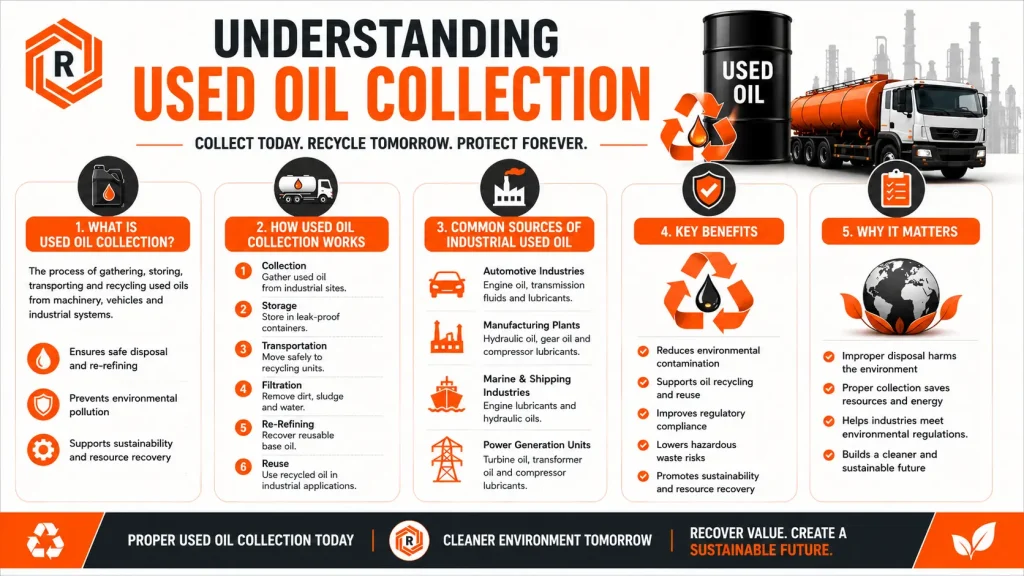
Industries generate massive amounts of used oil every year through machinery operation, vehicle maintenance, hydraulic systems, and industrial processing. If companies fail to manage this waste properly, they risk environmental pollution, legal penalties, and operational inefficiencies. This challenge has made used oil collection an essential part of modern industrial waste management.
Used oil collection refers to the systematic gathering, storage, transportation, and recycling of contaminated lubricants and industrial oils. Industries collect these oils from machines, engines, compressors, turbines, and hydraulic systems before sending them for recycling or re-refining.
Key benefits of proper used oil collection include:
- Reducing environmental contamination
- Supporting oil recycling and reuse
- Improving regulatory compliance
- Lowering hazardous waste risks
For example, automotive workshops collect used engine oil for recycling, while manufacturing plants recover hydraulic oils to reduce disposal costs and environmental impact.
What Is Used Oil Collection?
Used oil collection involves gathering contaminated or previously used industrial oils from machinery, vehicles, equipment, and industrial systems for safe disposal, recycling, or re-refining. Industries generate used oil during regular operations when lubricants become dirty, degraded, or mixed with contaminants such as metal particles, water, dust, and chemicals.
Common examples of used oil include:
- Engine oil from trucks and generators
- Hydraulic oil from manufacturing machines
- Gear oil from industrial equipment
- Turbine oil from power plants
Several industries produce large volumes of used oil every day, including:
- Automotive service centers
- Manufacturing plants
- Marine and shipping companies
- Construction equipment operators
For example, a single manufacturing plant may generate thousands of liters of waste hydraulic oil annually due to continuous machine operations. Similarly, shipping vessels regularly replace engine lubricants to maintain engine efficiency.
Organized used oil collection systems help industries handle this waste safely and efficiently. These systems usually include:
- Scheduled oil pickup services
- Leak-proof storage containers
- Authorized transport vehicles
Without proper collection systems, industries face serious risks such as soil contamination, water pollution, fire hazards, and heavy regulatory penalties. Proper used oil management also supports sustainability goals by allowing industries to recover valuable oil resources instead of discarding them as waste.
How Used Oil Collection Works
Used oil collection follows a structured process that helps industries manage hazardous oil waste safely and efficiently. The process starts at industrial facilities, workshops, power plants, and manufacturing units where machinery and vehicles generate contaminated oil during daily operations.
Industries usually store used oil in sealed containers or dedicated storage tanks to prevent spills and environmental contamination. Authorized waste management companies then collect the oil using specialized transport vehicles designed for hazardous materials.
The collection process typically includes:
| Stage | Process | Example |
| Collection | Gathering used oil from industrial sites | Automotive workshops collecting engine oil |
| Storage | Storing oil in leak-proof tanks | Manufacturing plants using sealed drums |
| Transportation | Moving used oil safely to recycling units | Licensed tanker trucks transporting waste oil |
| Filtration | Removing dirt, sludge, and water | Cleaning hydraulic waste oil |
| Re-Refining | Recovering reusable base oil | Producing RRBO from used lubricants |
| Reuse | Using recycled oil in industrial applications | Industrial burner fuel or lubricants |
For example, re-refining plants convert used lubricants into Re-Refined Base Oil (RRBO), which industries can reuse in lubricant manufacturing. This recycling approach reduces dependence on crude oil while lowering hazardous waste generation.
Common Sources of Industrial Used Oil
Many industries generate used oil as a byproduct of daily operations. Machinery, engines, turbines, and hydraulic systems require continuous lubrication, and over time these oils become contaminated with dirt, metal particles, moisture, and chemicals.
Major sources of industrial used oil include:
- Automotive Industries
- Service centers and fleet operators regularly replace engine oil, transmission fluids, and lubricants.
- Example: A commercial trucking company generates significant volumes of used engine oil through routine maintenance.
- Manufacturing Plants
- Factories use hydraulic oils, gear oils, and compressor lubricants to keep production equipment running efficiently.
- Example: Textile and steel manufacturing plants frequently change hydraulic fluids to prevent equipment wear.
- Marine and Shipping Industries
- Ships and marine vessels consume large quantities of engine lubricants and hydraulic oils.
- Example: Cargo vessels replace lubricating oils during scheduled engine maintenance.
- Power Generation Units
- Power plants use turbine oils, transformer oils, and compressor lubricants.
- Example: Thermal power stations regularly change turbine oil to maintain operational reliability.
According to environmental agencies, industries recycle millions of liters of used oil annually, helping reduce pollution while recovering valuable resources through re-refining and recycling processes.
Understanding Furnace Oil (FO)
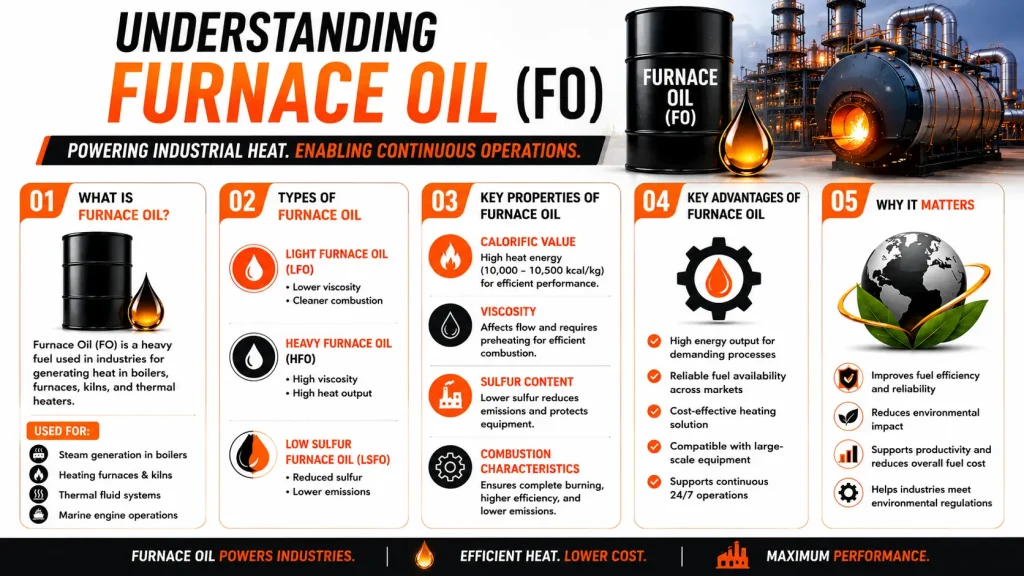
Furnace Oil (FO) remains one of the most widely used industrial fuels for generating heat in boilers, furnaces, kilns, and thermal fluid heaters. Industries prefer furnace oil because it delivers high heat output, supports continuous operations, and often costs less than many alternative fuels.
Produced during the crude oil refining process, furnace oil contains heavier hydrocarbon fractions that provide strong thermal energy during combustion. Its high calorific value, typically ranging from 10,000 to 10,500 kcal/kg, makes it suitable for energy-intensive industries such as steel, cement, textiles, and power generation.
Industries commonly use furnace oil for:
- Steam generation in industrial boilers
- Heating furnaces and kilns
- Thermal fluid heating systems
- Marine engine operations
For example, textile factories use furnace oil-fired boilers to produce steam for dyeing and processing, while cement plants rely on it to maintain high kiln temperatures.
Key advantages of furnace oil include:
- High energy output
- Reliable fuel availability
- Cost-effective industrial heating
- Compatibility with large-scale equipment
However, industries must manage combustion efficiency and emissions carefully to maximize performance and meet environmental regulations
What Is Furnace Oil?
Furnace Oil (FO) is a heavy liquid fuel obtained from the residual fractions of crude oil refining. Refineries produce furnace oil after extracting lighter petroleum products such as gasoline, diesel, and kerosene. Industries use it primarily as a heating fuel because it generates large amounts of thermal energy during combustion.
Furnace oil contains:
- Heavy hydrocarbon compounds
- Carbon-rich fuel molecules
- Sulfur compounds
- Small amounts of ash-forming materials
Its composition allows industries to generate stable and continuous heat for demanding industrial processes.
The primary role of furnace oil in industrial heating includes:
- Producing steam in boilers
- Heating furnaces and kilns
- Operating thermal fluid heaters
- Supporting manufacturing processes
For example, steel manufacturers use furnace oil to heat metal processing furnaces, while food processing plants use it in steam boilers for cooking and sterilization operations.
Several factors make furnace oil popular in industrial heating:
- High calorific value for efficient heat generation
- Reliable performance in large-scale operations
- Lower heating costs compared to some alternative fuels
- Wide availability across industrial markets
Because furnace oil provides consistent thermal energy, industries can maintain production efficiency even during continuous 24-hour operations. However, companies must monitor fuel quality, burner performance, and emissions to achieve optimal results and comply with environmental standards.
Types of Furnace Oil Used in Industries
Industries select different types of furnace oil based on equipment requirements, fuel efficiency goals, environmental regulations, and operating budgets. The most common variants include Light Furnace Oil (LFO), Heavy Furnace Oil (HFO), and Low Sulfur Furnace Oil (LSFO).
| Type | Characteristics | Common Applications |
| Light Furnace Oil (LFO) | Lower viscosity, easier handling, cleaner combustion | Small boilers, textile units, food processing plants |
| Heavy Furnace Oil (HFO) | High viscosity, high heat output, economical for large users | Cement plants, steel mills, marine vessels |
| Low Sulfur Furnace Oil (LSFO) | Reduced sulfur content, lower emissions | Industries with strict environmental requirements |
Light Furnace Oil (LFO)
LFO flows more easily than heavier fuel oils and requires less preheating before combustion. Industries often choose it for smaller heating systems where operational simplicity matters.
Example:
- Textile factories use LFO in steam boilers for consistent heat generation.
Heavy Furnace Oil (HFO)
HFO contains heavier hydrocarbon fractions and delivers excellent thermal energy for large industrial applications. Although it requires preheating before use, many industries choose it because of its cost-effectiveness.
Example:
- Cement manufacturing plants use HFO in kilns that operate at extremely high temperatures.
Low Sulfur Furnace Oil (LSFO)
LSFO helps industries reduce sulfur oxide emissions while maintaining reliable heating performance. Environmental regulations increasingly encourage industries to adopt low-sulfur fuel variants.
Example:
- Manufacturing facilities in regulated industrial zones often switch to LSFO to meet emission standards while maintaining production efficiency.
Key Properties of Furnace Oil
The effectiveness of furnace oil depends on several important physical and chemical properties. These characteristics influence fuel consumption, combustion efficiency, maintenance requirements, and environmental performance.
Calorific Value
Calorific value measures the amount of heat energy produced during combustion. Furnace oil typically delivers around 10,000-10,500 kcal/kg, making it suitable for high-temperature industrial applications.
Example:
- Steel and cement plants depend on high-calorific fuels to maintain continuous production temperatures.
Viscosity
Viscosity indicates how easily the fuel flows. High-viscosity furnace oil often requires preheating to achieve proper atomization and efficient combustion.
Sulfur Content
Sulfur content affects emissions and environmental compliance. Higher sulfur levels can increase sulfur oxide emissions and contribute to equipment corrosion. Many industries now prefer low-sulfur furnace oil to reduce environmental impact.
Combustion Characteristics
Good combustion characteristics ensure complete fuel burning, higher thermal efficiency, and lower smoke generation. Proper burner settings and fuel quality help industries maximize energy output while reducing maintenance costs.
For example, a well-maintained boiler using quality furnace oil can achieve better heat transfer efficiency and lower fuel consumption compared to systems operating with poor combustion conditions.
Used Oil Collection vs Furnace Oil (FO): Core Difference
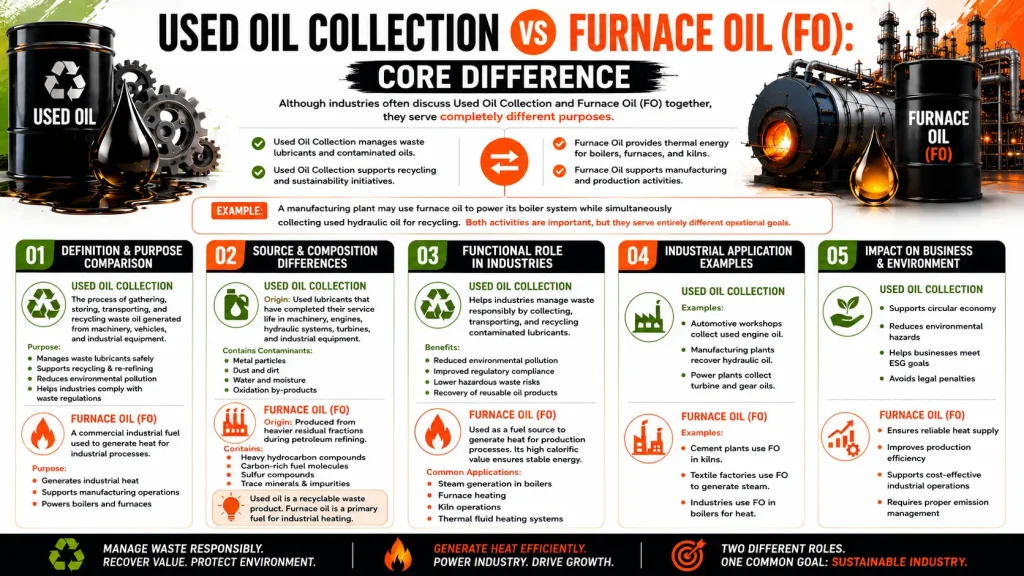
Although industries often discuss Used Oil Collection and Furnace Oil (FO) together, they serve completely different purposes. Used Oil Collection focuses on managing waste oil generated from industrial operations, while Furnace Oil functions as a fuel that produces heat for industrial processes.
Understanding this distinction helps businesses improve both environmental compliance and operational efficiency.
Key differences include:
- Used Oil Collection manages waste lubricants and contaminated oils.
- Furnace Oil provides thermal energy for boilers, furnaces, and kilns.
- Used Oil Collection supports recycling and sustainability initiatives.
- Furnace Oil supports manufacturing and production activities.
For example, a manufacturing plant may use furnace oil to power its boiler system while simultaneously collecting used hydraulic oil for recycling. Both activities are important, but they serve entirely different operational goals.
Definition and Purpose Comparison
At first glance, Used Oil Collection and Furnace Oil may appear related because both involve petroleum-based products. However, their purpose, application, and industrial value differ significantly.
Used Oil Collection refers to the process of gathering, storing, transporting, and recycling waste oil generated from machinery, vehicles, turbines, and industrial equipment. Its primary goal focuses on environmental protection, resource recovery, and regulatory compliance.
Furnace Oil (FO) is a commercial industrial fuel used to generate heat for production processes. Industries burn furnace oil in boilers, furnaces, kilns, and thermal fluid heaters to produce thermal energy.
The primary purposes differ in several ways:
Used Oil Collection
- Manages waste lubricants safely
- Supports recycling and re-refining
- Reduces environmental pollution
- Helps industries comply with waste regulations
Furnace Oil
- Generates industrial heat
- Supports manufacturing operations
- Powers boilers and furnaces
For example, an automotive workshop collects used engine oil after servicing vehicles, while a textile factory burns furnace oil to generate steam for fabric processing.
Source and Composition Differences
Used Oil Collection and Furnace Oil differ significantly in both origin and composition. Understanding these differences helps industries make informed decisions regarding fuel management, recycling, and environmental compliance.
Used oil originates from lubricants that have already completed their service life in machinery, engines, hydraulic systems, turbines, and industrial equipment. During operation, these oils accumulate contaminants such as:
- Metal particles
- Dust and dirt
- Water and moisture
- Oxidation by-products
For example, hydraulic oil from a manufacturing machine gradually degrades after continuous operation and eventually becomes classified as used oil.
In contrast, Furnace Oil comes directly from petroleum refining processes. Refineries produce furnace oil from heavier residual fractions that remain after extracting lighter fuels such as petrol, diesel, and kerosene.
Furnace oil typically contains:
- Heavy hydrocarbon compounds
- Carbon-rich fuel molecules
- Sulfur compounds
- Trace minerals and impurities
Industry reports estimate that used oil can often be re-refined and reused multiple times, reducing dependence on virgin petroleum resources. Furnace oil, however, serves as a primary energy source and undergoes combustion to generate heat.
Simply put, used oil begins as a lubricant and becomes a recyclable waste product, while furnace oil starts as a fuel specifically designed for industrial heating applications.
Functional Role in Industries
Used Oil Collection and Furnace Oil perform very different functions within industrial operations. One focuses on sustainability and waste management, while the other supports energy production and manufacturing efficiency.
Used Oil Collection helps industries manage waste responsibly by collecting, transporting, and recycling contaminated lubricants. This process reduces environmental risks and allows companies to recover valuable resources through re-refining.
Benefits of used oil collection include:
- Reduced environmental pollution
- Improved regulatory compliance
- Lower hazardous waste risks
- Recovery of reusable oil products
For example, a manufacturing facility can send used hydraulic oil to a re-refining plant instead of disposing of it as waste.
Furnace Oil plays a completely different role. Industries use it as a fuel source to generate heat for production processes. Its high calorific value makes it suitable for continuous industrial operations that require stable thermal energy.
Common applications include:
- Steam generation in boilers
- Furnace heating
- Kiln operations
- Thermal fluid heating systems
For example, a cement plant uses furnace oil to maintain kiln temperatures, while a textile factory uses it to generate steam for dyeing processes.
Conclusion
Used Oil Collection and Furnace Oil (FO) serve two very different but equally important functions in industrial operations. While furnace oil provides the thermal energy required to power boilers, furnaces, and production systems, used oil collection focuses on managing waste lubricants responsibly through recycling and re-refining. Together, they play a vital role in maintaining efficient, compliant, and sustainable industrial processes. Industries that optimize furnace oil consumption can reduce fuel costs, improve combustion efficiency, and enhance equipment performance. At the same time, proper used oil collection helps prevent environmental contamination, supports resource recovery, and ensures compliance with environmental regulations.
FAQ
1.What is the difference between used oil collection and furnace oil?
Used oil collection is a waste management and recycling process, while furnace oil is an industrial fuel used for heat generation.
2.Why is proper used oil collection important?
It prevents environmental pollution, supports recycling, and ensures regulatory compliance.
3.Can used oil be converted into industrial fuel?
Yes, re-refining and processing technologies can convert certain waste oils into reusable industrial fuels.
4.What industries use furnace oil the most?
Manufacturing plants, power stations, metal processing industries, and boilers commonly use furnace oil.
5.Is furnace oil environmentally harmful?
Furnace oil can produce sulfur emissions and particulate pollution if not properly managed.
6.What happens if industries dispose of used oil improperly?
Improper disposal can lead to soil contamination, water pollution, legal penalties, and environmental damage.
7.How can industries reduce furnace oil consumption?
Industries can improve burner efficiency, optimize combustion systems, and maintain equipment regularly.
8.Are there regulations for used oil disposal in India?
Yes, industries must follow hazardous waste management and pollution control regulations.
9.What are the benefits of recycling used oil?
Recycling reduces waste, conserves resources, lowers environmental impact, and supports sustainable industrial practices.
10.How do industries choose a reliable used oil collection company?
They should check certifications, compliance records, transportation safety, and recycling capabilities.