

Furnace Oil vs Diesel: Which Fuel Saves More Industrial Costs?
Introduction
Choosing the right industrial fuel can significantly impact operating costs, energy efficiency, and environmental compliance. When comparing furnace oil vs diesel, businesses often face a difficult decision: should they prioritize lower fuel costs or cleaner combustion and easier handling? The answer depends on factors such as fuel consumption, equipment compatibility, maintenance requirements, and long-term operational goals.
According to the International Energy Agency (IEA), gas/diesel oil accounted for approximately 32% of global oil product consumption in 2023, making it the world’s most widely used oil product. Meanwhile, residual fuel oils, including furnace oil, continue to play a vital role in industrial heating and boiler operations due to their cost advantages.
In this guide, we’ll compare furnace oil vs diesel across cost, efficiency, emissions, storage, and industrial applications to help you determine which fuel delivers the best value for your business.
Difference Between Furnace oil vs Diesel
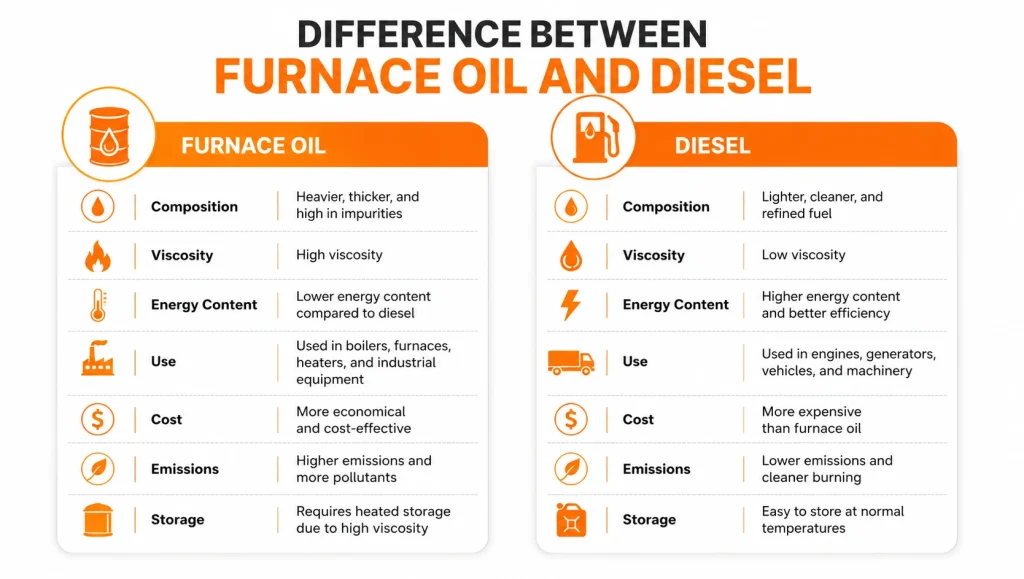
Although furnace oil vs diesel originate from crude oil, they serve different industrial purposes. The biggest difference lies in their composition, handling requirements, efficiency, and operating costs. Businesses often compare these fuels when selecting an energy source for boilers, furnaces, generators, or manufacturing plants.
Furnace oil is a heavy residual fuel that remains after refiners extract lighter petroleum products such as gasoline and diesel. It contains larger hydrocarbon molecules, which give it a thicker consistency. Diesel, on the other hand, comes from the middle-distillate fraction of crude oil and offers a cleaner and lighter fuel option.
Key differences include:
- Viscosity: Furnace oil is significantly thicker than diesel.
- Storage Requirements: Furnace oil often requires heating before pumping and combustion.
- Combustion Quality: Diesel burns cleaner and produces fewer emissions.
- Operating Cost: Furnace oil generally costs less per liter than diesel.
- Maintenance Needs: Furnace oil systems require more frequent cleaning due to higher residue formation.
- Applications: Industries commonly use furnace oil in boilers and furnaces, while diesel powers generators, vehicles, and industrial equipment.
Composition and Refining Process
The refining process creates one of the most significant differences between furnace oil vs diesel. Both fuels start as crude oil, but refiners separate them at different stages of the distillation process.
Diesel comes from the middle portion of the refining column. Refiners further process and treat it to remove impurities and reduce sulfur levels. As a result, diesel delivers cleaner combustion and better engine performance.
Furnace oil follows a different path. After refiners extract lighter fuels such as gasoline, kerosene, and diesel, the heavier residual fractions remain. Manufacturers blend and process these residues to create various grades of furnace oil vs diesel.
Viscosity and Flow Characteristics
Viscosity measures a fuel’s resistance to flow. This property plays a critical role in fuel handling, storage, pumping, and combustion performance. Furnace oil and diesel differ significantly in this area.
| Property | Furnace Oil | Diesel |
| Viscosity | High | Low |
| Flow Rate | Slower | Faster |
| Pumping Requirement | Often requires heating | No heating required |
| Storage Handling | More complex | Simpler |
| Atomization Quality | Lower without preheating | Excellent |
| Cold Weather Performance | Limited | Better |
Furnace oil’s thick consistency makes it difficult to pump at normal temperatures. Many industrial facilities heat furnace oil before transferring it through pipelines or injecting it into burners. This heating process reduces viscosity and improves combustion efficiency.
Diesel flows easily even at relatively low temperatures. Operators can store, transport, and use diesel without specialized heating systems. This advantage reduces operational complexity and startup time.
For instance, a manufacturing plant using furnace oil may maintain heated storage tanks and fuel lines to ensure continuous fuel flow. A diesel-powered generator can start immediately because diesel reaches injectors quickly without additional preparation.
Higher viscosity also affects atomization. When fuel enters a burner, it must break into fine droplets for efficient combustion. Diesel atomizes more effectively, resulting in cleaner burning and lower emissions. Furnace oil requires preheating to achieve similar performance.
Energy Content and Calorific Value
Energy content, often expressed as calorific value, indicates how much heat a fuel produces during combustion. Businesses use this metric to evaluate fuel efficiency and operating costs.
Both furnace oil vs diesel provide substantial energy output, but their values differ slightly depending on fuel grade and composition. In general, diesel offers a calorific value of approximately 42- 46 MJ/kg, while furnace oil typically ranges between 40 – 45 MJ/kg.
Consider the following comparison:
- Diesel: High energy density and efficient combustion
- Furnace Oil: Strong heat output for industrial heating applications
- Diesel: Better fuel-air mixing due to lower viscosity
- Furnace Oil: Cost-effective for continuous thermal operations
For example, a diesel generator converts fuel energy into electricity with high combustion efficiency. The refined nature of diesel supports rapid ignition and complete burning.
On the other hand, a large industrial boiler in a cement or textile plant may operate efficiently with furnace oil because the system prioritizes sustained heat production over rapid combustion. Even if furnace oil delivers slightly lower calorific value in some grades, its lower purchase cost often offsets the difference.
Suppose a factory consumes thousands of liters of fuel daily. In that case, fuel cost per unit of heat generated becomes more important than calorific value alone. This factor explains why many energy-intensive industries continue to use furnace oil despite diesel’s cleaner combustion characteristics.
When evaluating fuel options, businesses should consider both calorific value and total operating cost to determine the most economical solution.
Environmental Impact of Furnace oil vs Diesel
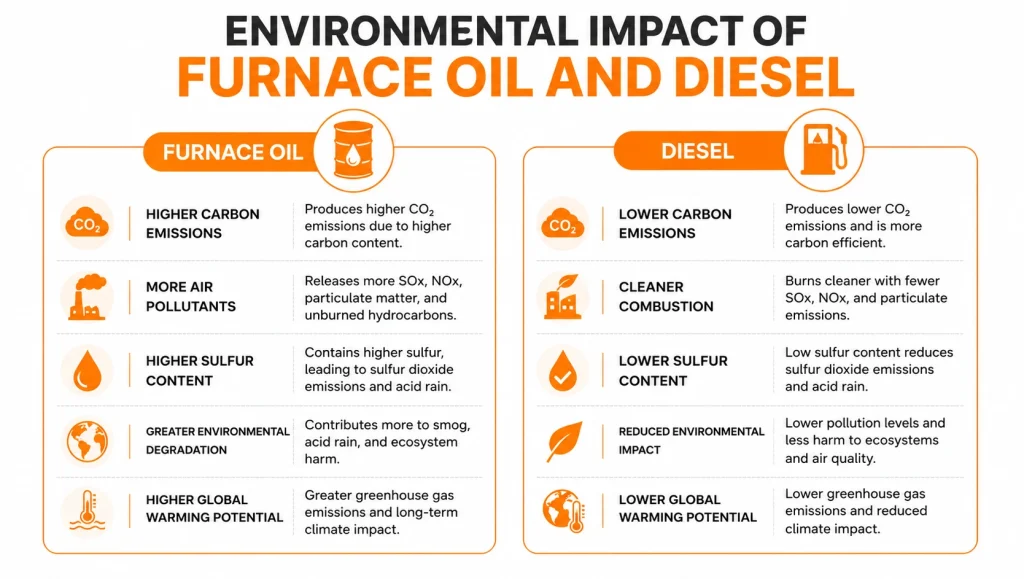
Environmental performance plays a major role when businesses compare furnace oil vs diesel. Both fuels generate energy efficiently, but they affect air quality and carbon emissions differently. Furnace oil typically contains higher sulfur levels and heavier hydrocarbons, which can increase particulate matter and sulfur oxide emissions during combustion. Diesel, on the other hand, burns more cleanly and produces fewer visible pollutants.
Industries that rely on boilers, furnaces, and generators must balance fuel costs with environmental responsibilities. Governments across the world continue to tighten emission standards to reduce industrial pollution. As a result, many companies now evaluate fuel choices based on both operational efficiency and sustainability goals.
Emission Levels Comparison
Emission levels represent one of the biggest differences between furnace oil vs diesel. Diesel generally produces cleaner exhaust gases, while furnace oil generates higher levels of pollutants due to its heavier composition.
Key emission differences include:
- Sulfur Oxides (SOx): Furnace oil often contains more sulfur, leading to higher SOx emissions.
- Particulate Matter (PM): Furnace oil combustion releases more soot and fine particles.
- Carbon Dioxide (CO₂): Both fuels emit CO₂, but combustion efficiency influences total emissions.
- Nitrogen Oxides (NOx): Diesel engines and burners can produce NOx, although modern emission-control systems help reduce these levels.
- Smoke Emissions: Furnace oil typically creates more visible smoke compared to diesel.
Regulatory Compliance Considerations
Industrial furnace oil vs diesel facilities must comply with environmental regulations that control emissions, fuel quality, and operational safety. The choice between furnace oil and diesel directly affects compliance requirements.
| Compliance Factor | Furnace Oil | Diesel |
| Sulfur Regulations | Often subject to stricter limits | Easier compliance with low-sulfur grades |
| Air Pollution Control | May require additional scrubbers and filters | Lower emission-control requirements |
| Emission Monitoring | More frequent monitoring in some industries | Generally simpler monitoring processes |
| Environmental Reporting | Higher scrutiny in regulated sectors | Often easier to manage |
| Future Sustainability Goals | May require fuel upgrades | Better alignment with carbon reduction initiatives |
For example, power plants and manufacturing facilities often install emission-control equipment when using furnace oil vs diesel
to meet local air-quality standards. Diesel-powered systems usually face fewer challenges because cleaner-burning fuel reduces pollutant output.
Sustainable Fuel Alternatives
As industries focus on reducing environmental impact, many organizations explore alternatives to traditional furnace oil vs diesel. These options help lower emissions while supporting long-term sustainability goals.
Popular alternatives include:
Biodiesel
- Produced from vegetable oils, animal fats, or recycled cooking oil.
- Can reduce lifecycle greenhouse gas emissions significantly.
- Works with many existing diesel systems.
Renewable Diesel
- Offers performance similar to conventional diesel.
- Produces lower emissions.
- Requires minimal equipment modifications.
Natural Gas
- Burns cleaner than both furnace oil and diesel.
- Produces lower sulfur and particulate emissions.
- Commonly used in modern industrial boilers.
Biomass Fuel
- Uses agricultural waste, wood pellets, or organic materials.
- Supports renewable energy initiatives.
- Suitable for specific industrial applications.
For instance, several food-processing plants have switched from furnace oil vs diesel to natural gas to reduce emissions and improve compliance. Similarly, logistics companies increasingly use biodiesel blends to lower their carbon footprint without replacing existing diesel engines.
Businesses that evaluate sustainable fuel alternatives today can reduce future compliance risks, strengthen environmental credentials, and support global decarbonization efforts while maintaining reliable operations.
Factors to Consider Before Choosing Between Furnace oil vs Diesel
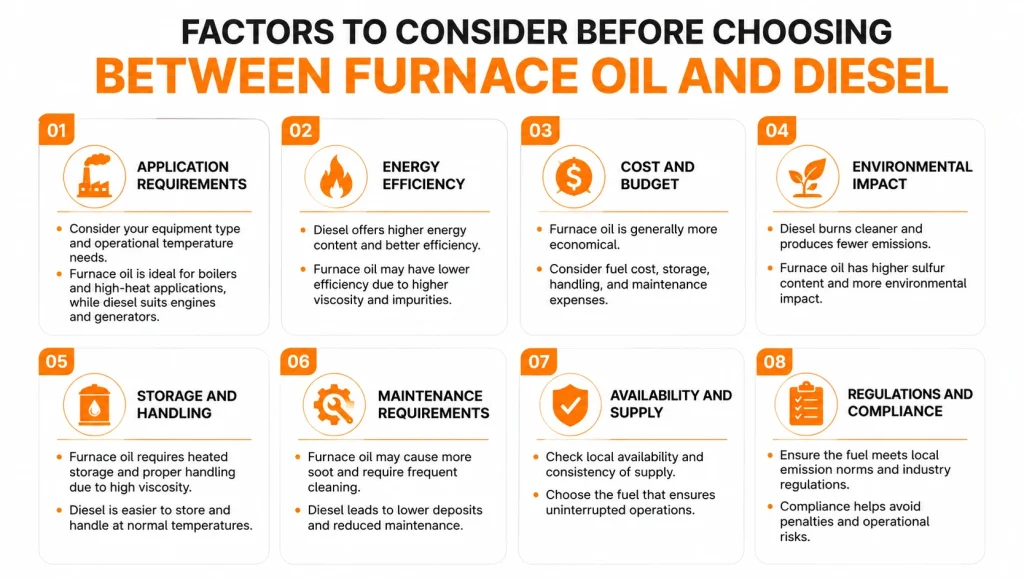
Selecting between furnace oil vs diesel involves more than comparing fuel prices. Businesses must evaluate several operational and financial factors to identify the most cost-effective solution. A poor fuel choice can increase maintenance costs, reduce efficiency, and create compliance challenges.
One of the first considerations is equipment compatibility. Some industrial boilers and burners operate efficiently with furnace oil, while others perform better with diesel. Converting equipment from one fuel type to another may require modifications and additional investment.
Environmental regulations also play a major role. Industries operating in regions with strict emission standards often prefer low-sulfur diesel because it produces fewer pollutants. Companies that use furnace oil may need extra emission-control systems to meet regulatory requirements.
Operational requirements should also influence the decision. Facilities that run continuously often choose furnace oil due to its lower cost per unit of heat generated. In contrast, businesses that need quick startup, flexible operation, or backup power frequently select diesel.
Industry studies suggest that fuel expenses can account for 30% – 60% of total operating costs in energy-intensive industries. Therefore, even small improvements in fuel efficiency can create significant long-term savings. By assessing equipment needs, environmental obligations, fuel availability, and operational goals, businesses can make a fuel choice that supports both profitability and sustainability.
Equipment Compatibility
Equipment compatibility directly affects the performance and efficiency of industrial fuel systems. Before choosing between furnace oil and diesel, businesses should verify whether their boilers, furnaces, generators, and burners support the selected fuel.
Important compatibility factors include:
- Burner Design: Furnace oil requires specialized burners capable of handling higher viscosity fuel.
- Fuel Heating Systems: Many furnace oil installations need preheating equipment to improve fuel flow and combustion.
- Storage Infrastructure: Furnace oil often requires heated storage tanks, while diesel remains easier to store and transport.
- Maintenance Requirements: Furnace oil can leave more deposits, increasing cleaning and maintenance frequency.
- Fuel Conversion Costs: Switching from furnace oil to diesel or vice versa may require burner upgrades and pipeline modifications.
Environmental Regulations
Environmental regulations increasingly influence industrial fuel decisions. Governments worldwide continue to introduce stricter standards to reduce air pollution, greenhouse gas emissions, and public health risks. Businesses must understand how different fuels affect regulatory compliance.
| Regulatory Area | Furnace Oil | Diesel |
| Sulfur Emissions | Higher compliance requirements | Easier compliance with low-sulfur grades |
| Particulate Matter | Higher particulate emissions | Lower particulate emissions |
| Air Quality Standards | May require additional control equipment | Often easier to meet standards |
| Emission Monitoring | More frequent monitoring in some sectors | Simpler monitoring procedures |
| Sustainability Targets | Greater challenges in achieving targets | Better support for emission-reduction goals |
For example, an industrial plant located near urban areas may face strict air-quality regulations. Using low-sulfur diesel can help reduce sulfur oxide and particulate emissions, making compliance easier. A facility operating on furnace oil may need scrubbers, filters, or upgraded burners to achieve similar results.
Operational Requirements
Operational requirements often determine whether furnace oil vs diesel delivers better value. Businesses should evaluate how they use fuel daily rather than focusing only on purchase price.
Facilities with continuous heating demands often favor furnace oil vs diesel because it offers lower fuel costs for large-scale operations. Industries such as textiles, chemicals, and food processing frequently use furnace oil in boilers that operate around the clock.
Diesel suits applications that require flexibility and quick response times. For example, hospitals, data centers, and commercial buildings rely on diesel generators because they start rapidly during power outages. Diesel also works well for equipment that operates intermittently.
Consider these operational factors:
- Required startup speed
- Daily fuel consumption
- Equipment operating hours
- Maintenance schedules
- Fuel storage capacity
- Reliability requirements
For instance, a manufacturing facility operating 24 hours a day may achieve significant fuel savings with furnace oil vs diesel. In contrast, a construction site running generators intermittently often benefits more from diesel’s convenience and ease of handling.
When businesses align fuel selection with operational needs, they improve efficiency, reduce downtime, and optimize long-term operating costs. A practical assessment of daily operations often reveals which fuel provides the greatest overall value.
Conclusion:
When comparing furnace oil vs diesel, there is no one-size-fits-all solution. The right choice depends on your industry’s fuel consumption, equipment requirements, operating budget, and environmental obligations. Furnace oil often provides lower fuel costs and works well for continuous industrial heating applications, making it a popular choice for manufacturing and processing industries.
Diesel, on the other hand, offers cleaner combustion, easier storage, quick startup, and better compliance with modern emission standards. It is ideal for generators, backup power systems, and operations that require flexibility and reliability.
Before making a decision, businesses should evaluate total operating costs, including fuel efficiency, maintenance requirements, emission-control expenses, and regulatory compliance. While furnace oil may offer immediate cost savings, diesel can reduce maintenance and environmental challenges over time. By carefully assessing operational needs and long-term goals, companies can select the fuel that delivers the best balance of cost, performance, and sustainability.
FAQs:
1. Which is cheaper, furnace oil or diesel?
Furnace oil is generally cheaper than diesel, making it a cost-effective choice for industries with high fuel consumption.
2. Which fuel is more efficient for industrial boilers?
Both fuels offer good efficiency, but the best option depends on the boiler design, operating conditions, and maintenance practices.
3. Does furnace oil produce more emissions than diesel?
Yes. Furnace oil typically produces higher sulfur oxide and particulate emissions than low-sulfur diesel.
4. Can diesel be used instead of furnace oil in a boiler?
Yes, many boilers can operate on diesel, although some systems may require burner adjustments or modifications.
5. Which fuel requires more maintenance?
Furnace oil generally requires more maintenance because it can leave deposits and residues in burners and fuel systems.
6. Is diesel better for backup generators?
Yes. Diesel provides quick startup, reliable performance, and easier storage, making it ideal for backup power systems.
7. What industries commonly use furnace oil?
Textile, chemical, food processing, manufacturing, and large-scale heating industries commonly use furnace oil.
8. How does fuel choice affect operating costs?
Fuel choice impacts fuel expenses, maintenance costs, equipment efficiency, and environmental compliance costs.
9. Are there environmental regulations for using furnace oil?
Yes. Many regions regulate sulfur content, emissions, and air quality standards for industries using furnace oil.
10. How do I choose between furnace oil and diesel?
Consider fuel costs, equipment compatibility, operational requirements, environmental regulations, and long-term business goals before making a decision.