

Industrial Heating Fuel Comparison: Which Fuel Performs Best?
Introduction
Selecting the right industrial heating fuel is no longer just about keeping operations running it directly affects production costs, energy efficiency, equipment life, and environmental compliance. This Industrial Heating Fuel Comparison guide helps industries evaluate fuel costs, efficiency, emissions, and long-term operational performance. An Industrial Heating Fuel Comparison helps manufacturers identify the most suitable fuel for their specific production requirements. According to the International Energy Agency (IEA), the industrial sector accounts for nearly 40% of global energy demand, with most energy consumed for high-temperature heating processes. Rising fuel prices, stricter emission regulations, and increasing maintenance expenses are forcing industries to rethink their fuel strategies. Choosing the wrong fuel can lead to excessive downtime, higher combustion losses, equipment damage, and unstable production output.
What Is Industrial Heating Fuel?
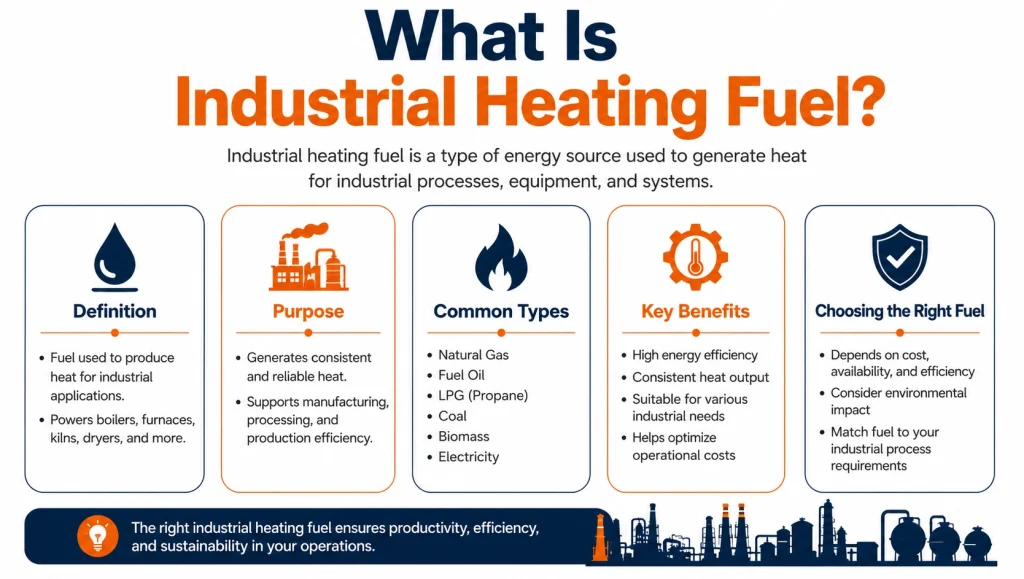
Industrial heating fuel refers to the energy source industries use to generate heat for boilers, furnaces, kilns, generators, and manufacturing equipment. These fuels power critical industrial operations such as steam generation, metal processing, chemical production, textile manufacturing, and food processing.Industries rely heavily on heating fuels because thermal energy drives most large-scale production systems. According to the International Energy Agency (IEA), industrial heating accounts for a major share of global industrial energy consumption, especially in high-temperature manufacturing sectors.
Common industrial heating fuels include:
- Furnace Oil (FO) – Widely used in boilers and heavy heating applications
- Light Diesel Oil (LDO) – Suitable for smaller industrial burners and generators
- Natural Gas – Cleaner-burning fuel with high combustion efficiency
- LPG – Popular for flexible industrial heating systems
- Coal – Used in large-scale cement and steel industries
- Biomass Fuel – Renewable option made from agricultural and organic waste
For example, textile factories often use furnace oil for steam boilers, while food processing plants prefer natural gas because it produces cleaner combustion. Choosing the right industrial heating fuel helps businesses reduce operating costs, improve energy efficiency, maintain production stability, and meet environmental regulations. Understanding fuel characteristics is the first step in conducting an effective Industrial Heating Fuel Comparison.
Definition of Industrial Heating Fuel
Industrial heating fuel refers to combustible energy sources industries use to generate heat for production processes, machinery operation, and thermal systems. These fuels supply the thermal energy required to run boilers, furnaces, heaters, kilns, ovens, and steam generation systems across multiple industries.
Common industrial heating fuels include:
- Furnace Oil (FO) – Used in industrial boilers and large heating systems
- Light Diesel Oil (LDO) – Suitable for small furnaces, burners, and generators
- Natural Gas – Preferred for clean combustion and higher efficiency
- LPG (Liquefied Petroleum Gas) – Common in flexible heating applications
For example:
- Textile industries use furnace oil boilers to generate steam for fabric processing
- Food manufacturing plants often choose natural gas because it burns cleaner
- Cement factories rely on coal-fired kilns to maintain extremely high temperatures
- Chemical industries use thermal heaters powered by diesel or gas fuels
Why Fuel Selection Matters in Industrial Operations
A detailed Industrial Heating Fuel Comparison helps businesses select the most cost-effective and reliable heating solution.Fuel selection directly affects industrial productivity, operating costs, equipment performance, and environmental compliance. Choosing the wrong fuel can increase fuel consumption, damage equipment, create production delays, and raise maintenance expenses. Industries that select efficient heating fuels often achieve better thermal performance and lower long-term operating costs.
- Fuel price and long-term operating cost
- Heat generation efficiency
- Equipment maintenance requirements
- Emission control compliance
The International Energy Agency (IEA) reports that improving industrial energy efficiency can reduce energy costs by up to 20% in many manufacturing sectors. This makes fuel selection a major strategic decision for industries operating boilers, furnaces, kilns, and thermal systems.
| Factor | Why It Matters | Example Impact |
| Cost Efficiency | Reduces operational expenses | Furnace oil lowers fuel cost in large boilers |
| Heat Output | Improves combustion performance | Natural gas provides faster and cleaner heat |
| Maintenance Impact | Reduces equipment wear and downtime | Cleaner fuels create fewer carbon deposits |
| Environmental Regulations | Helps industries meet emission standards | Low-sulfur fuels reduce pollution levels |
| Energy Reliability | Ensures uninterrupted production | Diesel offers backup reliability during gas shortages |
Industries That Depend on Heating Fuels
Many industries rely heavily on industrial heating fuels to maintain continuous production, generate steam, process raw materials, and operate high-temperature equipment. Without reliable heating fuel, large-scale manufacturing operations would face delays, equipment inefficiency, and rising operational costs. An Industrial Heating Fuel Comparison helps manufacturers identify the most suitable fuel for their specific production requirements.
Some of the major industries that depend on heating fuels include:
- Manufacturing Industry – Factories use boilers, furnaces, and thermal heaters for production processes and machinery operation.
- Textile Industry – Textile plants require steam boilers for dyeing, drying, washing, and fabric finishing processes. Furnace oil and natural gas remain common choices.
- Food Processing Industry – Food manufacturers use clean-burning fuels like LPG and natural gas for baking, sterilization, steaming, and packaging operations.
- Chemical Plants – Chemical industries depend on precise temperature control for reactions, distillation, and processing systems.
- Cement Industry – Cement plants use coal and alternative fuels in kilns operating at extremely high temperatures.
Types of Industrial Heating Fuels
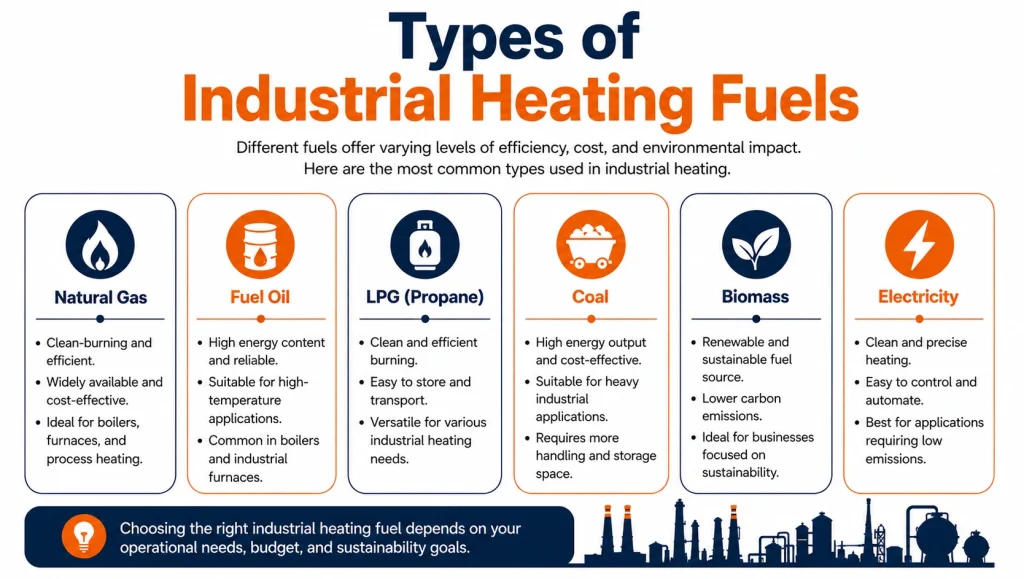
Industries use different types of heating fuels based on heat requirements, operating costs, combustion efficiency, and environmental regulations. Each fuel offers unique advantages for boilers, furnaces, kilns, generators, and thermal heating systems. When conducting an industrial heating fuel comparison, industries must consider calorific value and combustion efficiency. This Industrial Heating Fuel Comparison examines the advantages and limitations of the most commonly used industrial fuels. A comprehensive Industrial Heating Fuel Comparison allows industries to compare fuel performance, operating costs, and environmental impact.
Some of the most commonly used industrial heating fuels include:
- Furnace Oil (FO) – A cost-effective fuel widely used in boilers, furnaces, and large industrial heating applications. Industries prefer furnace oil for continuous high-temperature operations.
- Light Diesel Oil (LDO) – Suitable for smaller boilers, burners, and backup heating systems because it ignites quickly and burns efficiently.
- Natural Gas -One of the cleanest industrial fuels. It produces lower emissions, cleaner combustion, and reduced maintenance costs.
- LPG (Liquefied Petroleum Gas) – Popular in food processing and small manufacturing units because it offers flexible storage and cleaner burning.
- Coal – Common in cement plants, steel industries, and power-intensive operations that require extremely high heat output.
- Biomass Fuel – Renewable fuel made from agricultural waste, wood chips, and organic materials. Many industries adopt biomass to reduce carbon emissions.
Furnace Oil (FO)
Furnace Oil (FO) is a heavy industrial fuel widely used for large-scale heating applications. Industries choose furnace oil because it delivers high heat output at a lower operating cost compared to lighter fuels like diesel. It works especially well in boilers, furnaces, thermic fluid heaters, and industrial kilns that require continuous high-temperature operation. In an Industrial Heating Fuel Comparison, furnace oil is often chosen for its high heat output and lower operating cost. In any Industrial Heating Fuel Comparison, furnace oil remains a popular option for high-temperature industrial applications.
Furnace oil offers several important characteristics:
- High calorific value for strong heat generation
- Thick and viscous composition
- Cost-effective for bulk industrial consumption
- Suitable for high-capacity thermal systems
Many industries rely on furnace oil for daily operations, including:
- Textile factories for steam generation
- Chemical plants for thermal processing
- Paper mills for drying systems
- Food processing units for industrial boilers
Furnace oil provides strong heating efficiency because it generates a large amount of thermal energy per unit. Efficient burner tuning and proper combustion control can further improve fuel performance and reduce wastage.
Light Diesel Oil (LDO)
Light Diesel Oil (LDO) is a medium-viscosity industrial fuel commonly used in small and medium-scale industrial heating systems. Industries prefer LDO because it ignites easily, burns cleaner than heavier fuels, and requires less preheating. It performs well in boilers, furnaces, generators, thermic fluid heaters, and small industrial burners. Many industries include LDO in their Industrial Heating Fuel Comparison because of its cleaner combustion and lower maintenance requirements. An Industrial Heating Fuel Comparison often shows that LDO provides a balance between combustion efficiency and maintenance costs.
LDO offers several practical features that make it suitable for smaller operations:
- Lower sulfur content compared to furnace oil
- Faster ignition and smoother combustion
- Reduced carbon deposits in equipment
- Easier storage and handling
Small manufacturing units, textile workshops, bakeries, food processing plants, and commercial heating systems often choose LDO for reliable daily operations. For example, small textile dyeing units use LDO-fired boilers because they provide stable steam generation with lower maintenance downtime.
| Feature | Light Diesel Oil (LDO) Benefit |
| Combustion Quality | Cleaner and more efficient burning |
| Equipment Maintenance | Fewer deposits and easier cleaning |
| Operational Flexibility | Suitable for smaller boilers and heaters |
| Fuel Handling | Easier storage and transportation |
| Startup Performance | Quick ignition during operation |
LDO may cost more than furnace oil, but many industries accept the higher price because cleaner combustion reduces maintenance expenses and improves equipment lifespan. Industries with moderate heating requirements often select LDO to balance fuel efficiency, operational reliability, and maintenance control.
Industrial Diesel Oil (IDO)
Industrial Diesel Oil (IDO) is a versatile fuel widely used in industrial generators, burners, boilers, and heavy machinery. Industries choose IDO because it delivers reliable combustion performance, stable energy output, and efficient operation across different industrial applications. Compared to heavier fuels, IDO burns more efficiently and supports faster equipment startup. An Industrial Heating Fuel Comparison often highlights IDO for its reliable performance in generators and heating equipment.
IDO offers several performance benefits for industrial operations:
- High combustion efficiency for steady heat generation
- Faster ignition and smoother burner operation
- Lower residue formation compared to heavy oils
- Reliable performance in continuous operations
Many industries use IDO in backup power systems and industrial heating equipment because it responds quickly during power fluctuations or peak production periods.
Common applications of IDO include:
- Industrial diesel generators
- Thermic fluid heaters
- Industrial burners and furnaces
- Construction and mining equipment
Industries value IDO because it combines operational flexibility with dependable energy performance. In sectors where uninterrupted production matters, reliable fuel supply becomes critical. Even though IDO usually costs more than furnace oil, many industries prefer it because efficient combustion reduces maintenance issues and minimizes equipment wear. Many businesses conduct an Industrial Heating Fuel Comparison before selecting IDO for generators and thermal heating systems.
Key Factors in Industrial Heating Fuel Comparison
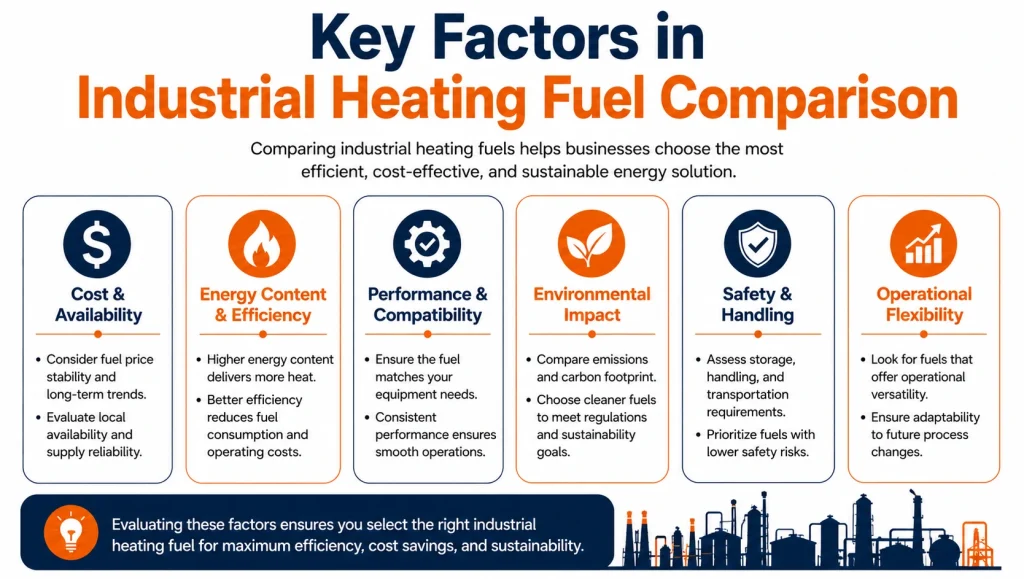
A successful Industrial Heating Fuel Comparison evaluates cost, efficiency, maintenance requirements, emissions, and fuel availability. Choosing the right fuel directly affects production performance, equipment lifespan, and long-term profitability. A fuel that appears cheaper initially may increase maintenance costs or reduce combustion efficiency over time.
Before selecting an industrial heating fuel, companies usually evaluate several important factors:
- Fuel Cost – Daily operating expenses and long-term fuel pricing
- Combustion Efficiency -Ability to generate maximum heat with minimum fuel wastage
- Calorific Value – Total energy produced per unit of fuel
- Equipment Compatibility – Suitability for boilers, burners, furnaces, and heaters
Fuel Cost and Availability
Fuel cost remains one of the most important factors in industrial heating fuel comparison. Even small fluctuations in fuel prices can significantly affect industrial operating expenses, especially in energy-intensive sectors such as steel, cement, chemicals, and manufacturing. Fuel pricing remains one of the most important considerations in any Industrial Heating Fuel Comparison.
Important cost-related factors include:
- Market Price Fluctuations – Global crude oil prices, seasonal demand, and geopolitical events directly affect fuel rates
- Transportation Costs – Long-distance fuel delivery increases operational expenses
- Storage Infrastructure – Some fuels require heated tanks, pressure systems, or specialized storage facilities
- Regional Accessibility – Fuel availability differs across industrial zones and regions
For example:
- Natural gas remains cost-effective in areas with strong pipeline infrastructure
- Furnace oil works well for large industries with bulk storage capacity
- LPG becomes practical in smaller operations where pipeline gas is unavailable
- Biomass fuel may reduce costs in agricultural regions with easy raw material access
According to industrial energy studies, fuel expenses can account for a major share of manufacturing operating costs in thermal-intensive industries. Reliable fuel availability also prevents production interruptions and downtime. Industries therefore focus on balancing fuel affordability, stable supply, and transportation efficiency when selecting industrial heating fuels.
Combustion Efficiency
Combustion efficiency measures how effectively a fuel converts energy into usable heat. Higher combustion efficiency allows industries to generate more thermal energy while consuming less fuel. This directly reduces operating costs, fuel wastage, and emissions. Combustion efficiency is a major factor in every Industrial Heating Fuel Comparison because it directly affects fuel consumption.
Several factors influence combustion efficiency:
- Fuel quality and composition
- Burner performance
- Air-to-fuel ratio
- Heat transfer capability
Natural gas usually delivers higher combustion efficiency because it burns cleaner and mixes easily with air. Furnace oil and coal may produce strong heat output, but improper combustion can create soot and carbon deposits that reduce efficiency.
Industries often monitor combustion efficiency to:
- Reduce fuel consumption
- Improve heat generation
- Lower maintenance costs
Calorific Value Comparison
Calorific value refers to the amount of heat energy a fuel releases during complete combustion. Industries use calorific value as a key benchmark when comparing heating fuels because it directly affects heat generation, fuel consumption, and operating efficiency. In simple terms, fuels with higher calorific values can produce more heat from a smaller quantity of fuel. Calorific value plays a critical role in an Industrial Heating Fuel Comparison because it determines heat generation capacity.
Different industrial fuels offer varying energy outputs:
- Furnace Oil (FO): Typically provides 10,000–10,500 kcal/kg, making it suitable for high-temperature industrial applications.
- Light Diesel Oil (LDO): Usually delivers 10,200–10,800 kcal/kg and offers efficient combustion in boilers and burners.
- Natural Gas: Produces approximately 8,000–9,500 kcal/m³ while maintaining clean and efficient combustion.
- Coal: Generally ranges between 4,000–7,000 kcal/kg, depending on the coal grade and quality.
A higher calorific value often helps industries:
- Generate more heat with less fuel consumption
- Improve boiler and furnace efficiency
- Reduce overall fuel procurement costs
- Maintain stable production temperatures
Conclusion
This Industrial Heating Fuel Comparison demonstrates that fuel selection directly impacts operational efficiency, maintenance costs, and environmental performance. Throughout this industrial heating fuel comparison, we explored how fuels such as furnace oil, LDO, IDO, natural gas, LPG, coal, and biomass differ in cost, combustion efficiency, calorific value, emissions, and industrial applications. This Industrial Heating Fuel Comparison highlights the strengths and limitations of each fuel used in industrial heating operations.
FAQs
1. What is the most efficient industrial heating fuel?
Natural gas is generally the most efficient industrial heating fuel due to its clean combustion and high energy efficiency.
2. Which industrial fuel is the cheapest for boilers?
Furnace oil is often the most cost-effective fuel for large industrial boiler operations.
3. Is natural gas better than furnace oil?
Natural gas offers cleaner combustion and lower maintenance, while furnace oil typically provides lower fuel costs.
4. Which fuel produces the least emissions?
Natural gas produces the lowest emissions among commonly used industrial heating fuels.
5. What fuel is best for industrial furnaces?
Natural gas, coal, and furnace oil are commonly used depending on furnace temperature and operational requirements.
6. How does calorific value affect fuel performance?
Higher calorific value allows a fuel to generate more heat energy with less consumption.
7. Which industrial heating fuel requires the least maintenance?
Natural gas requires the least maintenance because it burns cleaner and leaves fewer deposits.
8. Can industries switch from furnace oil to natural gas?
Yes, industries can switch to natural gas with suitable equipment modifications and infrastructure support.
9. What are the environmental risks of heavy heating fuels?
Heavy fuels can increase sulfur emissions, particulate pollution, and greenhouse gas output.
10.How do industries reduce industrial heating fuel costs?
Industries reduce fuel costs by improving combustion efficiency, maintaining equipment, and minimizing heat loss.
11.Which fuel is best for continuous industrial operations?
Furnace oil and natural gas are widely preferred for stable, continuous industrial heating operations.
12.What future fuels are replacing traditional industrial heating fuels?
Biomass, biofuels, green hydrogen, and renewable natural gas are emerging alternatives to traditional fossil fuels.