
Industrial Fuel Comparison: LDO vs HSD vs FO – Cost, Efficiency & Performance
Introduction:
Industries today face a constant challenge: balancing fuel efficiency, operational cost, and consistent energy output. With rising energy demand, diesel-based fuels still play a critical role globally, diesel accounts for a significant share of industrial energy use due to its reliability and high energy density. At the same time, inefficient fuel choices can increase costs and emissions, directly impacting productivity.
This is where Light Diesel Oil (LDO) becomes a practical solution. Positioned between heavy fuels and high-speed diesel, LDO offers a calorific value of around 10,200–10,500 kcal/kg, making it ideal for boilers, furnaces, and generators that require steady heat and performance.
What is Light Diesel Oil (LDO)?
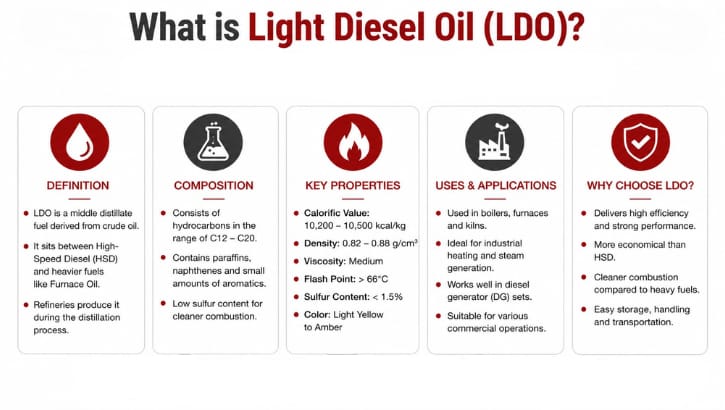
Light Diesel Oil (LDO) is a versatile industrial fuel that bridges the gap between heavy fuels like furnace oil and lighter fuels such as high-speed diesel. Industries choose LDO when they need consistent heat output, better combustion, and cost control without compromising efficiency.
You’ll often see LDO used in:
- Boilers and furnaces
- Small and medium-scale industries
- Diesel generator (DG) sets
From a performance standpoint, LDO delivers a calorific value of 10,200 – 10,500 kcal/kg, which supports stable thermal operations. It also burns cleaner than heavier oils, reducing maintenance issues in equipment.
Definition and Composition
Light Diesel Oil (LDO) is a refined petroleum fuel derived during the distillation of crude oil. Refineries produce it as an intermediate fraction, placing it between lighter fuels (like diesel) and heavier residual fuels.
What defines LDO?
- A medium-viscosity fuel designed for industrial heating
- A blend of hydrocarbons optimized for stable combustion
- Lower impurity levels compared to furnace oil
Composition Breakdown
LDO contains a mix of hydrocarbons, typically in the C12–C20 range, which ensures efficient burning and controlled energy release.
Typical Composition Table
| Component Type | Percentage Range | Role in Performance |
| Paraffins | 40–60% | Improve combustion efficiency |
| Naphthenes | 20–40% | Enhance fuel stability |
| Aromatics | 10–20% | Increase energy density |
| Sulfur Compounds | <1.5% | Affects emissions |
Key Characteristics of LDO
Light Diesel Oil (LDO) stands out because of its balanced physical and chemical properties. These characteristics make it suitable for industries that require consistent and controlled energy output.
Core Characteristics
- Calorific Value: ~10,200–10,500 kcal/kg
Ensures strong and stable heat generation
- Density: ~0.82–0.88 g/cm³
Supports efficient fuel atomization
- Viscosity: Medium range
Flows better than furnace oil
Requires less preheating
- Flash Point: Above 66°C
Improves safety during storage and handling
- Sulfur Content: Typically <1.5%
Produces fewer emissions than heavy fuels
Operational Benefits
- Easy to transport and store
- Works well in varied industrial conditions
- Provides consistent flame stability
These characteristics make LDO a dependable and efficient industrial fuel, especially for businesses aiming to balance performance and cost.
How LDO is Different from Other Fuels
Many industries struggle to choose between LDO, High-Speed Diesel (HSD), and Furnace Oil. Each fuel serves a different purpose, and understanding the differences helps you make better decisions.
Key Differences
LDO vs High-Speed Diesel (HSD):
- LDO costs less than HSD
- HSD suits automotive engines and high-speed applications
- LDO works better for stationary equipment like boilers
LDO vs Furnace Oil:
- LDO burns cleaner
- Furnace oil requires preheating due to high viscosity
- LDO reduces maintenance and downtime
Examples
- A textile unit chooses LDO instead of furnace oil to avoid frequent burner cleaning
- A factory uses HSD for vehicles but switches to LDO for boilers to cut costs
- Small industries prefer LDO because it doesn’t need complex heating systems
Light Diesel Oil (LDO) vs High-Speed Diesel (HSD) vs Furnace Oil (FO)
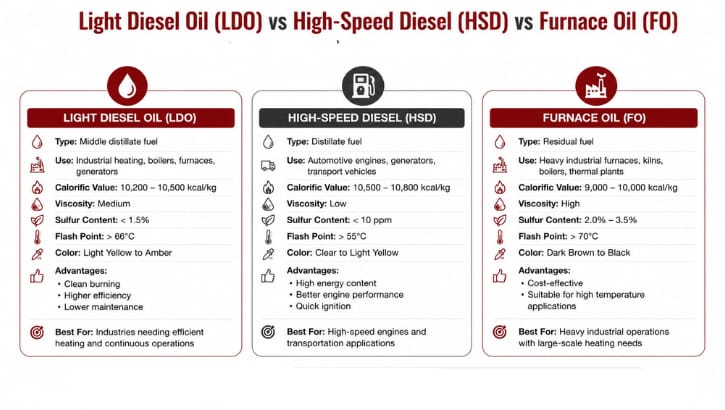
Choosing the right fuel can directly impact your operational cost, efficiency, and maintenance cycles. Many industries compare Light Diesel Oil (LDO), High-Speed Diesel (HSD), and Furnace Oil (FO) to find the best fit for their needs.
Here’s the quick reality:
- HSD delivers high performance but comes with a higher price
- Furnace Oil (FO) costs less but demands extra handling and maintenance
- LDO sits in the middle, offering a balance of cost and efficiency
From an energy perspective:
- HSD and LDO offer similar calorific values (~10,000+ kcal/kg)
- Furnace oil delivers slightly lower usable efficiency due to incomplete combustion
Industries often choose based on:
- Equipment type
- Budget constraints
- Maintenance capacity
In simple terms, LDO works as a practical middle-ground fuel, especially for businesses that want reliable performance without the complexity of heavy fuel systems.
Key Differences Between LDO, HSD, and Furnace Oil
Understanding the differences helps you avoid costly mistakes and improve efficiency.
1. Cost Comparison
- HSD: Highest cost due to refining and demand
- LDO: 10–20% cheaper than HSD (approx.)
- FO: Cheapest option but comes with hidden maintenance costs
2. Viscosity & Handling
- HSD: Low viscosity → no preheating required
- LDO: Medium viscosity → easy handling
- FO: High viscosity → requires preheating systems
3. Combustion Efficiency
- HSD: Very high efficiency (~90–95%)
- LDO: High efficiency (~85–90%)
- FO: Lower efficiency due to residue formation
4. Maintenance Impact
- HSD: Minimal residue → low maintenance
- LDO: Moderate cleanliness → manageable upkeep
- FO: High carbon deposits → frequent cleaning
5. Applications
- HSD: Vehicles, generators, heavy machinery
- LDO: Boilers, furnaces, DG sets
- FO: Large industrial heating systems
LDO vs HSD vs Furnace Oil: Detailed Comparison Table
A side-by-side comparison makes decision-making easier.
Comparison Overview
| Feature | LDO | HSD | Furnace Oil (FO) |
| Cost | Medium | High | Low |
| Calorific Value | ~10,200–10,500 kcal/kg | ~10,500 kcal/kg | ~9,500–10,000 kcal/kg |
| Viscosity | Medium | Low | High |
| Preheating | Not required | Not required | Required |
| Combustion | Clean | Very clean | Less clean |
| Maintenance | Moderate | Low | High |
| Storage | Easy | Easy | Complex |
| Applications | Boilers, DG sets | Vehicles, engines | Large furnaces |
What This Means for You
- LDO gives you stable performance without complex infrastructure
- HSD ensures maximum efficiency but increases fuel expenses
- Furnace oil reduces fuel cost but increases operational complexity
Which Fuel is Best for Your Industrial Needs?
The “best” fuel depends on how you run your operations. You need to match fuel choice with equipment, budget, and efficiency goals.
Choose HSD if you need:
- High-speed engine performance
- Reliable fuel for vehicles and mobile equipment
- Minimal maintenance interruptions
Choose LDO if you want:
- Balanced cost and efficiency
- Smooth operation in boilers and furnaces
- Lower maintenance compared to heavy fuels
Choose Furnace Oil if you focus on:
- Lowest fuel cost
- Large-scale industrial heating
- Systems already designed for heavy fuel
Key Decision Factors
- Budget → FO < LDO < HSD
- Efficiency → HSD > LDO > FO
- Maintenance → HSD < LDO < FO
Example
If you want cost savings without operational headaches, LDO often delivers the best balance. It helps industries maintain performance while keeping fuel and maintenance costs under control.
Benefits of Using Light Diesel Oil
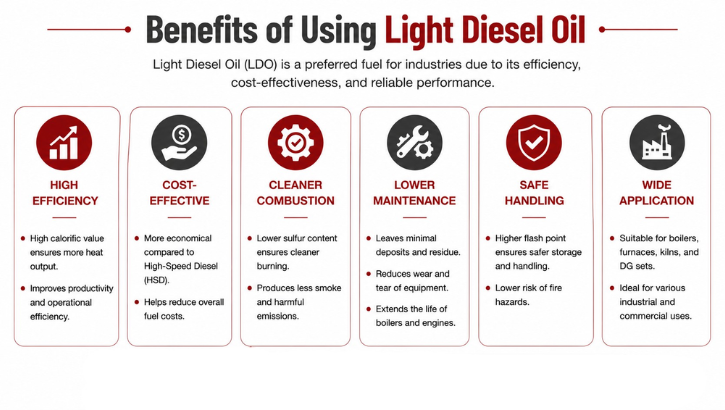
Light Diesel Oil (LDO) gives industries a strong balance of efficiency, cost control, and operational ease. Many businesses choose LDO because it delivers reliable performance without the complications of heavier fuels.
Key Benefits
- Balanced Efficiency: Delivers a calorific value of ~10,200–10,500 kcal/kg for stable heat output
- Cost Advantage: Costs 10–20% less than HSD in many markets
- Easy Handling: Medium viscosity removes the need for preheating systems
- Lower Maintenance: Produces fewer carbon deposits than furnace oil
- Versatile Usage: Works well in boilers, furnaces, and DG sets
Why Industries Prefer LDO
- Reduces downtime caused by clogging or residue
- Improves fuel utilization by up to 5–10% compared to heavy fuels
- Simplifies storage and transportation
In short, LDO helps industries run smoother operations while keeping fuel and maintenance costs under control.
High Efficiency and Performance
Light Diesel Oil (LDO) stands out for its ability to deliver consistent and reliable energy output across industrial applications. It supports operations that require steady heat without interruptions.
Performance Highlights
- High Calorific Value: ~10,200–10,500 kcal/kg ensures strong heat generation
- Stable Combustion: Maintains uniform flame, which improves process control
- Better Atomization: Medium viscosity allows efficient fuel-air mixing
Efficiency Advantages
- Achieves 85–90% combustion efficiency in most industrial systems
- Reduces unburnt fuel losses compared to furnace oil
- Improves thermal performance in boilers and furnaces
Operational Benefits
- Starts quickly and responds well to load changes
- Maintains consistent temperature levels
- Supports continuous production cycles
Why This Matters
- Consistent heat improves product quality in industries like textiles and food processing
- Efficient burning reduces fuel wastage and lowers operating costs
Cost-Effective Fuel Option
Light Diesel Oil (LDO) offers a practical solution for industries that want to reduce fuel expenses without sacrificing performance.
Cost Benefits
- Costs 10–20% less than High-Speed Diesel (HSD)
- Requires no preheating systems – saves equipment and energy costs
- Reduces maintenance expenses compared to furnace oil
Where Savings Come From
- Lower Fuel Price: Immediate cost advantage over premium fuels
- Reduced Maintenance: Fewer deposits mean less cleaning and downtime
- Improved Efficiency: Better combustion leads to optimal fuel usage
Operational Savings
- Cuts downtime by reducing equipment clogging
- Lowers labor costs for maintenance and cleaning
- Improves overall plant productivity
Real Impact
Industries switching from furnace oil to LDO often see:
- 10–15% reduction in maintenance costs
- Improved operational uptime
Cleaner Combustion Compared to Heavy Fuels
Light Diesel Oil (LDO) burns cleaner than heavy fuels like furnace oil, which makes a big difference in efficiency, maintenance, and environmental impact.
Cleaner Combustion Benefits
- Produces less carbon residue
- Reduces smoke and particulate emissions
- Keeps burners and equipment cleaner
Performance Advantages
- Improves combustion efficiency by up to 5–10% compared to heavy oils
- Reduces formation of sludge and deposits
- Maintains consistent flame quality
Environmental Impact
- Lower sulfur content – fewer harmful emissions
- Helps industries meet basic environmental compliance standards
Real-World Examples
- A textile unit switches to LDO and reduces soot buildup in boilers
- A small factory cuts maintenance cycles because burners stay cleaner
- A food processing plant improves air quality inside production areas
Applications and Uses of Light Diesel Oil
Light Diesel Oil (LDO) supports a wide range of industries that need reliable heat, steady combustion, and cost control. Its balanced properties make it suitable for both small and mid-scale operations where efficiency matters.
Where LDO is Commonly Used
- Industrial heating systems: Boilers, furnaces, and kilns
- Manufacturing units: Textile, chemical, and food processing industries
- Commercial setups: Bakeries, hotels, and small production units
- Power backup: Diesel generator (DG) sets
Why Industries Choose LDO
- Delivers ~10,200–10,500 kcal/kg calorific value for consistent energy
- Reduces maintenance compared to heavy fuels
- Eliminates the need for complex preheating systems
Industrial Applications
Industries depend on Light Diesel Oil (LDO) to maintain stable heat output and continuous production cycles. Its medium viscosity and clean combustion make it ideal for equipment that runs for long hours.
Key Industrial Uses
- Boilers: Generates steam for production processes
- Furnaces: Provides controlled heating for metals and materials
- Kilns: Supports cement, ceramics, and brick manufacturing
Why LDO Works Well in Industries
- Burns efficiently → improves thermal performance
- Reduces carbon deposits → lowers maintenance downtime
- Flows easily → simplifies fuel handling
Performance Benefits
- Achieves 85–90% combustion efficiency
- Reduces energy loss compared to furnace oil
- Supports consistent temperature control
Industry
- Textile Industry: Uses LDO in boilers for dyeing and processing
- Food Processing: Maintains uniform heating for baking and drying
- Chemical Plants: Ensures stable reactions with controlled heat
Operational Advantages
- Minimizes equipment wear and tear
- Improves production consistency
- Reduces unexpected shutdowns
LDO helps industries maintain efficiency, reduce maintenance, and ensure smooth operations, making it a reliable fuel for daily production needs.
Commercial Uses
Light Diesel Oil (LDO) plays an important role in commercial setups that require cost-effective and reliable heating solutions. Many small and medium businesses prefer LDO because it delivers steady performance without high operational complexity.
Common Commercial Applications
- Hotels and restaurants: Cooking, water heating, and baking
- Bakeries: Ovens and heating systems
- Laundry services: Steam generation for ironing and cleaning
- Small workshops: Metalwork and fabrication
Why Commercial Users Prefer LDO
- Lower cost compared to premium fuels like HSD
- Easy storage and handling without special equipment
- Consistent heat output for daily operations
Cost and Efficiency Benefits
- Reduces fuel expenses by 10–20% compared to HSD
- Improves operational efficiency in small setups
- Cuts maintenance costs due to cleaner combustion
Real Impact
- A bakery uses LDO to maintain even oven temperatures, improving product quality
- A hotel reduces energy costs while ensuring reliable hot water supply
- A laundry unit achieves faster steam generation with consistent output
Power Generation
Light Diesel Oil (LDO) serves as a dependable fuel for power generation, especially in areas where industries need backup or continuous electricity supply.
Where LDO is Used in Power Generation
- Diesel Generator (DG) sets
- Small captive power plants
- Backup systems in industries and commercial buildings
Why LDO Works for Power Generation
- Provides stable combustion, ensuring consistent power output
- Starts quickly, which helps during sudden power outages
- Reduces engine deposits compared to heavier fuels
Performance Advantages
- Supports efficient energy conversion
- Maintains steady generator performance
- Reduces maintenance frequency
Real-World Examples
- A manufacturing unit uses LDO-powered DG sets during power cuts to avoid production delays
- A hospital relies on LDO generators to ensure uninterrupted critical services
- A commercial complex uses LDO for backup power to maintain operations
Conclusion
Light Diesel Oil (LDO) stands out as a reliable, efficient, and cost-balanced fuel for modern industries. It bridges the gap between expensive high-performance fuels and heavy oils that demand complex handling. With its strong calorific value (~10,200–10,500 kcal/kg), cleaner combustion, and easy usability, LDO helps businesses maintain consistent operations, lower maintenance, and better cost control.
From industrial boilers and furnaces to commercial setups and power generation, LDO proves its value by delivering steady performance without operational complications. Industries that switch to LDO often see improved efficiency, reduced downtime, and optimized fuel expenses.
FAQ
1. What is Light Diesel Oil (LDO)?
Light Diesel Oil (LDO) is a petroleum-based fuel used mainly in industrial applications like boilers, furnaces, and generators. It offers a balance between cost, efficiency, and performance.
2. What is Light Diesel Oil used for?
Industries use LDO for:
- Boilers and steam generation
- Furnaces and kilns
- Diesel generator (DG) sets
- Small and medium-scale manufacturing units
3. What is the calorific value of LDO?
LDO typically has a calorific value of 10,200–10,500 kcal/kg, which ensures stable and efficient heat generation.
4. Is LDO the same as High-Speed Diesel (HSD)?
No, LDO differs from HSD. HSD is used in vehicles and high-speed engines, while LDO is designed for industrial heating and stationary equipment.
5. Is Light Diesel Oil cheaper than diesel?
Yes, LDO usually costs 10–20% less than High-Speed Diesel (HSD), making it a cost-effective option for industrial use.
6. Can LDO be used in generators?
Yes, LDO can be used in diesel generator (DG) sets, especially for industrial backup power and continuous operations.
7. What are the advantages of using LDO?
Key benefits include:
- High efficiency
- Lower cost compared to HSD
- Cleaner combustion than heavy fuels
- Reduced maintenance
8. What is the difference between LDO and Furnace Oil?
LDO burns cleaner and requires no preheating, while furnace oil is cheaper but needs preheating and causes more residue buildup.
9. Is LDO safe to store and handle?
Yes, LDO is relatively safe due to its higher flash point (above 66°C). However, proper storage, ventilation, and fire safety measures are essential.
10. How do I choose the right LDO supplier?
- Certified and compliant suppliers
- Consistent fuel quality
- Transparent pricing
- Reliable delivery and logistics