

ASTM-Compliant Re-Refined Base Oil for Industrial Use
Re-Refined Base Oil is becoming a strategic necessity for lubricant manufacturers facing rising crude prices and stricter environmental regulations. Producing virgin base oil from crude is energy-intensive and carbon-heavy. According to the U.S. Environmental Protection Agency (EPA), re-refining used oil requires up to 85% less energy than refining crude oil into virgin base stock. At the same time, the International Energy Agency (IEA) highlights that industrial energy demand continues to grow globally, increasing pressure on sustainable raw material sourcing.
Industrial buyers today cannot compromise on performance or compliance. ASTM standards for viscosity, flash point, sulphur content, and oxidation stability are mandatory for automotive and industrial applications. ASTM-compliant re-refining technology addresses both concerns delivering consistent quality, verified specifications, and measurable environmental benefits. The detailed information below explains how it works and why it matters for industrial use.
What is Re-Refined Base Oil?
Re-Refined Base Oil (RRBO) is a high-quality lubricant base stock produced by processing used lubricating oil through advanced purification and refining technologies. Instead of discarding used oil as waste, re-refining removes contaminants, degraded additives, metals, and impurities to restore the oil back to a usable base oil form. According to the U.S. Environmental Protection Agency (EPA), re-refining used oil can save up to 85% of the energy required to produce virgin base oil from crude while significantly reducing environmental waste.
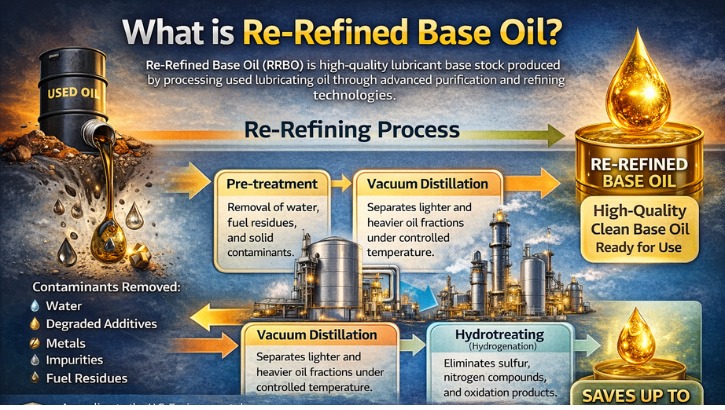
Definition and Production Process
Re-refining involves multiple controlled processing stages designed to restore oil purity and performance.
Typical steps include:
- Pre-treatment: Removal of water, fuel residues, and solid contaminants.
- Vacuum distillation: Separates lighter and heavier oil fractions under controlled temperature.
- Hydrotreating or hydrogenation: Eliminates sulphur, nitrogen compounds, and oxidation products.
- Final polishing: Produces clear, stable base oil suitable for lubricant blending.
Industry organizations such as the American Petroleum Institute recognize re-refining as a reliable method to recover valuable base oils from used lubricants.
How Re-Refining Differs from Virgin Base Oil Production
Virgin base oil is produced directly from crude petroleum through atmospheric and vacuum distillation. In contrast, re-refining focuses on purifying existing lubricating oils, which requires far less energy and raw resources.
Key differences include:
- Lower energy consumption
- Reduced crude oil dependency
- Lower carbon emissions
Why Used Oil is a Valuable Resource
Used oil still contains a large portion of reusable base oil. In fact, studies by the U.S. Environmental Protection Agency show that one gallon of used oil can produce nearly the same amount of re-refined oil as crude oil refining, making it a highly valuable recyclable resource for sustainable lubricant production.
Why ASTM Compliance Matters in Industrial Base Oils
In industrial lubrication, performance reliability depends heavily on standardized quality testing. ASTM compliance ensures that base oils meet globally accepted benchmarks for viscosity, thermal stability, corrosion resistance, and safety. Organizations like the ASTM International develop testing standards used worldwide by lubricant manufacturers, refineries, and industrial buyers. Following these standards helps ensure that a base oil performs consistently in demanding applications such as engine oils, hydraulic systems, and industrial machinery.
Importance of ASTM Testing Standards
ASTM standards provide a uniform testing framework that allows buyers to compare products objectively. Instead of relying on supplier claims, manufacturers can verify measurable properties through standardized laboratory tests.
Key benefits include:
- Consistent product performance across batches
- Reliable lubricant blending results
- Reduced equipment wear and maintenance risks
- Global acceptance for domestic and export markets
These standards also help lubricant producers maintain compliance with international quality expectations.
Key ASTM Tests Relevant to Base Oil (D445, D92, D97, D2270)
Some of the most critical ASTM tests used for base oil evaluation include:
- ASTM D445: Measures kinematic viscosity, which determines how the oil flows at specific temperatures.
- ASTM D92: Determines flash point, indicating the temperature at which oil vapors ignite.
- ASTM D97: Evaluates pour point, showing the lowest temperature at which the oil can flow.
- ASTM D2270: Calculates the viscosity index, indicating stability across temperature changes.
Risks of Using Non-Compliant Base Oils
Using base oils that do not meet ASTM standards can lead to serious operational issues, such as:
- Poor lubricant stability
- Increased equipment wear
- Inconsistent blending performance
- Safety risks in high-temperature environments
For industrial lubricant manufacturers, ASTM-compliant base oils provide the reliability needed for safe and efficient operations.
Technical Specifications of Re-Refined Base Oil (RRBO)
The performance of Re-Refined Base Oil (RRBO) is defined by several measurable technical parameters that determine how well the oil performs in lubricant formulations. These specifications are evaluated using internationally recognized test methods developed by organizations such as ASTM International. By following ASTM testing procedures, lubricant manufacturers can ensure consistent quality, safety, and compatibility with industrial and automotive applications.
Viscosity & Viscosity Index
Viscosity is one of the most critical properties of base oil because it determines how easily the oil flows at different temperatures. It is measured using ASTM D445, which calculates the kinematic viscosity of oil at specific temperatures such as 40°C and 100°C.
Key aspects include:
- Stable viscosity ensures proper lubrication between moving components
- Viscosity Index (ASTM D2270) indicates how well the oil maintains thickness across temperature changes
- Higher viscosity index improves thermal stability in engines and industrial equipment
Flash Point and Pour Point
These parameters determine how the oil behaves under extreme temperature conditions.
- Flash Point (ASTM D92): Measures the temperature at which oil vapors ignite. Higher flash points indicate better thermal safety.
- Pour Point (ASTM D97): Shows the lowest temperature at which the oil remains fluid.
Sulphur Content and Carbon Residue
Sulphur and carbon residue affect combustion cleanliness and lubricant stability.
- Sulphur levels are typically measured using ASTM D2622 or D129
- Conradson Carbon Residue (ASTM D189) indicates the tendency of oil to form deposits
Corrosion and Foaming Characteristics
Industrial oils must resist corrosion and foam formation to protect machinery.
- Copper Strip Corrosion Test (ASTM D130) checks for corrosive effects on metal components
- Foaming Characteristics (ASTM D892) evaluates foam formation and stability during operation
These ASTM-aligned specifications help ensure that RRBO delivers reliable performance in demanding lubricant applications.
Available Viscosity Grades – RR-L, RR-M, RR-H
Re-Refined Base Oil (RRBO) is typically produced in different viscosity grades to support various lubricant blending requirements. These grades are designed to meet specific performance needs in automotive and industrial applications. By offering multiple viscosity options, lubricant manufacturers can select the right base stock for engine oils, hydraulic fluids, gear oils, and other specialty lubricants. Industry standards and performance parameters for base oils are commonly evaluated using testing methods developed by organizations such as ASTM International, ensuring reliable and consistent quality.
RR-L (Light Grade) – Applications & Benefits
RR-L is a light viscosity base oil commonly used for lubricants that require better flow characteristics and low-temperature performance.
Typical uses include:
- Automotive engine oil blending
- Hydraulic oils for industrial machinery
- Light industrial lubricants
Key benefits:
- Improved fluidity in cooler conditions
- Efficient lubrication for high-speed components
- Suitable for multi-grade lubricant formulations
RR-M (Medium Grade) – Performance Characteristics
RR-M offers balanced viscosity and thermal stability, making it one of the most versatile grades in lubricant blending.
Performance advantages include:
- Stable viscosity across temperature changes
- Reliable oxidation resistance
- Compatibility with a wide range of additive packages
This grade is often used in industrial lubricants and mid-range engine oil formulations.
RR-H (Heavy Grade) – Industrial Use Cases
RR-H is a high-viscosity base oil designed for heavy-duty lubrication applications where thicker oil films are required.
Common industrial uses include:
- Gear oils and transmission lubricants
- Greases and heavy industrial machinery lubricants
- High-load equipment operating under extreme conditions
By offering RR-L, RR-M, and RR-H grades, RRBO suppliers provide flexible solutions for diverse lubricant manufacturing needs.
Key Features and Performance Benefits
Re-Refined Base Oil (RRBO) is designed to deliver reliable lubrication performance while maintaining strict quality standards required in automotive and industrial applications. Modern re-refining technologies remove contaminants, degraded additives, and impurities from used lubricating oils, restoring them into high-quality base stocks. According to the U.S. Environmental Protection Agency, properly re-refined oil can perform equally well as virgin base oil in lubricant production, making it both a sustainable and technically reliable choice for manufacturers.
Below are some of the key performance features that make RRBO suitable for industrial lubricant blending:
- High Oxidation Stability
RRBO resists chemical breakdown when exposed to heat and oxygen. This improves lubricant life and helps maintain consistent performance in engines, hydraulic systems, and industrial machinery. - Low Acidity Levels
Controlled Total Acid Number (TAN) helps reduce corrosion risks in metal components. Lower acidity ensures longer equipment life and stable lubricant formulations. - High Viscosity Index
A higher viscosity index indicates better resistance to temperature fluctuations. This allows lubricants to maintain proper thickness in both high-temperature and cold operating environments. - Low Sulphur Content
Lower sulphur levels contribute to cleaner combustion and reduced emissions, which is increasingly important for modern environmental standards. - Clear and Bright Appearance
Proper purification processes produce base oil that is visually clear, indicating effective contaminant removal and improved overall product quality.
These performance characteristics make RRBO a dependable base stock for a wide range of lubricant applications.
Industrial Applications of Re-Refined Base Oil
Re-Refined Base Oil (RRBO) is widely used across the lubricant manufacturing industry due to its consistent quality, performance stability, and sustainability benefits. Modern re-refining technology produces base oils that meet strict industry standards, allowing them to be safely used in a variety of automotive and industrial lubricant formulations. According to the American Petroleum Institute, properly processed re-refined oils can meet the same performance requirements as virgin base oils when used in approved lubricant formulations.
Automotive Engine Oil Blending
RRBO is commonly used as a base stock in engine oil manufacturing. After blending with additive packages, it helps produce lubricants used in passenger cars, commercial vehicles, and motorcycles.
Typical examples include:
- Passenger vehicle motor oils (PVMO)
- Commercial diesel engine oils
- Multi-grade engine oil formulations
Hydraulic Oil Manufacturing
Hydraulic systems rely on stable viscosity and oxidation resistance. RRBO provides a reliable base stock for:
- Industrial hydraulic fluids used in manufacturing equipment
- Hydraulic oils used in construction machinery such as excavators and loaders
- Factory automation systems requiring consistent lubrication
Gear Oils and Industrial Lubricants
Heavy-duty machinery requires lubricants that can withstand high pressure and temperature.
RRBO is used in:
- Industrial gear oils
- Transmission lubricants
- Compressor oils for industrial equipment
Greases and Specialty Lubricants
RRBO also supports the production of grease formulations and specialty lubricants used in demanding environments.
Common applications include:
- Industrial bearing greases
- Marine lubricants
- High-load machinery lubrication
These applications demonstrate how RRBO supports diverse lubricant manufacturing needs across multiple industries.
Environmental Benefits of Re-Refined Base Oil
Re-Refined Base Oil (RRBO) plays an important role in improving sustainability within the lubricant and petroleum industries. Instead of discarding used lubricating oil as waste, re-refining processes recover valuable base oil and restore it to usable quality. This approach significantly reduces environmental pollution while conserving natural resources. According to the U.S. Environmental Protection Agency, re-refining used oil can produce high-quality base stock while dramatically lowering energy consumption compared to producing virgin base oil from crude petroleum.
Energy Savings Compared to Virgin Oil
Producing base oil from crude requires extensive refining, distillation, and processing. Re-refining used oil requires much less energy.
Key sustainability advantages include:
- Re-refining uses up to 85% less energy than refining crude oil into virgin base stock.
- Lower energy consumption reduces industrial operating costs.
- Less reliance on crude oil extraction.
Waste Oil Recycling Impact
Used lubricating oil is one of the most commonly generated industrial wastes. Without proper recycling, it can contaminate soil and water resources.
For example:
- One gallon of used oil can contaminate up to one million gallons of water if improperly disposed.
- Recycling and re-refining prevent hazardous environmental pollution.
Lower Carbon Footprint
RRBO production helps reduce greenhouse gas emissions associated with petroleum refining.
Environmental benefits include:
- Reduced carbon emissions from crude oil processing
- Lower industrial waste generation
- Support for circular economy practices in the lubricant industry
These environmental advantages make RRBO a practical solution for industries aiming to improve sustainability while maintaining high lubricant performance standards.
Quality Assurance and Batch Consistency
Quality assurance is a critical factor in the production of Re-Refined Base Oil (RRBO), especially for lubricant manufacturers who rely on consistent base oil properties for blending. Industrial buyers expect every batch to meet the same performance standards for viscosity, purity, and thermal stability. To achieve this reliability, RRBO producers follow internationally recognized testing protocols and strict quality control systems throughout the refining process. Organizations such as ASTM International provide standardized test methods that help ensure consistent and verifiable product quality across global lubricant markets.
ASTM Testing Protocols Followed
RRBO quality is validated through multiple ASTM testing procedures that evaluate the chemical and physical properties of the oil.
Common ASTM tests include:
- ASTM D445 – Measures kinematic viscosity at specific temperatures
- ASTM D92 – Determines flash point to evaluate thermal safety
- ASTM D97 – Identifies pour point to assess low-temperature flow behavior
- ASTM D2270 – Calculates viscosity index for temperature stability
These tests ensure the oil performs reliably in demanding industrial applications.
Laboratory Validation and Trace Metal Control
Advanced laboratory analysis helps detect impurities and trace metals that may affect lubricant performance.
Key quality controls include:
- ICP testing to measure metal contamination levels
- Monitoring calcium, iron, and other trace metals
- Ensuring low Total Acid Number (TAN) for corrosion protection
Export-Ready Quality Standards
High-quality RRBO must also meet international export requirements.
Manufacturers typically ensure:
- Consistent batch-to-batch specifications
- Compliance with international lubricant blending standards
- Documentation for global industrial buyers
These strict quality assurance measures help build trust among lubricant manufacturers and industrial clients worldwide.
Re-Refined Base Oil vs Virgin Base Oil
When selecting a lubricant base stock, manufacturers often compare Re-Refined Base Oil (RRBO) with traditional virgin base oil derived directly from crude petroleum. Both types can be used in automotive and industrial lubricant formulations, but they differ in production process, environmental impact, and overall cost efficiency. With modern refining technologies, re-refined oils are now capable of meeting strict industry standards established by organizations like American Petroleum Institute and ASTM International.
Performance Comparison
Modern re-refining processes remove contaminants and degraded additives from used oil, restoring it to high-quality base stock.
Performance similarities include:
- Comparable viscosity stability when tested using ASTM standards
- Reliable oxidation resistance for lubricant blending
- Suitable for engine oils, hydraulic fluids, and industrial lubricants
Many lubricant manufacturers confirm that properly processed RRBO can perform similarly to virgin base oil in many applications.
Cost Efficiency
RRBO can offer economic advantages because it uses recycled oil rather than newly extracted crude.
Cost benefits include:
- Reduced raw material dependency on crude oil
- Lower refining energy requirements
- Competitive pricing for lubricant manufacturers
These savings can be significant in large-scale lubricant production.
Sustainability Comparison
From an environmental perspective, RRBO provides a clear advantage.
Key sustainability factors include:
- Re-refining uses significantly less energy than crude refining
- Reduces waste oil disposal and environmental contamination
- Supports circular economy practices in the lubricant industry
For manufacturers balancing performance, cost, and sustainability, RRBO has become an increasingly practical alternative to virgin base oil.
How to Choose a Reliable RRBO Supplier in India
Selecting a reliable Re-Refined Base Oil (RRBO) supplier in India is critical for lubricant manufacturers, industrial buyers, and blending companies. The quality of base oil directly affects lubricant performance, equipment protection, and product consistency. India’s lubricant market is expanding rapidly, with the country consuming over 2.7 million metric tons of lubricants annually, according to the International Energy Agency. This growing demand makes it essential to partner with suppliers who maintain strict quality and testing standards.
What Technical Documents to Request
Before purchasing RRBO, buyers should always request technical documentation to verify the oil’s quality and performance characteristics.
Important documents include:
- Technical Data Sheet (TDS) showing viscosity, flash point, and pour point values
- Material Safety Data Sheet (MSDS) detailing chemical safety information
- Certificate of Analysis (COA) confirming batch-specific test results
- ASTM test reports verifying viscosity, sulphur content, and corrosion resistance
These documents help ensure transparency and product reliability.
Certifications to Verify
Reliable RRBO suppliers typically maintain internationally recognized quality certifications.
Key certifications to check include:
- ISO 9001 for quality management systems
- ISO 14001 for environmental management practices
- Compliance with testing standards from ASTM International
These certifications demonstrate that the supplier follows standardized production and testing procedures.
Red Flags to Avoid
Industrial buyers should also watch for warning signs when evaluating suppliers.
Common red flags include:
- Lack of laboratory test reports
- Inconsistent viscosity or specification data
- No documentation for trace metal content
- Unclear sourcing or refining process
Choosing a supplier with verified testing, transparent documentation, and consistent product quality helps ensure long-term reliability for lubricant manufacturing operations.
Market Demand for Re-Refined Base Oil in India
India’s lubricant industry is expanding steadily due to rapid industrialization, automotive growth, and increasing demand for high-performance lubricants. As industries seek cost-effective and sustainable base stock alternatives, Re-Refined Base Oil (RRBO) is gaining strong market traction. According to the International Energy Agency, India is one of the fastest-growing energy markets, with industrial activity continuing to drive lubricant consumption across manufacturing, transportation, and heavy machinery sectors.

Growth in Industrial Lubricant Sector
The industrial lubricant segment plays a major role in base oil demand.
Key growth factors include:
- Expansion of manufacturing industries such as steel, cement, and chemicals
- Increased use of heavy machinery requiring high-performance lubricants
- Growth in automotive production and commercial transportation
India consumes over 2.5 million metric tons of lubricants annually, making it one of the largest lubricant markets in Asia.
Regulatory Push for Sustainability
Environmental regulations are also encouraging the adoption of re-refined base oils.
Important sustainability drivers include:
- Government initiatives promoting waste oil recycling
- Growing focus on reducing industrial emissions
- Increasing awareness of circular economy practices in the petroleum industry
These factors make RRBO an environmentally responsible alternative to virgin base oil.
Export Opportunities
India is also emerging as an important exporter of re-refined base oil.
Opportunities include:
- Growing demand in Asia, Africa, and Middle Eastern markets
- Competitive production costs compared to many global suppliers
- Availability of modern re-refining technologies
This combination of domestic demand and export potential is expected to strengthen the RRBO market in the coming years.
Conclusion
As industries continue to prioritize performance, sustainability, and cost efficiency, ASTM-compliant Re-Refined Base Oil (RRBO) has emerged as a reliable solution for modern lubricant manufacturing. With advanced re-refining technologies and strict ASTM testing standards, RRBO delivers consistent quality that meets the demanding requirements of automotive and industrial applications.
Key reasons why industries are adopting RRBO include:
- Performance Reliability
ASTM-aligned testing methods ensure stable viscosity, oxidation resistance, and thermal performance required for engine oils, hydraulic fluids, and industrial lubricants. - Regulatory Compliance
Meeting internationally recognized ASTM testing standards helps lubricant manufacturers maintain product quality and meet global regulatory requirements. - Sustainability Advantage
Re-refining used oil significantly reduces waste and energy consumption while supporting circular economy practices within the petroleum industry. - Cost Efficiency
By utilizing recycled base stock, RRBO helps reduce dependence on crude oil, offering a cost-effective alternative for lubricant production.
For lubricant manufacturers and industrial buyers looking for high-quality ASTM-compliant Re-Refined Base Oil, partnering with an experienced supplier is essential. Explore the RRBO solutions available at Rerol Refinery and discover reliable base oil products designed to support modern industrial lubricant applications.
Frequently Asked Questions (FAQ)
Is Re-Refined Base Oil as good as virgin base oil?
Yes, when produced using advanced re-refining technology, Re-Refined Base Oil (RRBO) can perform similarly to virgin base oil in many lubricant applications. The refining process removes contaminants, degraded additives, and metals, restoring the oil to a high-quality base stock. According to the U.S. Environmental Protection Agency, properly re-refined oil can meet the same quality and performance standards required for lubricant production.
What ASTM standards apply to RRBO?
RRBO quality is typically evaluated using testing standards developed by ASTM International. Important ASTM tests include:
- ASTM D445 – Kinematic viscosity measurement
- ASTM D92 – Flash point testing
- ASTM D97 – Pour point determination
- ASTM D2270 – Viscosity index calculation
These tests help verify the oil’s performance and stability in industrial and automotive lubricants.
Can RRBO be used in engine oil blending?
Yes. RRBO is widely used as a base stock for lubricant blending. When combined with appropriate additive packages, it can be used to produce:
- Passenger vehicle engine oils
- Diesel engine lubricants
- Industrial machinery lubricants
What is the viscosity index of ASTM-compliant RRBO?
Most ASTM-compliant RRBO products typically have a viscosity index around 95 or higher, indicating good stability across temperature changes.
Is re-refined base oil environmentally safe?
Yes. Re-refining used oil helps reduce waste and conserve natural resources. Studies from the U.S. Environmental Protection Agency show that re-refining used oil requires up to 85% less energy than producing virgin base oil , making it a more sustainable option.