

Industrial Fuel Options for Boilers and Heating Systems
Industrial Fuel Options for Boilers and Heating Systems play a critical role in determining operational efficiency, fuel cost, and environmental compliance in industrial facilities. According to the International Energy Agency (IEA), industrial heat accounts for nearly 20% of global final energy consumption, with boilers representing a major share of that demand. Selecting the wrong fuel can result in incomplete combustion, higher emissions, increased maintenance, and unnecessary operating expenses.
In India, tightening emission regulations and rising energy costs are pushing industries to reassess their industrial fuel strategy. Factors such as sulphur content, flash point, viscosity, and calorific value directly impact boiler efficiency and long-term equipment reliability. Even minor deviations in fuel quality can significantly affect combustion performance.
Understanding the right industrial fuel options ensures better efficiency, compliance, and cost control. You can see the detailed information below.
Why Choosing the Right Industrial Fuel Matters
Selecting the right industrial fuel options for boilers and heating systems is not just a procurement decision , it directly affects operating cost, efficiency, safety, and regulatory compliance. Industrial heat processes consume massive amounts of energy, and even small inefficiencies multiply into significant financial losses over time. The choice of fuel determines combustion quality, equipment lifespan, and environmental performance. Let’s break this down clearly.
Impact on Energy Consumption and Cost
According to the International Energy Agency (IEA), industrial heat accounts for nearly 20% of global final energy consumption. Boilers contribute a major share of that usage.
Fuel quality affects cost through:
- Higher fuel consumption when calorific value is low
- Increased downtime due to sludge and carbon deposits
- Maintenance costs from incomplete combustion
Even a 2% drop in boiler efficiency can significantly increase annual fuel expenses in mid-sized manufacturing units.
Effect on Boiler Efficiency and Performance
Boiler performance depends on:
- Flash point for safe ignition
- Kinematic viscosity for proper atomization
- Sulphur content for clean combustion
Poor-quality fuel leads to soot formation, reduced heat transfer, and higher stack losses.
Emission Compliance and Regulatory Pressure in India
The Central Pollution Control Board (CPCB) enforces stricter emission norms across industries. High sulphur industrial fuels increase SO₂ emissions, raising compliance risks and penalties.
What Are the Main Industrial Fuel Options for Boilers and Heating Systems?
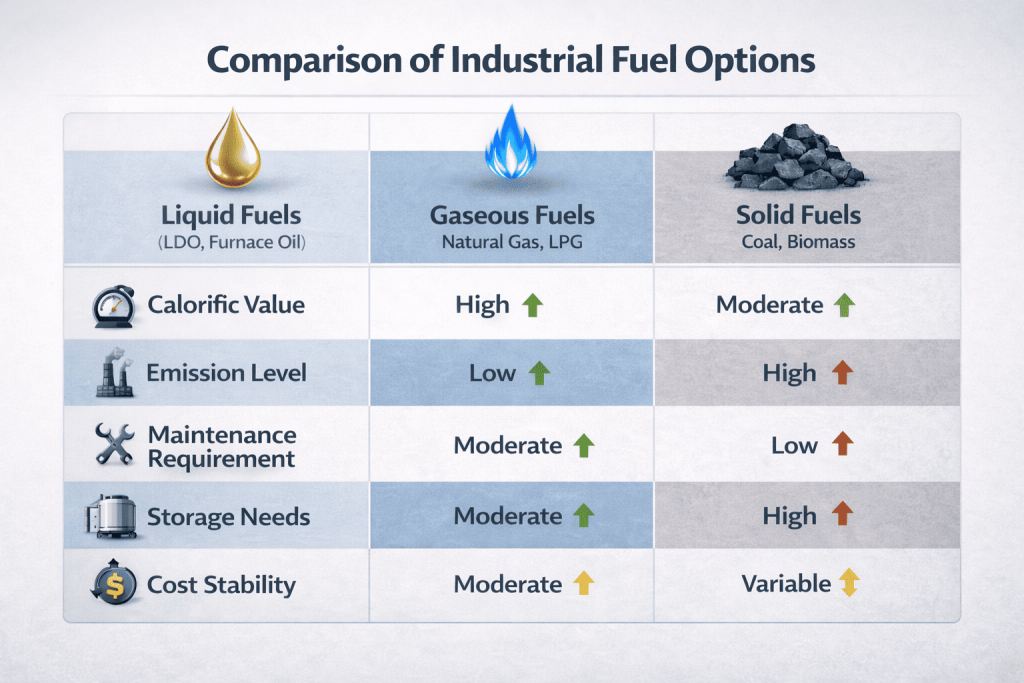
When evaluating industrial fuel options for boilers and heating systems, industries typically choose based on cost, availability, combustion efficiency, and emission norms. The global shift toward cleaner industrial energy, highlighted by the International Energy Agency, shows increasing movement toward lower-emission fuels but practicality and infrastructure still influence decisions in India.
Let’s break down the main categories.
Liquid Fuels – LDO and Furnace Oil
Liquid fuels remain widely used due to storage convenience and high calorific value.
- Light Diesel Oil (LDO) – Cleaner burning, controlled sulphur content, better atomization. Suitable for boilers, thermic fluid heaters, and industrial burners.
- Furnace Oil – Lower cost but heavier viscosity and higher maintenance requirements.
LDO typically offers better combustion efficiency compared to heavier fuel oils, reducing carbon deposits.
Gaseous Fuels – Natural Gas and LPG
- Natural Gas – High efficiency, lower emissions, and easier combustion control.
- LPG – Used where pipeline gas is unavailable.
Gas fuels produce significantly lower SO₂ emissions compared to high-sulphur liquid fuels.
Solid Fuels – Coal and Biomass
- Coal – Cost-effective but high ash and emission concerns.
- Biomass – Renewable but requires specialized handling systems.
Fuel selection depends on operational goals, compliance needs, and infrastructure availability.
Light Diesel Oil (LDO) as an Industrial Fuel Option
Among various industrial fuel options for boilers and heating systems, Light Diesel Oil (LDO) is widely preferred in sectors that demand controlled combustion and regulatory compliance. LDO offers a balance between performance, safety, and operational reliability especially in medium to large-scale manufacturing units.
Technical Specifications and IS 15770 Compliance
In India, LDO quality is governed by IS 15770 standards issued by the Bureau of Indian Standards. Key parameters include:
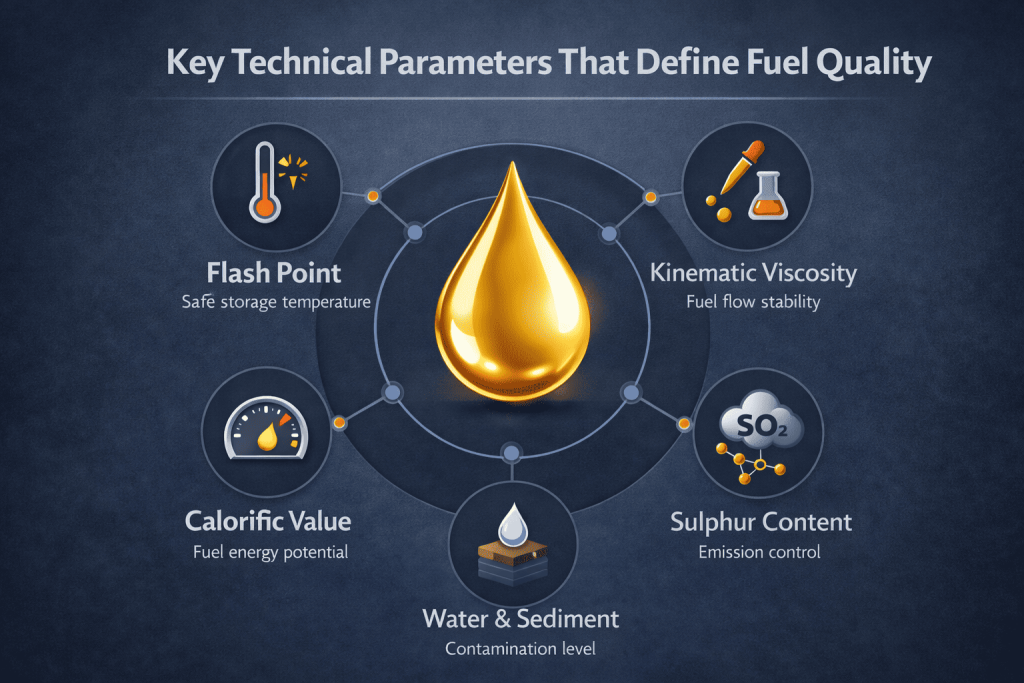
- Flash Point (Min 66°C) – Ensures safe handling and storage
- Kinematic Viscosity @ 40°C – Supports proper atomization
- Sulphur Content (Max 1.0%) – Controls SO₂ emissions
- Water & Sediment Limits – Prevents combustion instability
Compliance testing often follows IS 1448 and ASTM methods, ensuring batch-wise quality consistency.
Performance in Boilers and Thermic Fluid Heaters
LDO delivers:
- Stable flame characteristics
- Efficient heat transfer
- Lower carbon deposition compared to heavier oils
Proper atomization improves combustion efficiency and reduces soot formation.
Advantages Over Heavier Fuel Oils
Compared to furnace oil, LDO offers:
- Cleaner combustion
- Lower maintenance frequency
- Better emission control
For industries prioritizing efficiency and compliance, LDO remains a technically sound choice.
Furnace Oil as an Industrial Heating Fuel
Furnace oil remains one of the most commonly used industrial fuel options for boilers and heating systems, especially in cost-sensitive industries. It is a residual fuel derived from crude oil refining and is typically heavier and more viscous than Light Diesel Oil. While it offers economic advantages, it also comes with operational trade-offs.
Typical Industrial Applications
Furnace oil is widely used in:
- Textile processing units
- Cement manufacturing plants
- Chemical industries
- Large-capacity steam boilers
- Process heating furnaces
Its high calorific value makes it suitable for bulk heat generation where fuel cost per unit is a primary concern.
Cost Advantages and Trade-offs
The main attraction of furnace oil is lower upfront cost compared to lighter fuels. However:
- Higher viscosity requires preheating systems
- Lower atomization efficiency affects combustion quality
- Increased fuel handling infrastructure is needed
What looks cheaper initially can increase operational complexity.
Maintenance and Emission Considerations
Higher sulphur content contributes to SO₂ emissions, regulated in India by the Central Pollution Control Board (CPCB). Furnace oil also produces more carbon deposits, leading to:
- Frequent burner cleaning
- Reduced heat transfer efficiency
- Higher maintenance downtime
Natural Gas for Industrial Boilers and Heating Systems
Natural gas is increasingly considered one of the cleaner industrial fuel options for boilers and heating systems, particularly in urban industrial clusters. Its high combustion efficiency and lower emission profile make it attractive for industries aiming to reduce environmental impact while maintaining thermal performance.
Combustion Efficiency Benefits
Natural gas offers:
- Higher combustion efficiency due to uniform gaseous mixing
- Minimal ash or carbon residue
- Lower SO₂ and particulate emissions
According to the International Energy Agency (IEA), natural gas produces significantly lower CO₂ emissions per unit of energy compared to coal and heavier fuel oils. Clean combustion improves heat transfer and reduces boiler fouling, resulting in lower maintenance frequency.
Infrastructure and Availability Challenges
Despite performance benefits, natural gas adoption depends on:
- Pipeline connectivity
- Consistent supply contracts
- Initial infrastructure investment
Industries located outside major gas grid networks often face supply constraints.
Long-Term Cost Stability
Gas pricing can fluctuate based on global energy markets. However, long-term contracts and domestic gas policies in India aim to provide predictable pricing. For industries with access to reliable supply, natural gas delivers stable, efficient, and cleaner industrial heating performance.
Key Technical Parameters That Define Fuel Quality
Not all industrial fuels are created equal. The performance of boilers and heating systems depends heavily on measurable technical parameters. Ignoring these metrics leads to inefficient combustion, safety risks, and regulatory violations. In India, fuel testing often follows standards set by the Bureau of Indian Standards and validated through ASTM methods.
Flash Point and Safety Standards
Flash point determines the minimum temperature at which fuel vapors ignite.
- Higher flash point = safer storage and handling
- For LDO, IS 15770 specifies a minimum of 66°C
Low flash point fuels increase fire hazards in industrial environments.
Kinematic Viscosity and Atomization
Viscosity affects how well fuel atomizes inside the burner.
- Proper viscosity ensures uniform spray pattern
- Poor atomization leads to incomplete combustion
- Higher viscosity fuels require preheating
Efficient atomization improves heat transfer and reduces soot buildup.
Sulphur Content and Emission Impact
High sulphur content increases SO₂ emissions, regulated by the Central Pollution Control Board (CPCB). Excess sulphur also accelerates corrosion inside boiler tubes.
Water, Sediment, and Contaminants
Even small amounts of water or sediment can:
- Disrupt combustion stability
- Increase carbon residue
- Reduce boiler lifespan
Fuel quality testing is not optional, it’s operational protection.
Industrial Fuel Efficiency and Operating Cost Impact
Fuel efficiency is not just a technical metric it directly determines profitability. In energy-intensive industries, fuel expenses can account for 30-40% of total operating costs. According to the International Energy Agency (IEA), improving industrial energy efficiency could significantly reduce operational expenditure and emissions simultaneously. That’s why evaluating industrial fuel efficiency is critical.
Calorific Value and Heat Output
Calorific value defines how much heat energy a fuel releases during combustion.
- Higher calorific value = more heat per unit of fuel
- Reduces total fuel consumption
- Improves thermal efficiency
For example, fuels with higher net calorific value generate more steam per liter, reducing overall usage.
Fuel-to-Steam Ratio Analysis
The fuel-to-steam ratio measures how efficiently fuel converts into usable steam.
- Lower ratio = better efficiency
- Poor-quality fuel increases fuel input per ton of steam
- Incomplete combustion increases stack losses
A small inefficiency here compounds into major annual cost differences.
Real Cost-per-Heat-Unit Comparison
Smart operators calculate cost per million kcal or per ton of steam, not just per liter.
Sometimes a slightly higher-priced fuel delivers better efficiency, lower maintenance, and fewer shutdowns resulting in lower long-term operating cost.
Compliance and Testing Standards for Industrial Fuels in India
Compliance is not paperwork, it’s risk management. When selecting industrial fuel options for boilers and heating systems, adherence to national and international testing standards ensures safety, performance consistency, and environmental responsibility. Regulatory bodies in India have tightened oversight, especially for sulphur content and emission control.
IS 15770 Standards for LDO
Light Diesel Oil (LDO) quality is governed by IS 15770, issued by the Bureau of Indian Standards (BIS). This standard defines limits for:
- Flash Point (minimum 66°C)
- Kinematic Viscosity
- Sulphur Content (maximum 1.0%)
- Water & Sediment
Compliance ensures safe storage, efficient combustion, and emission control. Non-compliant fuel increases corrosion, soot formation, and operational hazards.
ASTM Test Methods for Quality Verification
Many industrial fuel suppliers use ASTM methods such as ASTM D4294 for sulphur testing and ASTM D93 for flash point measurement. These internationally recognized protocols add credibility and consistency to batch-wise quality testing.
Environmental Norms and Pollution Control Requirements
The Central Pollution Control Board (CPCB) regulates industrial emissions across states. High sulphur fuels contribute to SO₂ emissions, which can attract penalties and shutdown notices.
Strict testing and documented compliance protect industries from regulatory and operational risk.
How to Choose the Best Industrial Fuel for Your Boiler System
Selecting the right option from various industrial fuel options for boilers and heating systems requires technical evaluation not just price comparison. The wrong choice can reduce efficiency, increase emissions, and shorten equipment life. A structured approach ensures long-term operational stability.
Boiler Type and Load Requirements
Start with your boiler configuration:
- Fire-tube vs water-tube boilers
- Steam capacity (TPH – tons per hour)
- Continuous vs fluctuating load
High-capacity boilers demand fuels with stable calorific value and consistent combustion characteristics. Even a 1-2% efficiency drop in large steam systems significantly increases annual fuel cost.
Fuel Availability and Storage Conditions
Fuel choice depends on:
- Local pipeline infrastructure (for natural gas)
- Storage tank capacity (for liquid fuels)
- Handling systems (preheating for furnace oil)
Limited infrastructure often restricts fuel flexibility.
Budget Constraints vs Performance Goals
The lowest price per liter does not equal the lowest operating cost. Evaluate:
- Cost per unit of heat generated
- Maintenance frequency
- Downtime risk
Environmental and Safety Compliance
Emission standards enforced by the Central Pollution Control Board (CPCB) demand controlled sulphur levels and safe storage practices.
Choosing wisely means balancing cost, efficiency, compliance, and operational reliability not chasing short-term savings.
Importance of Quality Assurance in Industrial Fuel Supply
When it comes to industrial fuel options for boilers and heating systems, quality assurance is not optional; it directly impacts performance, compliance, and equipment lifespan. Even small inconsistencies in fuel composition can reduce combustion efficiency and increase maintenance costs. Industries that rely on documented testing avoid operational surprises and regulatory risks.
Batch-Wise Testing and Documentation
Reliable suppliers conduct batch-wise testing based on standards issued by the Bureau of Indian Standards (BIS). Typical parameters tested include:
- Flash point
- Kinematic viscosity
- Sulphur content
- Water and sediment
Providing test reports ensures transparency and traceability. Without documentation, industries operate blindly.
Third-Party Lab Verification
Many companies rely on ASTM-compliant methods such as ASTM D4294 for sulphur analysis. Independent lab verification adds credibility and reduces disputes over quality deviations.
Impact of Inconsistent Fuel on Equipment
Poor-quality fuel can lead to:
- Carbon buildup inside boiler tubes
- Increased burner wear
- Higher stack losses
- Unexpected downtime
Repeated inefficiencies compound into significant financial losses. Quality assurance protects both equipment performance and long-term operational stability.
Role of Reliable Industrial Fuel Suppliers
Choosing the right supplier is just as important as selecting the right industrial fuel options for boilers and heating systems. Even high-quality fuel loses its value if supply is inconsistent or documentation is incomplete. In energy-intensive industries, unplanned downtime caused by delayed fuel delivery can halt production and trigger major financial losses.
Timely Delivery and Supply Chain Stability
Reliable suppliers ensure:
- Consistent bulk fuel availability
- Scheduled deliveries aligned with production cycles
- Emergency supply support during peak demand
According to the International Energy Agency (IEA), supply chain resilience is critical for industrial energy security. Interruptions in fuel supply can disrupt manufacturing operations and increase dependency on higher-cost alternatives.
Technical Support and Documentation
Professional industrial fuel suppliers provide:
- Batch-wise test certificates
- Compliance documentation (IS / ASTM methods)
- Guidance on storage and handling practices
This reduces compliance risks and operational uncertainty.
Long-Term Industrial Partnership Benefits
Long-term partnerships offer:
- Stable pricing contracts
- Predictable fuel quality
- Operational consistency
A dependable supplier is not just a vendor they are a strategic energy partner supporting efficiency, compliance, and sustained industrial growth.
Conclusion:
Selecting the right industrial fuel options for boilers and heating systems directly impacts efficiency, compliance, and operational cost. From calorific value and sulphur limits to viscosity and flash point, every parameter influences combustion stability and long-term equipment performance. Industries that ignore fuel quality often face higher maintenance cycles, emission risks, and unexpected downtime.
This is where Rerol Refinery stands apart. With Light Diesel Oil (LDO) supplied in compliance with IS 15770 standards, batch-wise quality testing, and documented verification, Rerol ensures consistent industrial-grade performance. Reliable supply, technical transparency, and adherence to Indian regulatory norms provide operational confidence to manufacturing units across sectors.
If your facility depends on boilers, thermic fluid heaters, or industrial burners, choosing a compliant and quality-assured fuel partner is critical.
Contact Rerol Refinery today to discuss your industrial fuel requirements and request technical documentation.
Frequently Asked Questions (FAQs)
What is the best industrial fuel for boilers?
There is no one-size-fits-all answer. The best choice among industrial fuel options for boilers and heating systems depends on boiler capacity, emission norms, infrastructure, and budget. For example:
- Light Diesel Oil (LDO) – Cleaner combustion, controlled sulphur levels, easier handling
- Furnace Oil – Lower upfront cost but higher maintenance
- Natural Gas – High efficiency and lower emissions, where pipeline access exists
According to the International Energy Agency (IEA), improving industrial fuel efficiency significantly reduces operating costs and emissions.
Is Light Diesel Oil better than furnace oil?
Technically, LDO offers:
- Better atomization
- Lower carbon deposits
- Improved emission control
Furnace oil may be cheaper per liter but often increases long-term maintenance.
What flash point is required for industrial fuel safety?
As per IS 15770 issued by the Bureau of Indian Standards (BIS), LDO must have a minimum flash point of 66°C for safe storage and handling.
How does sulphur content affect boiler performance?
High sulphur increases SO₂ emissions and accelerates corrosion inside boiler tubes, impacting lifespan and compliance.
Which standards regulate industrial fuels in India?
Industrial fuels are regulated by BIS standards (IS 15770 for LDO) and emission norms enforced by the Central Pollution Control Board (CPCB).