

Difference Between Industrial Diesel Oil and Regular Diesel
What Is Industrial Diesel Oil?
Industrial Diesel Oil (IDO) is a petroleum-based fuel specifically formulated for industrial heating and combustion systems. Unlike automotive diesel, it is not designed for vehicles but for steady, high-temperature industrial operations where consistent thermal output and safety are critical. In energy-intensive industries, even small variations in fuel properties can impact efficiency and maintenance cycles. According to the International Energy Agency, industry accounts for nearly 37% of global final energy consumption, with process heating forming a major share.
Definition and Industrial Purpose
Industrial Diesel Oil is engineered to:
- Deliver stable combustion in controlled environments
- Maintain appropriate viscosity for burner atomization
- Ensure safe storage through higher flash point characteristics
- Support long-duration heating operations
It is commonly used where consistent thermal energy is essential for production continuity.
Where It Is Commonly Used
IDO is widely applied in:
- Boilers – steam generation in manufacturing
- Thermic fluid heaters – textile and chemical processing
- Industrial burners – uniform flame stability
- Furnaces – metal treatment and process heating
Compliance with IS 15770 Standards
In India, Industrial Diesel Oil must comply with IS 15770 specifications set by the Bureau of Indian Standards. Parameters like flash point, sulfur content, ash, and carbon residue are tested using IS 1448 methods to ensure safety, efficiency, and regulatory compliance.
What Is Regular Diesel Oil ?
Regular diesel is a transportation-grade fuel primarily designed for use in automotive engines. Unlike Industrial Diesel Oil, which is formulated for controlled industrial combustion, regular diesel is optimized for mobility, emission control , and engine responsiveness. Its chemical composition, additive package, and sulfur limits are strictly aligned with vehicular performance and environmental regulations.
Automotive Diesel Explained
Automotive diesel is refined to deliver efficient combustion in compression-ignition engines. It includes performance-enhancing additives that:
- Improve fuel injector cleanliness
- Reduce engine knocking
- Enhance cold-start performance
- Minimize carbon deposits
India’s transport sector heavily depends on diesel. According to the Ministry of Petroleum and Natural Gas, diesel contributes to nearly 40% of total petroleum product consumption in the country, largely driven by commercial transportation.
Designed for Transport Engines
Regular diesel is engineered for:
- High-speed vehicle engines
- Common rail direct injection systems
- Stop-and-go traffic conditions
- Load fluctuations during highway driving
It is not optimized for sustained high-temperature industrial heating applications like boilers or furnaces.
Bharat Stage Emission Standards
Automotive diesel must comply with emission norms regulated by the Central Pollution Control Board under Bharat Stage (BS-VI) standards. These norms restrict sulfur content to 10 ppm, significantly reducing vehicular emissions and supporting cleaner air initiatives.
Why People Confuse Industrial Diesel Oil and Regular Diesel
At first glance, Industrial Diesel Oil and regular diesel look almost identical. Both are petroleum-derived fuels with similar color and texture. This visual similarity, combined with overlapping terminology like “diesel,” leads many buyers to assume they are interchangeable. In reality, their formulation, compliance standards, and end-use applications are significantly different.
Similar Appearance and Base Composition
Both fuels originate from crude oil distillation. They share comparable hydrocarbon structures, which explains their similar physical appearance. However, the difference lies in:
- Additive composition
- Sulfur limits
- Flash point requirements
- Intended combustion environment
Even minor specification changes can affect performance in industrial systems operating at sustained high temperatures.
Misconception About Interchangeability
Many procurement teams assume diesel is “diesel,” without checking regulatory standards. Automotive diesel is regulated under emission norms governed by the Central Pollution Control Board, while Industrial Diesel Oil follows industrial specifications such as IS 15770.
Using the wrong fuel can lead to:
- Incomplete combustion
- Higher carbon deposits
- Reduced burner efficiency
Cost-Driven Decisions and Risks
Price differences sometimes push industries to substitute fuels without technical evaluation. According to the International Energy Agency, fuel efficiency improvements in industry can significantly reduce operational costs. Short-term savings from incorrect fuel selection often result in long-term maintenance and compliance expenses.
Key Differences Between Industrial Diesel Oil and Regular Diesel
The real distinction between Industrial Diesel Oil and regular diesel lies in safety parameters, chemical composition, and intended usage. While both are derived from crude oil, their specifications are engineered for completely different operational environments industrial heating vs. automotive engines.
Flash Point Comparison
Flash point determines fire safety during storage and handling.
- Industrial Diesel Oil typically has a higher flash point (as per IS 15770, minimum around 66°C depending on grade).
- Regular diesel is formulated for automotive use and regulated under emission norms.
Higher flash point reduces fire risk in large industrial storage tanks and boiler rooms.
Sulfur Content Limits
- Automotive diesel (BS-VI) limits sulfur to 10 ppm under regulations monitored by the Central Pollution Control Board.
- Industrial Diesel Oil sulfur limits vary depending on industrial standards and combustion requirements.
Sulfur impacts emissions, corrosion, and maintenance frequency.
Viscosity Range
Viscosity affects atomization in burners.
Industrial Diesel Oil maintains a viscosity range suitable for steady industrial combustion, whereas automotive diesel is optimized for high-pressure fuel injection systems.
Additive Composition
Regular diesel contains additives for:
- Engine cleanliness
- Emission reduction
- Fuel injector protection
Industrial Diesel Oil prioritizes:
- Stable flame characteristics
- Reduced residue formation
Intended Equipment Design
Automotive engines operate under variable load conditions.
Industrial systems like boilers and furnaces require continuous, stable combustion. According to the International Energy Agency, industrial heat demand forms a major share of global energy consumption, reinforcing the need for fuel specifically designed for such applications.
Industrial Diesel Oil Specifications as per IS 15770
Industrial Diesel Oil is not a generic fuel it must meet defined quality benchmarks to ensure safety, combustion efficiency, and equipment protection. In India, these requirements are governed by IS 15770 standards issued by the Bureau of Indian Standards. These specifications define the acceptable physical and chemical limits for industrial-grade diesel.
Critical Parameters
Key parameters tested under IS 15770 include:
- Flash Point (Minimum limit) – Ensures safe storage and handling in industrial environments.
- Ash Content (Max limit) – Excess ash leads to deposits and reduced boiler efficiency.
- Carbon Residue – Indicates the tendency of fuel to form coke deposits during combustion.
- Water Content – High water levels reduce calorific value and can damage burners.
- Copper Strip Corrosion Test – Measures corrosive impact on metal components.
These parameters are typically evaluated using IS 1448 testing methods and, in some cases, ASTM procedures for sulfur analysis.
Why Standard Testing Matters
Industrial systems operate continuously under high temperatures. Even minor deviations in fuel quality can increase maintenance downtime and reduce thermal efficiency. According to the International Energy Agency, improving industrial energy efficiency is one of the most cost-effective ways to lower operating expenses and emissions. Standard-compliant testing ensures predictable performance, regulatory compliance, and long-term equipment reliability.
Performance Impact in Industrial Equipment
The choice between Industrial Diesel Oil and regular diesel directly affects how efficiently industrial systems operate. Boilers, burners, and furnaces are engineered for specific fuel characteristics. When fuel properties mismatch equipment design, performance drops and costs rise. According to the International Energy Agency, improving energy efficiency in industrial heating systems can significantly reduce fuel consumption and emissions.
Combustion Efficiency in Boilers
Boilers require consistent atomization and stable flame patterns. Industrial Diesel Oil is formulated to:
- Maintain proper viscosity for spray combustion
- Reduce carbon residue formation
- Deliver stable calorific output
If regular automotive diesel is used, combustion may become uneven, leading to heat loss and increased fuel consumption.
Impact on Burner Performance
Burners depend on precise fuel-air mixing. Differences in sulfur content, flash point, and additives can cause:
- Incomplete combustion
- Flame instability
- Soot formation
This directly affects thermal efficiency and process consistency.
Effect on Maintenance Frequency
Fuel impurities increase deposit formation inside heat exchangers and combustion chambers. Over time, this leads to:
- More frequent shutdowns
- Higher cleaning costs
- Reduced equipment lifespan
Using fuel that aligns with IS standards minimizes these operational risks and supports long-term industrial reliability.
Safety Differences Between Industrial Diesel Oil and Regular Diesel
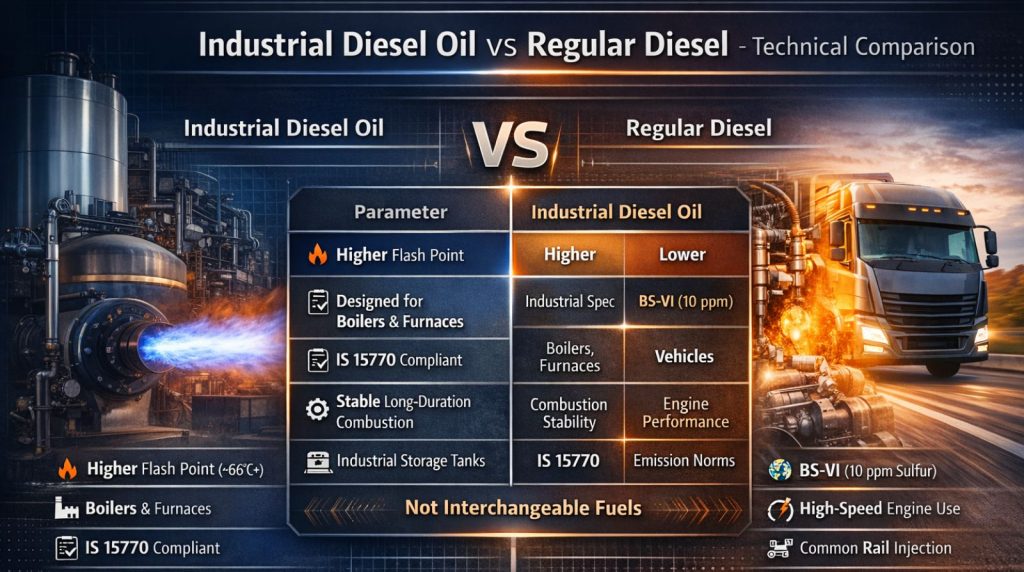
Safety is one of the most overlooked differences between Industrial Diesel Oil and regular diesel. While both are combustible fuels, their flash point, storage conditions, and regulatory frameworks vary significantly. In industrial environments where large volumes of fuel are stored, even small safety deviations can create serious operational risks.
Flash Point and Storage Risk
Flash point determines the minimum temperature at which fuel vapors ignite. Industrial Diesel Oil, as per IS standards defined by the Bureau of Indian Standards, maintains a higher flash point threshold suitable for industrial storage conditions.
Higher flash point means:
- Reduced fire hazard in storage tanks
- Safer handling in boiler rooms
- Lower vapor ignition risk
Regular diesel, optimized for vehicle use, operates under different risk assumptions and storage scales.
Handling Guidelines
Industrial fuels must follow structured handling practices, including:
- Proper ventilation in storage areas
- Periodic tank inspection
- Water contamination monitoring
- Controlled transfer systems
Large-scale industrial facilities often implement internal fuel quality checks aligned with IS 1448 testing procedures.
Industrial Fire Safety Compliance
Industrial facilities must comply with safety regulations and fire norms. According to guidance referenced by the Petroleum and Explosives Safety Organisation, fuel storage and handling must align with safety codes to minimize accident risks. Using compliant Industrial Diesel Oil reduces exposure to regulatory violations and fire hazards.
Cost Considerations and Procurement Factors
When comparing Industrial Diesel Oil and regular diesel, price alone should not drive the decision. Many industries look at per-litre cost, but real procurement decisions must consider compliance, taxation, and long-term operating impact.
Price Variability
Regular diesel prices fluctuate based on global crude oil trends and government pricing mechanisms. In India, pricing data published by the Ministry of Petroleum and Natural Gas shows frequent revisions linked to international benchmarks. Industrial Diesel Oil pricing, however, may vary based on bulk supply contracts, sulfur content, and compliance grade.
Short-term savings from switching fuels without technical validation can backfire if performance drops.
Taxation Differences
Automotive diesel is subject to excise duty, VAT, and other transport-related taxes. Industrial Diesel Oil may fall under different commercial taxation categories depending on usage and state regulations. Procurement teams must verify documentation to avoid compliance risks.
Long-Term Operating Cost Impact
The real cost difference appears in operations:
- Increased burner maintenance
- Higher carbon deposits
- Reduced boiler efficiency
- Unplanned downtime
According to the International Energy Agency, energy efficiency improvements in industry significantly lower operational expenses. Choosing fuel aligned with industrial standards reduces hidden costs and improves lifecycle equipment performance
Risks of Using Regular Diesel in Industrial Applications
Using regular automotive diesel in place of Industrial Diesel Oil might seem like a quick cost-saving move but technically, it’s a risky decision. Industrial combustion systems are engineered for specific viscosity, flash point, and residue characteristics. When those parameters don’t match, performance and compliance suffer.
Incomplete Combustion
Industrial burners require stable atomization and controlled flame patterns. Automotive diesel, optimized for vehicle engines, may not deliver consistent combustion in boilers or furnaces. This can result in:
- Soot formation
- Higher fuel consumption
- Reduced thermal efficiency
- Increased stack emissions
According to the International Energy Agency, improving combustion efficiency in industrial heating systems significantly reduces energy waste and emissions. Using unsuitable fuel works against that goal.
Equipment Wear and Tear
Different additive packages and sulfur levels can accelerate:
- Carbon deposit buildup
- Corrosion in metal components
- Injector or nozzle clogging
- Heat exchanger fouling
This increases maintenance frequency and unplanned shutdowns.
Regulatory Non-Compliance
Industrial fuel usage must align with safety and quality standards such as IS 15770 issued by the Bureau of Indian Standards. Using non-compliant fuel can expose facilities to inspection risks, documentation issues, and potential penalties.
How to Choose the Right Industrial Diesel Oil Supplier
Selecting the right Industrial Diesel Oil supplier is not just about pricing it’s about compliance, reliability, and long-term operational safety. A poor-quality supplier can increase downtime, regulatory risk, and maintenance costs. Industrial fuel procurement must be treated as a technical decision, not just a commercial one.
Certification and IS Compliance
Always verify that the supplier complies with IS 15770 standards issued by the Bureau of Indian Standards. Ask for:
- Product specification sheets
- IS 1448 test method references
- Sulfur and flash point certification
- Quality assurance documentation
Compliance ensures the fuel meets defined safety and performance benchmarks.
Batch-Wise Testing
Reliable suppliers conduct batch-wise quality testing rather than relying on generic claims. Key checks should include:
- Flash point verification
- Ash and carbon residue limits
- Water content analysis
- Copper strip corrosion test
Consistent testing minimizes combustion irregularities and protects industrial equipment.
Documentation and Technical Support
A professional supplier should provide:
- Test reports on request
- Safety data sheets (SDS)
- On-site technical guidance if needed
According to the International Energy Agency, improving industrial fuel efficiency directly reduces operational costs. Partnering with a compliant, technically capable supplier supports both performance and regulatory assurance.
Industrial Diesel Oil in India – Market and Usage Trends
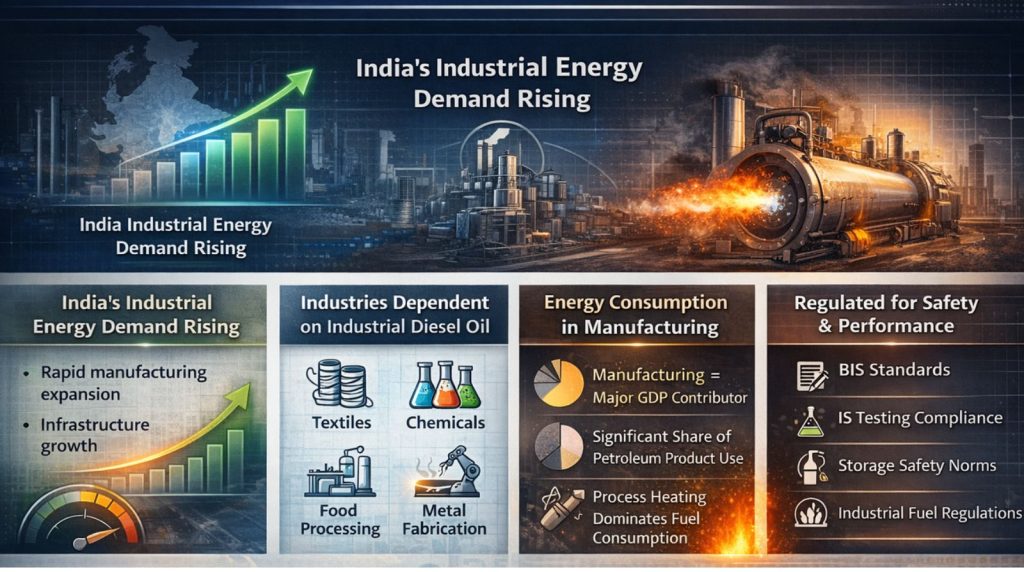
Industrial Diesel Oil plays a significant role in India’s manufacturing and process industries, especially where consistent thermal energy is required. As industrial production expands, fuel demand for boilers, furnaces, and thermic systems continues to grow.
Industrial Fuel Demand Growth
India is one of the fastest-growing energy markets globally. According to the International Energy Agency, India’s industrial energy demand is expected to increase substantially over the next decade due to infrastructure development and manufacturing expansion. Liquid fuels, including industrial-grade diesel, remain critical in sectors where electrification is not yet fully viable.
Industries relying on Industrial Diesel Oil include:
- Textiles
- Chemicals
- Food processing
- Metal fabrication
- Pharmaceuticals
Energy Consumption in Manufacturing Sector
Manufacturing contributes significantly to India’s GDP and energy use. Data from the Ministry of Petroleum and Natural Gas indicates that industrial consumption forms a major share of total petroleum product usage, reflecting heavy reliance on process heating fuels.
Regulatory Landscape
Fuel quality and storage are governed by standards issued by the Bureau of Indian Standards. Compliance with IS specifications and safety norms ensures industrial efficiency, environmental responsibility, and operational stability in an increasingly regulated energy market.
Conclusion:
When it comes to industrial heating systems, the choice is clear: Industrial Diesel Oil is the correct fuel for boilers, furnaces, thermic fluid heaters, and industrial burners. Regular diesel is engineered for vehicles under emission regulations, not for sustained high-temperature industrial combustion. Using the wrong fuel may appear cost-effective initially, but it increases risks related to safety, efficiency, and compliance.
Industrial Diesel Oil that complies with IS 15770 standards defined by the Bureau of Indian Standards ensures:
- Higher operational safety due to appropriate flash point
- Stable combustion and better thermal efficiency
- Reduced carbon deposits and maintenance frequency
- Regulatory compliance with Indian fuel quality norms
According to the International Energy Agency, improving industrial fuel efficiency is one of the most effective ways to lower operating costs and emissions. That starts with choosing the right fuel.
For industries seeking consistent supply, batch-wise tested quality, and full documentation support, sourcing Industrial Diesel Oil from a compliant supplier like Rerol Refinery ensures performance reliability, safety assurance, and long-term operational stability.
Frequently Asked Questions
Can industrial diesel oil be used in vehicles?
No. Industrial Diesel Oil is not designed for automotive engines. Vehicle engines operate under Bharat Stage (BS-VI) emission norms regulated by the Central Pollution Control Board, which limit sulfur content to 10 ppm. Industrial Diesel Oil follows different specification standards and combustion requirements. Using it in vehicles can damage engine components and violate emission regulations.
Is industrial diesel oil cheaper than regular diesel?
Price differences depend on market conditions, taxation, and bulk procurement contracts. While Industrial Diesel Oil may sometimes appear cost-effective for large industrial use, switching fuels purely for price without technical validation can increase maintenance and operational costs.
What is the flash point of industrial diesel oil?
As per IS 15770 guidelines issued by the Bureau of Indian Standards, Industrial Diesel Oil typically maintains a minimum flash point around 66°C (depending on grade). This higher flash point improves storage safety in industrial environments.