
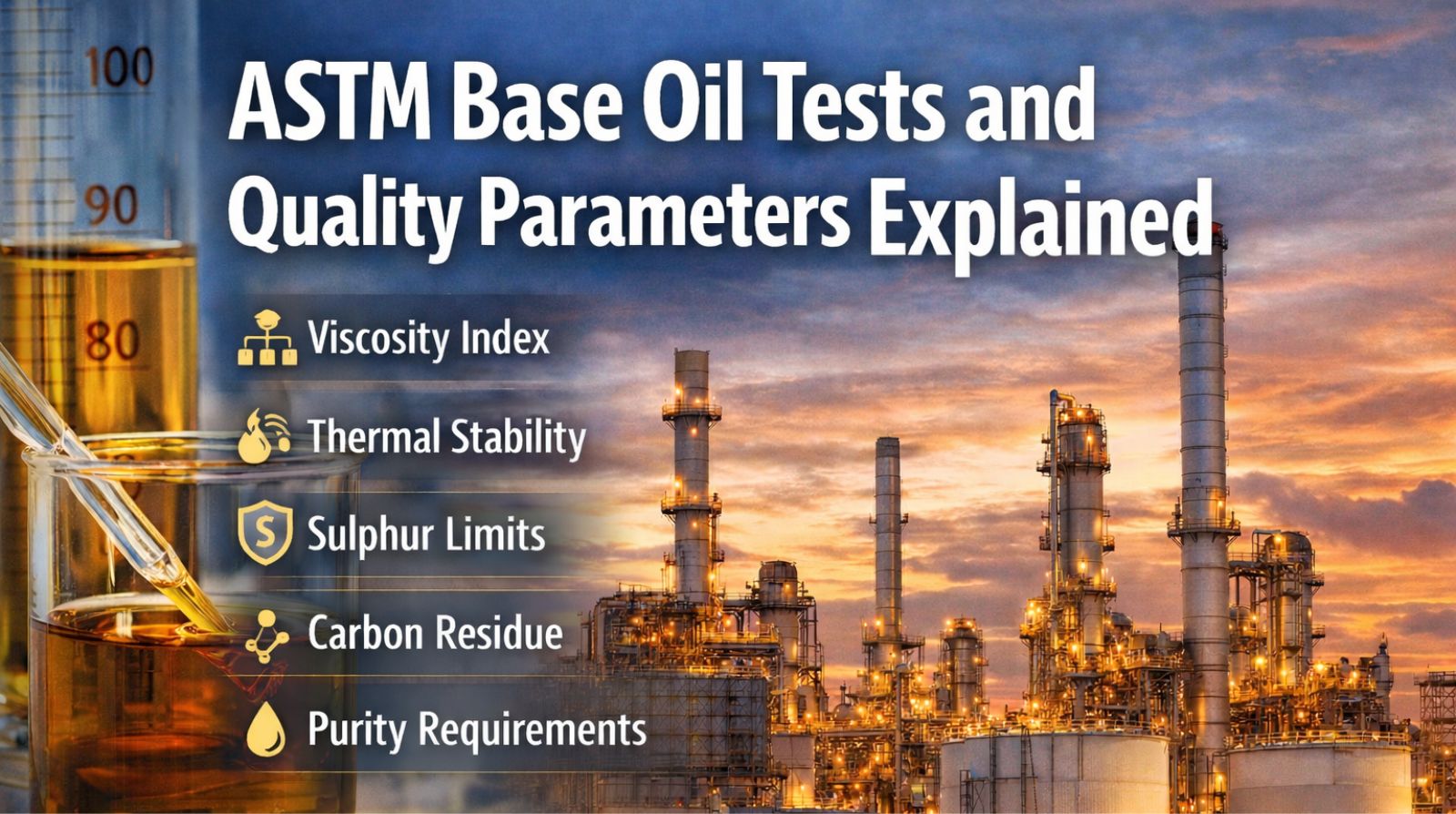
ASTM Base Oil Tests and Quality Parameters Explained
ASTM Base Oil Specifications define the technical foundation of lubricant performance, blending stability, and long-term equipment protection. According to ASTM International, standardized testing methods ensure consistency, safety, and measurable quality across global supply chains. Yet many buyers still prioritize cost over compliance, overlooking critical parameters like viscosity index, sulphur content, and total acid number,a mistake that can lead to oxidation instability and reduced lubricant lifespan.
The industrial sector accounts for nearly 37% of global final energy consumption , as reported by the International Energy Agency. Even small deviations in base oil purity or thermal stability can impact machinery efficiency and increase maintenance costs.
Understanding ASTM Base Oil Specifications helps lubricant manufacturers and procurement teams make data-driven decisions backed by verified laboratory testing.
What Are ASTM Base Oil Specifications?
ASTM Base Oil Specifications are standardized technical parameters that define the quality, performance, and safety benchmarks of base oils used in lubricant manufacturing. These specifications are not optional marketing claims; they are laboratory-tested, globally recognized measurement systems that determine whether a base oil is suitable for blending automotive or industrial lubricants. Without ASTM-aligned testing, buyers cannot reliably compare suppliers or verify consistency.
Role of ASTM International in Standardization
ASTM International develops internationally accepted test methods used across more than 140 countries. These methods ensure reproducibility and eliminate ambiguity in quality assessment.
Key examples include:
- ASTM D445 – Kinematic viscosity measurement
- ASTM D92 – Flash point determination
- ASTM D2270 – Viscosity index calculation
- ASTM D664 – Total Acid Number (TAN) testing
These standardized procedures reduce disputes in global trade and ensure technical consistency.
Why Specifications Matter in Lubricant Manufacturing
Base oil represents 70–90% of finished lubricant composition , according to the American Petroleum Institute. If viscosity index or oxidation stability falls outside ASTM limits, the final product’s performance drops significantly.
Clear ASTM Base Oil Specifications ensure:
- Stable blending performance
- Lower sludge formation
- Improved thermal resistance
- Export compliance
Difference Between ASTM Standards and General Quality Claims
“High quality” is subjective. ASTM compliance is measurable.
ASTM-based validation includes:
- Certified laboratory reports
- Defined maximum/minimum limits
- Traceable documentation
- Batch consistency verification
That difference protects buyers from operational and financial risk.
Why ASTM Base Oil Specifications Are Critical for Performance
ASTM Base Oil Specifications directly influence lubricant durability, machinery protection, and long-term operational cost. When base oil quality deviates from ASTM-defined limits, the consequences are measurable higher oxidation rates, viscosity breakdown, sludge formation, and reduced equipment lifespan. According to the American Petroleum Institute, base oil composition determines the thermal stability and cleanliness performance of finished engine oils. This is not theoretical, it directly affects field performance.
Impact on Engine Oil Stability
Engine oils operate under extreme heat and pressure. If viscosity index (ASTM D2270) or flash point (ASTM D92) is below standard:
- Oil thins at high temperatures
- Oxidation accelerates
- Deposits form inside engines
Studies referenced by SAE International show that oxidation stability directly impacts oil drain intervals and engine wear rates. Poor base oil quality shortens service life.
Influence on Industrial Equipment Efficiency
The International Energy Agency reports industry accounts for nearly 37% of global final energy consumption. Even minor lubricant inefficiencies increase friction losses. ASTM-compliant viscosity and low sulphur content improve:
- Thermal stability
- Gear protection
- Hydraulic response accuracy
Role in Export and Regulatory Compliance
ASTM documentation ensures:
- Traceable lab reports
- Defined maximum impurity limits
- Batch-to-batch consistency
Without ASTM compliance, export approvals and OEM compatibility become high-risk decisions.
Key ASTM Base Oil Tests Every Buyer Should Understand
When evaluating ASTM Base Oil Specifications, buyers must go beyond generic quality claims and focus on critical laboratory parameters. These ASTM test methods define performance reliability, blending stability, and long-term lubricant efficiency. Without reviewing these reports, procurement decisions become guesswork.
Kinematic Viscosity – ASTM D445
This test measures how easily base oil flows at 40°C and 100°C. Viscosity directly impacts film strength and lubrication performance.
- Too low → inadequate wear protection
- Too high → poor circulation and energy loss
ASTM International states ASTM D445 ensures reproducible viscosity measurement across laboratories worldwide.
Flash Point – ASTM D92
Flash point determines thermal safety and volatility. Lower flash point oils evaporate faster under heat.
- Higher flash point → better high-temperature stability
- Reduces fire risk during storage and transport
Viscosity Index – ASTM D2270
Viscosity index (VI) measures temperature stability. A VI above 95 typically indicates stable performance across varying temperatures.
Total Acid Number – ASTM D664
TAN indicates oxidation level and contamination. Lower TAN means better chemical stability and longer lubricant life.
Together, these tests form the backbone of reliable base oil evaluation.
Understanding Viscosity and Thermal Stability Parameters
Viscosity and thermal stability are not minor lab numbers; they directly determine whether a lubricant protects machinery or fails under stress. Within ASTM Base Oil Specifications, these parameters define how oil behaves under heat, load, and long operating cycles. If viscosity shifts too much with temperature, performance drops fast.
Why Viscosity Index Above 95 Is Important
Viscosity Index (VI), calculated under ASTM D2270, measures how stable oil viscosity remains across temperature changes.
- Higher VI (>95) → Better stability in hot and cold conditions
- Reduced thinning at high temperatures
- Improved film strength under load
According to ASTM International, standardized VI calculation ensures comparability across suppliers. A low VI base oil can lead to increased wear and reduced engine protection.
Thermal Stability and Oxidation Resistance
Oxidation is the silent performance killer. The American Petroleum Institute highlights that oxidation instability increases sludge formation and acid buildup in lubricants.
Stable base oil reduces:
- Deposit formation
- Acid number growth
- Viscosity breakdown
Blending Performance Considerations
High thermal stability improves additive compatibility. It ensures:
- Uniform blending
- Extended drain intervals
- Predictable field performance
Poor thermal control directly increases maintenance cost and equipment downtime.
Sulphur, Carbon Residue, and Purity Requirements
When evaluating ASTM Base Oil Specifications, purity parameters like sulphur content, carbon residue, and aromatic composition directly impact combustion cleanliness, oxidation stability, and environmental compliance. These are not minor technical details; they influence emissions, deposit formation, and long-term equipment reliability.
Sulphur Limits and Environmental Impact
Sulphur content affects both emissions and corrosion resistance. High sulphur levels contribute to sulphur oxide (SOx) emissions during combustion and can accelerate internal component wear.
Under ASTM testing (D129 / D2622), sulphur levels are tightly controlled. Lower sulphur base oils offer:
- Reduced emission impact
- Improved additive compatibility
- Better oxidation resistance
The International Energy Agency highlights that cleaner fuel and lubricant formulations support industrial emission reduction goals.
Conradson Carbon Residue – ASTM D189
ASTM D189 measures carbon-forming tendency after evaporation. Higher residue means greater deposit risk in engines and turbines.
- Lower carbon residue → cleaner combustion
- Reduced sludge formation
- Improved equipment efficiency
PCA Content and Hydrocarbon Composition
Polycyclic Aromatics (PCA), tested under IP 346, must remain below defined limits (often <3%). Lower PCA levels improve:
- Health and environmental safety
- Oxidation stability
- Export compliance
Purity isn’t optional, it’s performance insurance.
Corrosion, Foaming, and Water Separation Testing
Beyond viscosity and purity, ASTM Base Oil Specifications also evaluate how base oil behaves in real operating conditions especially in the presence of metal surfaces, air entrainment, and moisture. Corrosion resistance, foaming control, and water separation are critical for hydraulic systems, turbines, and industrial gearboxes where contamination is common.
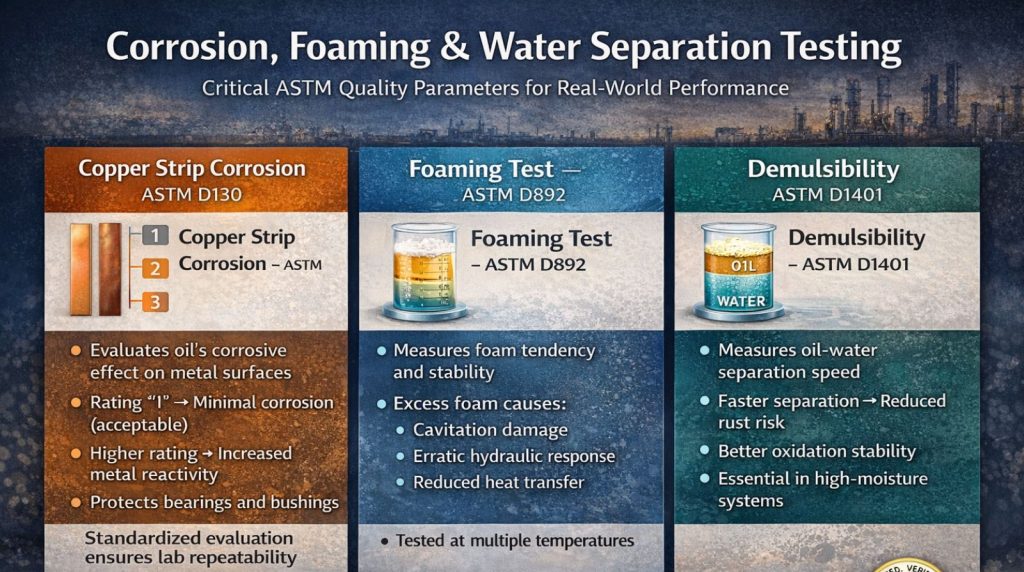
Copper Strip Corrosion – ASTM D130
ASTM D130 measures the corrosive effect of oil on copper surfaces under controlled temperature conditions. Even minor corrosive tendencies can damage bearings and bushings over time.
- Rating “1” → Minimal corrosion (acceptable)
- Higher ratings → Increased metal reactivity
ASTM International specifies standardized evaluation to ensure repeatability across labs.
Foaming Characteristics – ASTM D892
Foam reduces lubrication efficiency by trapping air inside the oil. According to the American Petroleum Institute, excessive foaming leads to:
- Cavitation damage
- Erratic hydraulic response
- Reduced heat transfer
ASTM D892 measures foam tendency and stability under different temperatures.
Demulsibility – ASTM D1401
Water contamination is unavoidable in many industrial systems. ASTM D1401 evaluates how quickly oil separates from water.
- Faster separation → Reduced rust risk
- Better oxidation stability
- Improved equipment protection
In high-moisture environments, demulsibility is not optional, it’s essential.
ASTM Specifications for Re-Refined Base Oil (RRBO)
Re-Refined Base Oil (RRBO) must meet the same ASTM Base Oil Specifications as virgin base oils to be commercially viable. The American Petroleum Institute recognizes that properly processed re-refined oils can perform comparably to conventional Group I base oils when tested under standardized ASTM methods. The difference lies in processing technology not in compliance standards.
RR-L Grade Quality Parameters
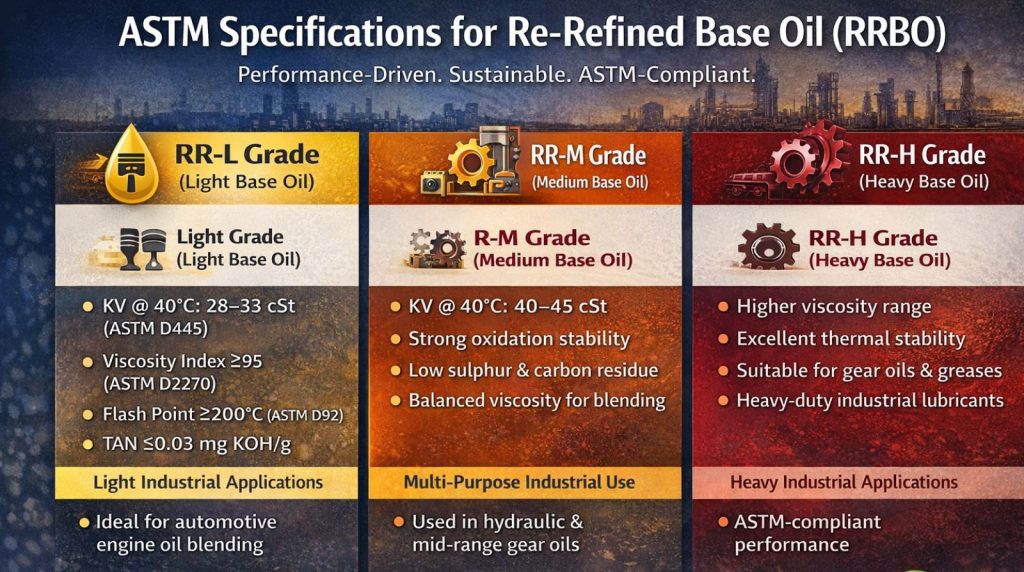
RR-L (Light Grade) typically features:
- KV @ 40°C: 28–33 cSt (ASTM D445)
- Viscosity Index: ≥95 (ASTM D2270)
- Flash Point: ≥200°C (ASTM D92)
- Low TAN: ≤0.03 mg KOH/g
This grade is commonly used for automotive engine oil blending and light industrial lubricants.
RR-M Grade Performance Characteristics
RR-M (Medium Grade) provides balanced viscosity for multi-purpose lubricant blending.
- KV @ 40°C: 40-45 cSt
- Strong oxidation stability
- Low sulphur and carbon residue
It supports hydraulic oils and mid-range gear formulations.
RR-H Grade Industrial Applications
RR-H (Heavy Grade) is suitable for:
- Gear oils
- Greases
- Heavy-duty industrial lubricants
When tested under ASTM International methods, RRBO demonstrates consistent thermal stability and purity comparable to conventional base oils.
Quality Control and Batch Consistency Measures
Meeting ASTM Base Oil Specifications once is not enough. True quality lies in consistent batch-to-batch performance. In lubricant manufacturing, even minor variation in viscosity, sulphur content, or oxidation stability can disrupt blending ratios and compromise finished product quality. That’s why structured quality control systems are essential.
Importance of Batch-to-Batch Testing
Every production batch should undergo repeat ASTM testing to confirm:
- Kinematic viscosity (ASTM D445) remains within range
- Flash point (ASTM D92) meets safety limits
- Total Acid Number (ASTM D664) stays controlled
According to ASTM International, standardized repeatability ensures reliable comparison across production cycles. Without batch validation, suppliers risk performance deviations that may only appear during field use.
Third-Party Laboratory Verification
Independent lab verification strengthens buyer confidence. The International Organization for Standardization emphasizes that accredited laboratories improve credibility and reduce compliance disputes in international trade.
Third-party reports help ensure:
- Unbiased results
- Export acceptance
- OEM approval compatibility
Documentation and Compliance Records
Proper documentation should include:
- Technical Data Sheets (TDS)
- Certificate of Analysis (COA)
- Traceable batch records
Transparent records reduce procurement risk and support regulatory audits.
Common Mistakes When Evaluating ASTM Base Oil Specifications
Even experienced buyers make avoidable errors when assessing ASTM Base Oil Specifications. The problem isn’t lack of data, it’s misinterpreting or ignoring it. Poor evaluation decisions often lead to higher maintenance costs, blending inconsistencies, and export compliance risks.
Focusing Only on Price
Low price per metric ton can look attractive, but it often hides quality compromises. If viscosity index drops below ASTM thresholds or sulphur levels increase, long-term costs rise through:
- Increased sludge formation
- Shorter lubricant drain intervals
- Higher equipment wear
According to the International Energy Agency, industrial efficiency losses significantly impact operational costs. Choosing substandard base oil to save upfront cost is rarely economical in the long run.
Ignoring Detailed Test Reports
Many buyers glance at a summary instead of reviewing full ASTM test results. Critical parameters like:
- ASTM D445 (viscosity range)
- ASTM D664 (TAN limits)
- ASTM D189 (carbon residue)
must be verified against defined limits set by ASTM International.
Overlooking Sustainability and Source Quality
With global focus on cleaner production, sustainable sourcing matters. Properly processed RRBO meeting ASTM standards can reduce environmental impact while maintaining performance but only if backed by verified documentation and controlled re-refining processes.
How to Verify ASTM Base Oil Specifications Before Procurement
Verifying ASTM Base Oil Specifications before procurement is not optional, it’s risk management. A single batch deviation in viscosity, sulphur content, or oxidation stability can disrupt blending and damage long-term customer relationships. Smart buyers rely on structured verification, not assumptions.
Reviewing Technical Data Sheets (TDS)
A proper TDS should clearly list ASTM test methods and parameter limits, including:
- Kinematic Viscosity – ASTM D445
- Flash Point – ASTM D92
- Viscosity Index – ASTM D2270
- Total Acid Number – ASTM D664
If ASTM methods are not explicitly mentioned, that’s a red flag. According to ASTM International, standardized methods ensure repeatable and comparable laboratory results.
Comparing ASTM Test Reports
Always compare actual batch reports (COA) against declared specifications. Look for:
- Consistency across multiple batches
- Sulphur and carbon residue within limits
- Acceptable corrosion and demulsibility ratings
Discrepancies indicate unstable quality control.
Supplier Audit and Quality Assurance Review
The International Organization for Standardization emphasizes documented quality systems (e.g., ISO-certified processes) to reduce procurement risk.
Audit checkpoints should include:
- In-house lab capabilities
- Third-party verification
- Traceable batch records
Verification prevents performance surprises after delivery.
Conclusion:
Understanding ASTM Base Oil Specifications is not just about reading lab numbers it’s about protecting performance, ensuring compliance, and reducing operational risk. From viscosity control (ASTM D445) to oxidation stability and sulphur limits, every parameter directly influences lubricant reliability and equipment lifespan.
According to ASTM International, standardized testing ensures consistency, repeatability, and global comparability in petroleum products. Meanwhile, the American Petroleum Institute confirms that base oil quality significantly impacts finished lubricant stability and performance. Ignoring ASTM validation increases the risk of blending issues, export rejection, and higher maintenance costs.
When sourcing re-refined base oils, choosing a supplier with transparent documentation, batch-to-batch consistency, and strict ASTM-aligned quality control is critical. Reliable partners provide:
- Detailed Technical Data Sheets (TDS)
- Certificate of Analysis (COA) for every batch
- Low sulphur and controlled TAN levels
- Verified corrosion and demulsibility results
At Rerol Refinery, ASTM-aligned RRBO production combines performance, sustainability, and documented quality assurance ensuring buyers receive measurable, compliant, and consistent base oil solutions.
Frequently Asked Questions About ASTM Base Oil Specifications
What is the most important ASTM test for base oil?
There isn’t one single “most important” test but ASTM D445 (Kinematic Viscosity) is foundational. Viscosity directly affects film strength, blending behavior, and thermal performance. According to ASTM International, D445 ensures accurate and reproducible viscosity measurement worldwide. However, viscosity must be evaluated alongside flash point (ASTM D92), viscosity index (ASTM D2270), and TAN (ASTM D664) for a complete quality profile.
What viscosity index is acceptable for RRBO?
For most applications, a Viscosity Index (VI) ≥95 is considered stable for Group I-type base oils. Higher VI improves temperature resistance and reduces thinning under heat, supporting longer drain intervals.
Are re-refined base oils ASTM compliant?
Yes if properly processed. The American Petroleum Institute recognizes that re-refined oils can meet the same ASTM testing standards as virgin base oils when manufactured under controlled conditions.
How often should base oil be tested?
Ideally, every production batch should undergo ASTM testing to ensure consistency, traceability, and export compliance.